Author: Alexander Christian Greco

  • The Fundamentals of Logic

    The Fundamentals of Logic

    Written by Alexander Christian Greco

    With the Help of ChatGPT

    From Philosophical Origins to Contemporary Applications

    https://cdn.britannica.com/94/127494-050-5255C2D0/Boethius-woodcut-Holbein-1537.jpg
    https://i.pinimg.com/564x/d5/f7/84/d5f784436927aadd0125003983f8eff4.jpg

    Abstract

    Logic is the systematic study of valid reasoning. It examines how conclusions follow from premises, how truth is preserved through inference, and how structured thought can be distinguished from persuasion, intuition, or belief. Originating in ancient philosophy as a tool for understanding reality, discourse, and knowledge, logic has evolved into a formal discipline that underpins mathematics, computer science, artificial intelligence, law, and the natural sciences. This article explores the foundations of formal logic, tracing its philosophical origins, conceptual development, and symbolic formalization, and demonstrates how these foundations directly support contemporary applied uses of logic in modern technological and social systems [1][2].

    https://iep.utm.edu/wp-content/media/Aristotle-logic-figure-2.gif

    1. What Logic Is—and What It Is Not

    Logic concerns valid inference, not truth in isolation. An argument is logically valid when its conclusion follows necessarily from its premises, regardless of whether those premises are factually true [3]. An argument is sound only when it is both valid and its premises are true.

    For example:

    All mammals can fly.
    Whales are mammals.
    Therefore, whales can fly.

    This argument is valid because its structure preserves truth, but it is unsound because the premises are false.

    Logic is therefore distinct from:

    • Psychology, which studies how humans actually reason
    • Rhetoric, which studies persuasion and argumentation techniques
    • Epistemology, which studies belief, justification, and knowledge

    Logic is a normative discipline: it specifies how reasoning ought to proceed in order to preserve truth and avoid contradiction [4].


    2. The Philosophical Origins of Logic

    2.1 Ancient Greece: Logic as Rational Structure

    The formal study of logic begins in ancient Greece, most notably with Aristotle, whose works constitute the first systematic treatment of deductive reasoning [5].

    https://europe.factsanddetails.com/archives/001/202410/large-1d9a02b5345cbf67.jpg

    Aristotle introduced syllogistic logic, which analyzes arguments composed of:

    • A major premise
    • A minor premise
    • A conclusion

    Classic example:

    All humans are mortal.
    Socrates is human.
    Therefore, Socrates is mortal.

    Aristotle conceived logic as an instrument (Organon)—a tool applicable to all domains of inquiry, including science, metaphysics, and ethics [6].

    Other philosophical contributions include:

    • Plato, who emphasized dialectical reasoning and structured philosophical debate
    • The Stoic philosophers, who developed an early form of propositional logic focusing on whole statements rather than categorical terms [7]

    https://image.invaluable.com/housePhotos/swanngalleries/09/601109/H0132-L112466926.jpg

    2.2 Medieval Logic: Language, Meaning, and Precision

    Throughout the medieval period, logic was preserved and expanded by Islamic, Jewish, and Christian scholars. Logic became central to education and theological reasoning, forming part of the trivium alongside grammar and rhetoric [8].

    Key medieval developments included:

    • Refinement of syllogistic forms
    • Early semantic theories of reference and signification
    • Distinctions between syntactic form and semantic meaning

    These advances anticipated later formal distinctions between syntax and semantics in modern logic and computer science.


    https://philosophy-models.blog/wp-content/uploads/2021/12/aristotle-logical-concepts-4.png

    3. The Birth of Formal and Symbolic Logic

    3.1 From Natural Language to Formal Systems

    In the nineteenth century, logic underwent a profound transformation. Philosophers and mathematicians sought to eliminate the ambiguity of natural language by replacing it with precise symbolic notation.

    Two figures were especially influential:

    • George Boole, who demonstrated that logical relations could be expressed algebraically using binary variables [9]
    • Gottlob Frege, who developed predicate logic and established the foundations of modern formal logic [10]

    Frege introduced:

    • Quantifiers (∀ “for all”, ∃ “there exists”)
    • Variables and predicates
    • A rigorous distinction between objects and properties

    This shift marked the emergence of mathematical logic as a formal discipline.

    https://www.researchgate.net/publication/291418819/figure/fig3/AS%3A718510820962304%401548317737478/Summary-of-the-common-Boolean-logic-gates-with-symbols-and-truth-tables.png
    https://image2.slideserve.com/3656400/predicate-logic3-l.jpg
    https://www.tandfonline.com/cms/asset/dc1c9791-b241-4133-9378-9abb260afbb7/thpl_a_2405417_f0001_ob.jpg

    3.2 Core Components of Formal Logic

    Formal logical systems consist of several interrelated components [11]:

    1. Syntax – formal rules governing symbol formation
    2. Semantics – interpretation of symbols and truth values
    3. Inference Rules – valid transformations (e.g., modus ponens)
    4. Proof Systems – structured demonstrations of validity

    These systems allow reasoning to proceed independently of interpretation, enabling logic to be mechanized and automated.


    4. Major Branches of Logic

    4.1 Propositional Logic

    Propositional logic analyzes relationships between whole statements that are either true or false. It employs logical connectives such as:

    • AND (∧)
    • OR (∨)
    • NOT (¬)
    • IF–THEN (→)

    Truth tables define how compound statements derive truth values from simpler ones [12]. Propositional logic forms the conceptual basis of digital electronics.


    4.2 Predicate (First-Order) Logic

    Predicate logic extends propositional logic by allowing quantification over individuals and relations:

    ∀x (Human(x) → Mortal(x))

    This expressiveness makes predicate logic indispensable for mathematics, linguistics, and computer science [13].


    4.3 Modal and Non-Classical Logics

    Classical logic assumes:

    • Bivalence (every statement is true or false)
    • Non-contradiction

    However, many applications require alternative systems, including:

    • Modal logic (necessity and possibility)
    • Temporal logic (time-based reasoning)
    • Fuzzy logic (degrees of truth)
    • Paraconsistent logic (controlled contradiction)

    These systems are essential for AI reasoning, legal interpretation, and natural-language analysis [14].


    5. Logic and the Foundations of Mathematics

    Logic underlies mathematics at its most fundamental level. Mathematical proofs are formal logical arguments built from axioms and inference rules.

    Twentieth-century developments include:

    • Logicism
    • Proof theory
    • Model theory

    The work of Kurt Gödel demonstrated inherent limitations in formal systems. Gödel’s incompleteness theorems show that any sufficiently powerful logical system cannot be both complete and consistent [15].


    6. Logic in Computer Science and Technology

    https://sandbox.mc.edu/~bennet/cs110/boolalg/gate4.gif

    6.1 Hardware

    Digital hardware implements Boolean logic physically:

    • Transistors encode binary values
    • Logic gates perform inference operations

    Modern processors execute logical operations billions of times per second [16].

    https://cms.boardmix.com/images/articles/what-is-a-flowchart-for-computer-science.png

    6.2 Software and Algorithms

    Programming languages rely on formal logic for:

    • Control flow
    • Conditional execution
    • Program verification

    Algorithms can be understood as executable logical proofs that guarantee correct outcomes when assumptions are met [17].


    6.3 Artificial Intelligence

    AI systems employ logic for:

    • Knowledge representation
    • Automated reasoning
    • Constraint satisfaction

    Even data-driven machine-learning systems rely on logical frameworks for model definition, optimization, and evaluation [18].


    7. Logic Beyond Technology

    7.1 Law, Ethics, and Policy

    Legal reasoning uses logical principles to:

    • Interpret statutes
    • Resolve contradictions
    • Ensure consistency in judgments

    Ethical theories rely on logical structure to test moral coherence and universalizability [19].


    7.2 Science and Medicine

    Scientific inquiry depends on:

    • Deductive hypothesis testing
    • Logical consistency
    • Falsifiability

    Medical diagnosis often resembles formal inference under uncertainty, combining probabilistic and logical reasoning [20].


    8. Why Logic Remains Essential

    Logic provides:

    • Cognitive discipline
    • Protection against fallacies
    • Transferable reasoning skills across domains

    In an era of information overload and automated decision-making, logic serves as the infrastructure of rational thought.


    Conclusion

    Logic began as a philosophical investigation into reasoning itself. Over centuries, it evolved into a formal, symbolic, and computational discipline. Today, it operates quietly beneath modern civilization—structuring scientific explanation, enabling digital computation, guiding legal reasoning, and powering artificial intelligence.

    From Aristotle’s syllogisms to contemporary formal systems, the foundations of logic remain consistent: clarity, structure, and the preservation of truth. To understand logic is to understand the grammar of rationality itself.


    References

    1. Copi, I. M., Cohen, C., & McMahon, K. (2016). Introduction to Logic. Routledge.
    2. Haack, S. (1978). Philosophy of Logics. Cambridge University Press.
    3. Hurley, P. J. (2015). A Concise Introduction to Logic. Cengage.
    4. Priest, G. (2008). An Introduction to Non-Classical Logic. Cambridge University Press.
    5. Aristotle. Prior Analytics.
    6. Shields, C. (2014). Aristotle. Routledge.
    7. Bobzien, S. (1998). Stoic Logic. Oxford University Press.
    8. Klima, G. (2018). Medieval Philosophy. Oxford University Press.
    9. Boole, G. (1854). An Investigation of the Laws of Thought.
    10. Frege, G. (1879). Begriffsschrift.
    11. Enderton, H. (2001). A Mathematical Introduction to Logic. Academic Press.
    12. Mendelson, E. (2015). Introduction to Mathematical Logic. CRC Press.
    13. van Benthem, J. (2010). Logical Dynamics of Information and Interaction. Cambridge.
    14. Blackburn, P., de Rijke, M., & Venema, Y. (2001). Modal Logic. Cambridge.
    15. Gödel, K. (1931). On Formally Undecidable Propositions.
    16. Mano, M. M., & Ciletti, M. D. (2017). Digital Design. Pearson.
    17. Knuth, D. (1997). The Art of Computer Programming. Addison-Wesley.
    18. Russell, S., & Norvig, P. (2021). Artificial Intelligence: A Modern Approach. Pearson.
    19. Rawls, J. (1971). A Theory of Justice. Harvard University Press.
    20. Pearl, J. (2009). Causality. Cambridge University Press.

    Further Reading

    Introductory

    • Graham Priest – Logic: A Very Short Introduction
    • Stanford Encyclopedia of Philosophy: “Logic”

    Formal & Mathematical

    • Elliott Mendelson – Introduction to Mathematical Logic
    • Raymond Smullyan – First-Order Logic

    Computer Science & AI

    • Huth & Ryan – Logic in Computer Science
    • Nilsson – Artificial Intelligence: Foundations of Computational Agents

    Philosophical Foundations

    • Quine – Philosophy of Logic
    • Susan Haack – Deviant Logic
  • Marketing Traditional Businesses Using Current Technology

    Marketing Traditional Businesses Using Current Technology

    Written by Alexander Christian Greco

    With the Help of ChatGPT

    A Practical Integration Framework for Modern Growth

    Abstract

    Traditional businesses—local services, brick-and-mortar retailers, professional firms, and legacy manufacturers—do not need to abandon proven methods to compete in a technology-driven market. Instead, they benefit most by integrating modern digital tools into existing operational strengths, such as trust, service quality, reputation, and long-term customer relationships. This article presents a practical, systems-oriented framework for using current marketing technology—search visibility, customer relationship management (CRM), content, automation, analytics, and artificial intelligence—to modernize traditional business marketing without losing its human foundation. Emphasis is placed on measurable outcomes, sustainable workflows, and ethical compliance.


    Disclosure

    This article was drafted with the assistance of an AI language model (ChatGPT) and reviewed for clarity and educational value. It is intended for informational purposes only and does not constitute legal, financial, or marketing advice. Businesses should consult qualified professionals regarding regulatory compliance, data privacy, and advertising law.


    Table of Contents

    1. The Integration Mindset: Technology as a Multiplier
    2. Mapping the Modern Customer Journey
    3. Digital Foundations: Websites, Listings, and Trust Signals
    4. Local Visibility and “Near-Me” Discovery
    5. CRM Systems and Follow-Up Automation
    6. Content That Converts: Proof Over Promotion
    7. Paid Advertising with Operational Alignment
    8. Reputation, Reviews, and Referral Systems
    9. Measurement and Attribution (Including Offline Sales)
    10. AI and Automation in Practical Use
    11. Compliance, Ethics, and Consumer Protection
    12. A 30 / 60 / 90-Day Integration Plan
    13. Further Reading
    14. References

    1. The Integration Mindset: Technology as a Multiplier

    A common misconception among traditional business owners is that digital marketing requires transforming the company into a technology business. In practice, the opposite is true. The most successful integrations use technology to amplify existing advantages rather than replace them.

    Traditional strengths—such as personal relationships, consistent service quality, and community reputation—remain decisive factors in purchasing decisions [1]. Technology enhances these strengths by improving discoverability, responsiveness, and consistency at scale.

    A useful framework:

    • Human value: trust, craftsmanship, reliability
    • Technological leverage: speed, reach, automation, data

    When technology is applied as a multiplier rather than a substitute, it produces compounding returns over time.


    2. Mapping the Modern Customer Journey

    Before selecting tools or platforms, businesses must understand how customers move from awareness to advocacy. Research consistently shows that modern customers blend online and offline behaviors throughout the purchasing process [2].

    A generalized journey:

    1. Discovery (search engines, maps, referrals, signage)
    2. Evaluation (reviews, website, photos, social proof)
    3. Contact (calls, forms, bookings, walk-ins)
    4. Conversion (purchase, appointment, contract)
    5. Retention (follow-ups, reminders, service intervals)
    6. Advocacy (reviews, referrals, user-generated content)

    Technology should be applied at friction points—missed calls, slow responses, unclear pricing, or inconsistent follow-up—rather than indiscriminately across all stages.


    3. Digital Foundations: Websites, Listings, and Trust Signals

    3.1 The Role of the Website

    For most traditional businesses, a website functions as a verification asset, not a sales funnel. Customers use it to confirm legitimacy, relevance, and professionalism [3].

    Minimum requirements include:

    • Mobile responsiveness and fast load times
    • Clear service descriptions and service areas
    • Prominent calls-to-action
    • Trust indicators (licenses, certifications, testimonials)

    3.2 Business Listings and Accuracy

    Accurate and complete business listings significantly influence local visibility. Platforms operated by Google emphasize consistency of name, address, and phone number (NAP) data as a ranking factor [4].


    4. Local Visibility and “Near-Me” Discovery

    Local search is often the highest-return digital channel for traditional businesses. Optimizing a Google Business Profile improves map visibility, customer confidence, and conversion likelihood [5].

    Key practices include:

    • Complete profile information
    • Regular photo uploads
    • Service descriptions and attributes
    • Active review management

    According to Google, businesses with complete profiles are significantly more likely to receive customer interactions [6].


    5. CRM Systems and Follow-Up Automation

    Customer relationship management systems centralize lead handling, communication history, and sales pipelines. Studies show that delayed responses dramatically reduce conversion probability, especially for service-based businesses [7].

    Automation should be limited to:

    • Immediate acknowledgments
    • Appointment confirmations and reminders
    • Post-service follow-ups

    The goal is speed and consistency, not impersonality.


    6. Content That Converts: Proof Over Promotion

    Content marketing for traditional businesses should prioritize evidence, not volume. Trust-based content consistently outperforms promotional messaging [8].

    Three high-impact content categories:

    1. Proof: testimonials, case studies, before-and-after examples
    2. Process: explanations of how services work and what affects pricing
    3. Personality: values, community involvement, behind-the-scenes insights

    This approach aligns with consumer psychology research on credibility and decision-making [9].


    7. Paid Advertising with Operational Alignment

    Paid advertising is most effective when operational capacity and follow-up systems are already in place. Search advertising captures existing demand, while social platforms support awareness and retargeting [10].

    Effective campaigns are:

    • Narrowly targeted
    • Service-specific
    • Outcome-oriented

    Advertising should scale what already converts, not compensate for unclear offers or weak trust signals.


    8. Reputation, Reviews, and Referral Systems

    Online reviews function as digital word-of-mouth and significantly influence purchasing behavior [11]. Formalizing review and referral processes ensures consistency without pressuring customers.

    Best practices include:

    • Timely review requests
    • Transparent responses to negative feedback
    • Simple referral incentives

    9. Measurement and Attribution (Including Offline Sales)

    Marketing decisions should be informed by measurable outcomes. Tools such as Google Analytics 4 support event tracking and offline attribution through structured data submission [12].

    Key metrics:

    • Cost per lead
    • Lead-to-conversion rate
    • Time to close
    • Repeat customer rate

    Offline attribution methods—such as call tracking and CRM tagging—are critical for traditional businesses where sales often occur in person.


    10. AI and Automation in Practical Use

    Artificial intelligence provides efficiency gains in drafting, summarization, and categorization. It is most effective when used to support human decision-making, not replace it [13].

    High-value use cases:

    • Drafting marketing copy
    • Summarizing customer interactions
    • Generating FAQ content
    • Assisting with internal documentation

    11. Compliance, Ethics, and Consumer Protection

    Marketing activities must comply with consumer protection regulations enforced by the Federal Trade Commission. This includes adherence to the CAN-SPAM Act for email communications and disclosure requirements for endorsements [14][15].

    Transparency is not only a legal obligation—it is a trust-building asset.


    12. A 30 / 60 / 90-Day Integration Plan

    Days 1–30

    • Optimize website and listings
    • Implement CRM and missed-call handling
    • Establish review workflows

    Days 31–60

    • Publish proof-based content
    • Launch compliant email communications
    • Set up retargeting audiences

    Days 61–90

    • Deploy paid search campaigns
    • Implement conversion and offline tracking
    • Document repeatable marketing processes

    Conclusion

    Marketing traditional businesses with modern technology is not about chasing platforms or trends. It is about building systems that consistently translate trust into visibility, visibility into engagement, and engagement into revenue. When technology is integrated thoughtfully, traditional businesses gain resilience, scalability, and long-term competitive advantage.


    Further Reading

    • Building a StoryBrand – Donald Miller
    • Influence – Robert Cialdini
    • Google Business Profile Help Center
    • FTC Advertising and Marketing Guidance
    • Harvard Business Review: Digital Transformation in SMEs
    • McKinsey & Company: Consumer Decision Journeys

    References

    1. Kotler, P., & Keller, K. (2016). Marketing Management. Pearson.
    2. Lemon, K. N., & Verhoef, P. C. (2016). Understanding customer journeys. Journal of Marketing.
    3. Nielsen Norman Group. (2023). Trust and credibility in web design.
    4. Google. (n.d.). Local ranking factors documentation.
    5. Google. (n.d.). Google Business Profile best practices.
    6. Google. (n.d.). Local search behavior insights.
    7. Harvard Business Review. (2011). The short life of online sales leads.
    8. Edelman Trust Barometer. (2024).
    9. Cialdini, R. (2021). Influence. Harper Business.
    10. WordStream. (2024). Search vs. social advertising benchmarks.
    11. BrightLocal. (2023). Local consumer review survey.
    12. Google Developers. (2024). GA4 Measurement Protocol.
    13. McKinsey Global Institute. (2023). The economic potential of generative AI.
    14. Federal Trade Commission. (n.d.). CAN-SPAM compliance guide.
    15. Federal Trade Commission. (2023). Endorsement and testimonial guidelines.
  • The Basics of Computer Science: A Software-Focused Introduction

    The Basics of Computer Science: A Software-Focused Introduction

    Written by Alexander Christian Greco

    With the Help of ChatGPT

    Introduction

    Computer science is frequently reduced to “learning how to code,” but this description obscures the discipline’s true scope. At its core, computer science is the systematic study of computation, information, and automated processes. Software is the primary medium through which these ideas are expressed, tested, and deployed in the real world.

    Software acts as the logical interface between human intent and machine execution. It transforms raw hardware into systems capable of reasoning, communication, creativity, and large-scale coordination. Nearly every modern domain—science, medicine, finance, education, entertainment, and governance—relies on software systems grounded in computer science principles [1].

    This article introduces the foundations of computer science with a specific emphasis on software, explaining how software is defined, structured, executed, and maintained. Rather than focusing on any single programming language or toolchain, the discussion centers on enduring concepts that remain relevant across decades of technological change.


    1. What Is Software?

    Software is a collection of instructions and data that directs a computer’s hardware to perform specific tasks. These instructions are encoded symbolically, stored digitally, and executed electronically.

    At the most fundamental level, software consists of:

    • Algorithms (procedures for solving problems)
    • Data representations (ways of encoding information)
    • Control logic (rules that determine execution order)

    Unlike hardware, software is intangible. It can be copied perfectly, modified rapidly, and distributed globally at minimal cost—features that explain its central role in modern society [2].

    Software vs. Hardware

    Without software, hardware has no purpose. Conversely, software cannot exist without hardware. Computer science studies this relationship formally.


    2. Major Categories of Software

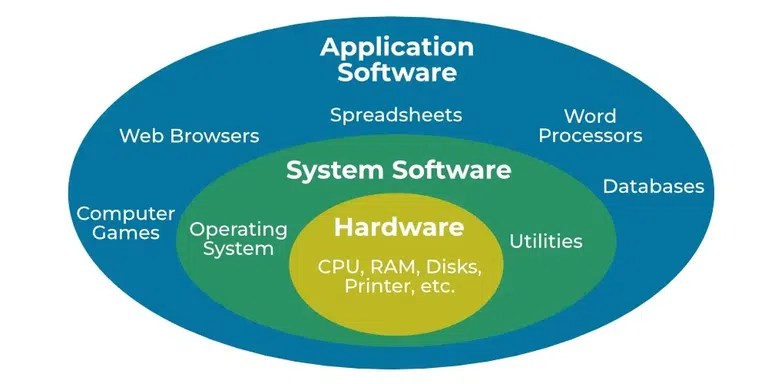
    Software systems are commonly grouped into three broad categories: system software, application software, and development software.

    https://media.geeksforgeeks.org/wp-content/uploads/20230419082314/System-Software-vs-Application-Software-768.webp

    2.1 System Software

    System software manages the internal operation of a computer and provides essential services to other programs. The most prominent example is the operating system.

    Modern operating systems such as Windows, macOS, and Linux perform tasks including:

    • Process scheduling
    • Memory management
    • File system control
    • Hardware abstraction
    • Security enforcement

    System software ensures that application programs can run reliably without needing direct control over hardware [3].

    2.2 Application Software

    Application software is designed for end users, enabling them to perform specific tasks such as writing documents, analyzing data, communicating, or creating media.

    Examples include:

    • Web browsers
    • Office productivity tools
    • Media editors
    • Scientific modeling software
    • Games and simulations

    Applications rely on operating systems to handle low-level operations, allowing developers to focus on user-facing functionality.

    2.3 Development Software

    Development software enables the creation of other software systems. This includes:

    • Compilers and interpreters
    • Integrated Development Environments (IDEs)
    • Debuggers
    • Build systems
    • Version control platforms

    Programming languages such as Python, Java, C, and JavaScript are themselves software artifacts, designed to express computation in structured, human-readable forms [4].


    3. How Software Works: From Code to Execution

    https://miro.medium.com/v2/resize%3Afit%3A1400/1%2AoF6ViJv49IdoaMYR9VYb3Q.png

    Understanding software requires understanding how symbolic instructions ultimately control physical systems.

    https://www.learncomputerscienceonline.com/wp-content/uploads/2020/08/Instruction-Cycle-.jpg

    3.1 Source Code

    Software begins as source code, written by humans using programming languages. Source code defines:

    • Data structures
    • Algorithms
    • Logical constraints
    • Input/output behavior

    Programming languages are designed to balance expressiveness, safety, and performance.

    3.2 Translation: Compilation and Interpretation

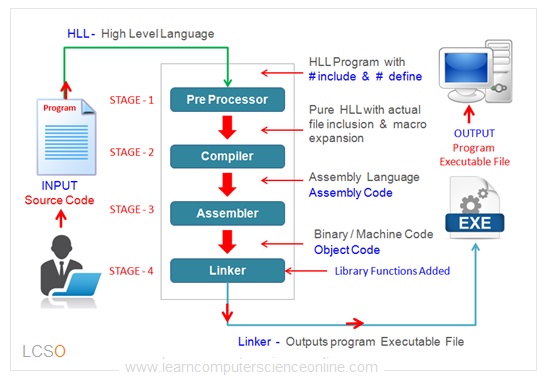
    Computers execute instructions in machine code, not high-level languages. Translation bridges this gap.

    • Compilation converts source code into machine code before execution.
    • Interpretation translates and executes instructions incrementally.

    Many modern platforms use a hybrid approach combining compilation, interpretation, and runtime optimization [5].

    3.3 Execution and the Instruction Cycle

    During execution:

    1. Instructions are loaded into memory
    2. The CPU fetches an instruction
    3. The instruction is decoded
    4. The instruction is executed
    5. Results are stored

    This fetch–decode–execute cycle occurs billions of times per second, enabling complex software behavior.


    4. Core Software Concepts in Computer Science

    Several foundational concepts govern all software systems.

    4.1 Algorithms

    An algorithm is a finite, well-defined procedure for solving a problem.

    Computer science evaluates algorithms by:

    • Correctness
    • Time complexity
    • Space complexity
    • Scalability

    Algorithms form the theoretical backbone of software performance [6].

    4.2 Data Structures

    Data structures define how information is stored and accessed.

    Common structures include:

    • Arrays and lists
    • Stacks and queues
    • Trees
    • Hash tables
    • Graphs

    The choice of data structure directly impacts efficiency, memory usage, and maintainability.

    4.3 Control Flow

    Control flow determines how execution proceeds through a program.

    Key mechanisms include:

    • Conditional branching
    • Iteration
    • Function calls
    • Error handling

    Control flow enables software to respond dynamically to input and environment changes.


    5. Software Abstraction and Layering

    Abstraction is a central principle in computer science.

    https://www.abstractionlayeredarchitecture.com/images/Layers.png

    Abstraction hides implementation details behind well-defined interfaces, allowing developers to reason about systems at different levels.

    https://miro.medium.com/v2/resize%3Afit%3A1400/1%2APJiASFJbzCFkjK0xY2xF3A.png

    Typical Abstraction Layers

    1. Physical hardware
    2. Firmware
    3. Operating system
    4. System libraries
    5. Application frameworks
    6. End-user software
    https://miro.medium.com/v2/resize%3Afit%3A1200/1%2Aarn23sOTupIdJ7gdgU7bWQ.png

    Abstraction reduces complexity, improves reliability, and enables large-scale collaboration [7].


    6. Programming Paradigms

    Programming paradigms define different ways of structuring software.

    6.1 Procedural Programming

    Programs are written as sequences of instructions and procedures. This paradigm emphasizes clarity and order.

    6.2 Object-Oriented Programming (OOP)

    Software is organized around objects that combine data and behavior.

    Core principles include:

    • Encapsulation
    • Inheritance
    • Polymorphism

    OOP supports modularity and reuse [8].

    6.3 Functional Programming

    Functional programming treats computation as mathematical function evaluation, emphasizing immutability and declarative logic.

    Modern software systems often blend paradigms to balance clarity, safety, and performance.


    7. Software Engineering and Design

    Computer science provides theory; software engineering applies it in practice.

    7.1 Design Principles

    Effective software design emphasizes:

    • Modularity
    • Separation of concerns
    • Simplicity
    • Readability
    • Reusability

    These principles reduce long-term costs and errors.

    7.2 Testing and Debugging

    Testing verifies correctness; debugging identifies faults.

    Common testing strategies include:

    • Unit testing
    • Integration testing
    • System testing

    Testing is essential for reliability and security [9].

    7.3 Maintenance and Evolution

    Most software effort occurs after initial development. Maintenance includes:

    • Bug fixes
    • Security updates
    • Performance optimization
    • Feature expansion

    Well-designed software anticipates change.


    8. Software in the Real World

    Software underpins nearly every modern system:

    • Web platforms
    • Mobile applications
    • Embedded devices
    • Scientific simulations
    • Artificial intelligence
    • Financial infrastructure
    • Cybersecurity systems

    Each domain applies the same foundational principles in different contexts [10].


    9. Why Software Matters in Computer Science

    Software is where abstract computation becomes tangible reality. It allows:

    • Knowledge to be formalized
    • Processes to be automated
    • Systems to scale globally
    • Human creativity to be amplified

    Computer science provides the theoretical framework; software is its most visible and impactful expression.


    Conclusion

    Computer science is fundamentally the study of software systems—how they represent information, execute logic, and interact with hardware and society. Understanding software at a conceptual level enables individuals to learn new technologies efficiently, design robust systems, and reason critically about digital infrastructure.

    As software continues to shape the modern world, literacy in its principles is no longer optional. It is a foundational component of education, innovation, and informed citizenship.


    References

    1. Denning, P. J. (2007). Computing is a natural science. Communications of the ACM.
    2. Brooks, F. P. (1987). No Silver Bullet—Essence and Accidents of Software Engineering. IEEE Computer.
    3. Tanenbaum, A. S., & Bos, H. (2015). Modern Operating Systems. Pearson.
    4. Sebesta, R. W. (2019). Concepts of Programming Languages. Pearson.
    5. Aho, A. V., Lam, M. S., Sethi, R., & Ullman, J. D. (2006). Compilers: Principles, Techniques, and Tools. Pearson.
    6. Cormen, T. H., et al. (2022). Introduction to Algorithms. MIT Press.
    7. Parnas, D. L. (1972). On the Criteria to Be Used in Decomposing Systems into Modules. Communications of the ACM.
    8. Gamma, E., et al. (1994). Design Patterns. Addison-Wesley.
    9. Myers, G. J., Sandler, C., & Badgett, T. (2011). The Art of Software Testing. Wiley.
    10. Sussman, G. J., & Abelson, H. (1996). Structure and Interpretation of Computer Programs. MIT Press.

    Further Reading

    Books

    • Code: The Hidden Language of Computer Hardware and Software — Charles Petzold
    • Clean Code — Robert C. Martin
    • The Pragmatic Programmer — Andrew Hunt & David Thomas

    Academic & Educational

    • MIT OpenCourseWare – Computer Science
    • Stanford CS curriculum materials
    • ACM Digital Library

    Online Resources

    • Mozilla Developer Network (MDN)
    • FreeCodeCamp
    • CS50 (Harvard University)
  • Exercises for Cardiovascular Health

    Exercises for Cardiovascular Health

    A Comprehensive, Evidence-Based Guide to Strengthening the Heart, Lungs, and Circulatory System


    Introduction

    Cardiovascular health—commonly referred to as cardio health—describes the functional capacity and resilience of the heart, lungs, blood vessels, and circulatory system as an integrated whole. A well-functioning cardiovascular system ensures efficient oxygen delivery, nutrient transport, waste removal, hormonal signaling, and thermal regulation throughout the body. Deficits in cardiovascular fitness are strongly associated with increased risk of heart disease, stroke, metabolic disorders, cognitive decline, and premature mortality [1][2].

    Regular physical activity—particularly cardiovascular exercise—has repeatedly been shown to be one of the most effective non-pharmaceutical interventions for improving heart health across the lifespan [3]. Unlike medications that target isolated biomarkers such as cholesterol or blood pressure, exercise induces systemic adaptations that improve the efficiency, elasticity, and regulatory capacity of the cardiovascular system itself.

    This article provides a comprehensive, research-informed overview of cardiovascular exercise, explaining:

    • How cardio exercise affects heart and lung physiology
    • Which exercise modalities are most effective
    • How intensity, frequency, and recovery influence outcomes
    • How cardio exercise benefits mental health and longevity

    The goal is to provide a practical yet scientifically grounded guide that can be applied by beginners, experienced exercisers, and health educators alike.


    Understanding Cardiovascular Exercise

    https://www.nsca.com/contentassets/9166e0d6d9494e28a47b33695627fcae/oxygen-uptake-and-the-aerobic-and-anaerobic-contributions-to-exercise-1.jpg

    What Is Cardiovascular (Aerobic) Exercise?

    Cardiovascular exercise—also known as aerobic exercise—refers to sustained physical activity that relies primarily on oxygen-dependent energy production. During aerobic activity, large muscle groups contract rhythmically, increasing the demand for oxygen and energy, which in turn elevates heart rate, breathing rate, and blood flow [4].

    https://m.media-amazon.com/images/I/51-wL%2BI0L3L._AC_UF894%2C1000_QL80_.jpg

    Examples include walking, running, cycling, swimming, rowing, and dancing. The defining characteristic is duration and continuity, rather than maximal force production.

    Core Physiological Mechanisms

    During regular cardiovascular training, several key adaptations occur:

    • Increased stroke volume: the heart pumps more blood per beat
    • Reduced resting heart rate: indicating improved cardiac efficiency
    • Enhanced capillary density in skeletal muscle
    • Improved mitochondrial number and function
    • Improved endothelial function, aiding blood vessel flexibility

    Collectively, these adaptations reduce cardiovascular strain during both exercise and daily life, lowering long-term disease risk [5][6].


    Steady-State Cardiovascular Exercises

    https://media-cldnry.s-nbcnews.com/image/upload/t_fit-1240w%2Cf_auto%2Cq_auto%3Abest/rockcms/2022-03/power-walk-mc-220309-c355ce.jpg

    Steady-state cardiovascular exercise involves maintaining a relatively constant intensity for an extended period, typically ranging from 20 to 90 minutes. This form of training is foundational for aerobic endurance and cardiovascular efficiency.

    Walking

    Walking is often underestimated, yet it remains one of the most widely recommended cardiovascular activities by public health organizations [7].

    Benefits

    • Low injury risk and minimal equipment requirements
    • Improves blood pressure, lipid profiles, and insulin sensitivity
    • Strong adherence due to accessibility

    Best Practices

    • Aim for a brisk pace (3–4 mph)
    • Maintain posture and arm swing
    • Accumulate 150–300 minutes per week for maximal benefit [1]
    https://media-cldnry.s-nbcnews.com/image/upload/newscms/2019_23/2426541/180509-running-outdoors-al-1053.jpg

    Jogging and Running

    Running substantially increases cardiovascular workload and oxygen consumption.

    Benefits

    • Improves VO₂ max (maximal oxygen uptake)
    • Enhances cardiac output
    • Supports bone density and metabolic health

    Considerations

    • Progress gradually to avoid overuse injuries
    • Rotate surfaces and footwear
    • Incorporate recovery days
    https://www.siroko.com/blog/c/app/uploads/2021/07/fitness_21858fa8-864f-404f-9bf5-c2a7d5f72ed7-1440x900.jpg.webp

    Cycling

    Cycling—both indoor and outdoor—offers scalable cardiovascular training with low joint stress.

    Benefits

    • Sustained heart-rate elevation
    • Strong improvements in leg vascularization
    • Suitable for long-duration sessions

    Swimming

    Swimming is uniquely effective due to its involvement of nearly all major muscle groups while remaining non-impact.

    Benefits

    • Improves lung capacity and breathing control
    • Beneficial for individuals with arthritis or joint limitations
    • Promotes balanced muscular endurance

    High-Intensity Interval Training (HIIT)

    https://www.the-hospitalist.org/wp-content/uploads/2022/05/HIIT-Example-WEB.jpg

    Defining HIIT

    High-Intensity Interval Training (HIIT) consists of repeated bouts of near-maximal effort interspersed with periods of active or passive recovery. Sessions are typically shorter than steady-state cardio but impose greater cardiovascular stress per unit time [8].

    Cardiovascular Benefits of HIIT

    Research demonstrates that HIIT can produce equal or superior improvements in cardiovascular fitness compared to traditional endurance training, particularly in time-constrained individuals [9].

    https://cdn.runrepeat.com/storage/gallery/post/25741/sprint-interval-training-for-beginners-11982282-main.png

    Key Benefits

    • Rapid improvements in VO₂ max
    • Improved insulin sensitivity
    • Enhanced heart-rate recovery
    • Increased post-exercise oxygen consumption

    Sample Structure

    • 20–40 seconds high-intensity effort
    • 60–120 seconds recovery
    • 10–20 total minutes

    HIIT can be applied to running, cycling, rowing, stair climbing, or bodyweight circuits.


    Low-Impact Cardiovascular Options

    Low-impact cardio reduces mechanical stress while still challenging the cardiovascular system.

    Elliptical Training

    • Continuous motion minimizes joint loading
    • Allows intensity modulation via resistance and incline

    Rowing

    • Combines aerobic demand with muscular endurance
    • Engages posterior chain and upper body
    • Encourages synchronized breathing

    Water-Based Exercise

    • Hydrostatic pressure aids circulation
    • Buoyancy reduces joint compression
    • Effective for rehabilitation and aging populations

    Functional and Lifestyle Cardio

    https://www.wta.org/go-outside/trail-smarts/how-to/capture.jpg

    4

    Cardiovascular benefits are not limited to structured workouts. Non-exercise physical activity contributes significantly to overall heart health [10].

    Examples

    • Stair climbing
    • Hiking and outdoor recreation
    • Active commuting
    • Household and occupational movement

    These activities improve daily energy expenditure and reduce sedentary time, both of which are independently linked to cardiovascular risk.


    Frequency, Intensity, and Volume Guidelines

    https://www.chodatfitness.com.au/wp-content/uploads/2015/04/training-zones.png

    Evidence-Based Recommendations

    Major health organizations such as the World Health Organization, American Heart Association, and Centers for Disease Control and Prevention recommend:

    • 150–300 minutes/week of moderate-intensity aerobic activity, or
    • 75–150 minutes/week of vigorous-intensity activity [1][2][7]

    Measuring Intensity

    • Talk test
    • Heart-rate zones
    • Rating of perceived exertion (RPE)

    Balancing intensity and volume is essential for sustainable progress.


    Recovery and Cardiovascular Adaptation

    Recovery is a critical, often overlooked component of cardiovascular training.

    Why Recovery Matters

    • Prevents autonomic nervous system fatigue
    • Reduces risk of arrhythmia and overtraining
    • Allows structural cardiac adaptations to occur

    Recovery Strategies

    • Active recovery sessions
    • Adequate sleep (7–9 hours)
    • Proper hydration and nutrition

    Cardiovascular fitness improves between workouts, not just during them.


    Cardiovascular Exercise Across the Lifespan

    Youth and Adolescence

    • Supports healthy cardiac development
    • Improves academic and cognitive outcomes [11]

    Adulthood

    • Reduces risk of coronary artery disease
    • Improves stress tolerance and work capacity

    Older Adults

    • Preserves functional independence
    • Improves endothelial function and balance
    • Reduces all-cause mortality risk [12]

    Mental and Cognitive Benefits

    Cardiovascular exercise is strongly associated with improved mental health.

    Documented Effects

    • Reduced anxiety and depressive symptoms
    • Increased neurotrophic factors (e.g., BDNF)
    • Improved memory and executive function [13]

    The heart, brain, and nervous system operate as a tightly integrated network.


    Building a Sustainable Cardio Routine

    Long-term cardiovascular health depends on adherence.

    Practical Principles

    • Prioritize enjoyment and variety
    • Combine steady-state and interval work
    • Track trends, not perfection
    • Adjust based on life demands

    The most effective program is the one you maintain consistently over years—not weeks.


    Conclusion

    Cardiovascular exercise remains one of the most powerful tools for improving health, longevity, and quality of life. Through walking, running, cycling, swimming, HIIT, or simply moving more each day, individuals can dramatically improve heart efficiency, vascular health, metabolic regulation, and mental resilience.

    Scientific evidence consistently shows that regular cardiovascular activity reduces disease risk, enhances cognitive function, and extends lifespan. By understanding how cardio exercise works and applying evidence-based principles of frequency, intensity, and recovery, individuals can build heart-healthy routines that scale across the lifespan and adapt to changing circumstances.


    References

    1. World Health Organization. (2020). WHO Guidelines on Physical Activity and Sedentary Behaviour.
    2. American Heart Association. (2022). Physical Activity Recommendations for Adults.
    3. Lee, I.-M., et al. (2012). Effect of physical inactivity on major non-communicable diseases. The Lancet.
    4. Powers, S. K., & Howley, E. T. (2021). Exercise Physiology: Theory and Application.
    5. Bassett, D. R., & Howley, E. T. (2000). Limiting factors for maximum oxygen uptake. Medicine & Science in Sports & Exercise.
    6. Green, D. J., et al. (2017). Exercise and vascular adaptation. Journal of Physiology.
    7. Centers for Disease Control and Prevention. (2023). How Much Physical Activity Do Adults Need?
    8. Gibala, M. J., et al. (2012). Physiological adaptations to low-volume HIIT. Journal of Physiology.
    9. Weston, M., et al. (2014). HIIT in patients with lifestyle-induced cardiometabolic disease. British Journal of Sports Medicine.
    10. Ekelund, U., et al. (2019). Dose-response associations between physical activity and mortality. BMJ.
    11. Hillman, C. H., et al. (2008). Be smart, exercise your heart. Nature Reviews Neuroscience.
    12. Lear, S. A., et al. (2017). Physical activity and mortality. The Lancet.
    13. Erickson, K. I., et al. (2011). Exercise training increases size of hippocampus. PNAS.

    Further Reading & Learning Resources

    Organizations & Guidelines

    • World Health Organization – Physical Activity Guidelines
    • American College of Sports Medicine – Exercise Prescription Standards
    • American Heart Association – Cardio Fitness Resources

    Books

    • Spark – John J. Ratey
    • The Joy of Movement – Kelly McGonigal
    • Exercise Physiology – Powers & Howley

    Journals

    • Journal of Physiology
    • Medicine & Science in Sports & Exercise
    • British Journal of Sports Medicine

    Multimedia

    • Huberman Lab Podcast – Exercise & Cardiovascular Health
    • Stanford Human Performance Lectures
    • WHO Physical Activity Video Series
  • Audio & Visual Content Creation: Craft, Workflow, and Professional Roles

    Audio & Visual Content Creation: Craft, Workflow, and Professional Roles

    Written by Alexander Chriatian Gteco

    With the Help of ChatGPT

    Abstract

    Audio and visual (A/V) content creation sits at the center of the modern digital economy. From short-form social video and long-form documentaries to podcasts, livestreams, and immersive multimedia experiences, A/V media shapes how information is taught, sold, remembered, and trusted. This article continues the content-creation series by exploring how audio and visual content is created, what quality standards define professional-grade output, and the specialized roles that support A/V production at scale. Emphasis is placed on real-world workflows, transferable skills, and the expanding job market surrounding audio-visual media.¹²

    Disclosure

    This article was developed with the assistance of ChatGPT as a drafting, structuring, and research-support tool. All editorial decisions, organization, and final intent reflect human oversight and authorship.


    Table of Contents

    1. Introduction to Audio & Visual Content
    2. Defining Audio/Visual Content Creation
    3. Core Components of Visual Content
    4. Core Components of Audio Content
    5. Integrated A/V Workflows
    6. Quality Standards in Professional A/V Media
    7. Platforms and Distribution Ecosystems
    8. Roles in Audio/Visual Content Creation
    9. Business Models and Monetization
    10. Career Pathways and Skill Development
    11. Future Trends in A/V Creation
    12. Conclusion
    13. References
    14. Further Reading & Learning Resources

    1. Introduction to Audio & Visual Content

    Audio and visual content creation refers to the deliberate design, recording, editing, and distribution of sound-based, image-based, or combined media for communication, education, persuasion, or storytelling. While written content remains foundational, A/V formats offer higher emotional bandwidth, greater immediacy, and stronger retention for many audiences.³

    In the contemporary media environment, audio and visual formats dominate:

    • Short-form video delivers rapid, algorithm-driven discovery
    • Long-form video supports education and deep narrative
    • Podcasts enable intimate, trust-based engagement
    • Livestreams collapse the distance between creator and audience

    Advances in mobile hardware, broadband connectivity, and cloud-based tools have lowered the barrier to entry while simultaneously raising audience expectations for quality.⁴


    2. Defining Audio/Visual Content Creation

    Audio/visual content creation blends technical execution with creative intention. Unlike static media, A/V content is time-based, meaning that meaning unfolds sequentially and must be carefully paced.⁵

    Defining characteristics include:

    • Temporal structure (timing, rhythm, duration)
    • Multisensory communication (sight and sound)
    • Narrative progression (beginning, development, resolution)
    • Performance or presence (voice, expression, motion)

    As a result, A/V creation requires both engineering precision and storytelling literacy—a duality that shapes modern creative roles.


    3. Core Components of Visual Content

    https://greenbuzzagency.com/wp-content/uploads/2020/02/lighting-in-video-production.jpg

    3.1 Composition and Framing

    Visual composition directs attention and establishes meaning before any words are spoken. Techniques such as the rule of thirds, depth layering, leading lines, and negative space are foundational in cinematography and visual design.⁶

    Effective framing:

    • Reduces cognitive load
    • Establishes subject importance
    • Communicates tone subconsciously

    3.2 Lighting

    Lighting determines clarity, professionalism, and emotional tone. Even simple setups—key light, fill light, and back light—dramatically affect perceived quality. Poor lighting is consistently cited as a primary marker of amateur production.⁷

    https://s.studiobinder.com/wp-content/uploads/2020/05/Camera-Shot-Framing-Framing-Examples-StudioBinder.jpg.webp?resolution=1600%2C2

    3.3 Camera Movement and Perspective

    Camera movement introduces intentionality:

    • Static shots suggest stability or authority
    • Handheld shots convey immediacy or realism
    • Controlled motion guides emotional pacing

    Perspective influences power relationships, intimacy, and viewer empathy.

    3.4 Editing and Visual Rhythm

    Editing is not merely technical assembly—it is narrative construction. Decisions about cuts, pacing, and transitions determine how information is interpreted and remembered.⁸


    4. Core Components of Audio Content

    https://images.prismic.io/buzzsprout/aEHnerh8WN-LVsBc_ProPodcastSetupHeaderAlt.JPG?auto=format%2Ccompress

    4.1 Voice and Performance

    The human voice carries emotion, credibility, and personality. Research consistently shows that vocal clarity and pacing significantly affect listener trust and comprehension.⁹

    https://wave-editor.com/screenshot.png

    4.2 Sound Quality

    Audiences will tolerate imperfect visuals far longer than distorted or noisy audio. Key quality factors include:

    • Clean signal capture
    • Controlled noise floor
    • Consistent loudness

    4.3 Sound Design and Music

    Music and ambient sound shape emotional context. Strategic sound design enhances immersion and reinforces narrative intent without distracting from content.¹⁰

    4.4 Editing and Mixing

    Audio editing removes friction; mixing creates balance. Compression, equalization, and level normalization ensure consistent listening experiences across devices.¹¹


    5. Integrated A/V Workflows

    Most modern productions integrate audio and visuals into a unified pipeline:

    1. Concept development and scripting
    2. Recording (audio and/or video)
    3. Asset management and labeling
    4. Rough cut
    5. Fine edit
    6. Sound design and color correction
    7. Platform-specific export

    Professional creators rely on repeatable systems, templates, and version control to maintain consistency at scale.¹²


    6. Quality Standards in Professional A/V Media

    Across industries, professional A/V media exhibits:

    • Intentional framing and audio clarity
    • Consistent branding and tone
    • Clear narrative purpose
    • Technical reliability
    • Audience-appropriate pacing

    Quality signals trust, and trust underpins monetization and audience retention.¹³


    7. Platforms and Distribution Ecosystems

    Distribution platforms shape both format and strategy.

    Major ecosystems include:

    • YouTube – long-form and evergreen video
    • TikTok – short-form discovery-driven content
    • Spotify – podcasts and serialized audio
    • Twitch – real-time audience interaction
    • Instagram – hybrid visual and short-form media

    Each platform rewards distinct pacing, aspect ratios, and engagement strategies.¹⁴


    8. Roles in Audio/Visual Content Creation

    8.1 Video Producer

    Oversees projects end-to-end, balancing creative vision with logistical constraints.¹⁵

    8.2 Videographer / Cinematographer

    Manages camera operation, lighting, and visual consistency. Combines technical mastery with aesthetic judgment.

    8.3 Video Editor

    Shapes narrative, pacing, and emotional flow. Editors often define brand identity more than any other role.¹⁶

    8.4 Audio Engineer

    Responsible for recording quality, mixing, mastering, and sound design across formats.

    8.5 Content Strategist

    Aligns media output with audience goals, platform behavior, and monetization models.

    8.6 On-Camera / Voice Talent

    Provides personality, authority, and continuity—often serving as the primary audience touchpoint.


    9. Business Models and Monetization

    Audio/visual content supports:

    • Advertising and sponsorships
    • Subscription models
    • Educational products and courses
    • Licensing and syndication
    • Freelance and agency services

    Sustainable creators design monetization into content strategy rather than adding it later.¹⁷


    10. Career Pathways and Skill Development

    Common entry points include:

    • Freelance editing or audio work
    • Production assistance roles
    • Niche content channels
    • Brand media teams

    Transferable skills include storytelling, technical literacy, project management, and audience psychology. Career paths are increasingly non-linear.¹⁸


    11. Future Trends in A/V Creation

    Emerging developments include:

    • AI-assisted editing and transcription
    • Virtual and augmented production environments
    • Interactive and immersive media
    • Hybrid human–AI creative workflows

    Future-proof creators understand systems and fundamentals, not just tools.¹⁹


    12. Conclusion

    Audio and visual content creation has become a foundational form of modern literacy. Those who master both craft and professional structure gain durable leverage across education, business, and culture. As this series continues, subsequent articles will examine audio-only mastery, visual design systems, and interactive media in greater depth.


    13. References

    1. Mayer, R. E. (2020). Multimedia Learning. Cambridge University Press.
    2. McLuhan, M. (1964). Understanding Media. McGraw-Hill.
    3. Guo, P. J., Kim, J., & Rubin, R. (2014). How video production affects student engagement. ACM Learning@Scale.
    4. Cisco. (2023). Annual Internet Report.
    5. Bordwell, D., & Thompson, K. (2019). Film Art: An Introduction. McGraw-Hill.
    6. Brown, B. (2016). Cinematography: Theory and Practice. Focal Press.
    7. Zettl, H. (2015). Television Production Handbook. Cengage.
    8. Murch, W. (2001). In the Blink of an Eye. Silman-James Press.
    9. Nass, C., & Brave, S. (2005). Wired for Speech. MIT Press.
    10. Sonnenschein, D. (2001). Sound Design. Michael Wiese Productions.
    11. Rumsey, F., & McCormick, T. (2014). Sound and Recording. Focal Press.
    12. Adobe. (2023). Creative Workflow Best Practices.
    13. Nielsen Norman Group. (2022). Trust and User Experience.
    14. Meta & Google Creator Reports (2023).
    15. Epstein, E. J. (2012). The Hollywood Economist. Melville House.
    16. Oldham, G. (2012). First Cut: Conversations with Film Editors. UC Press.
    17. Patreon. (2023). Creator Economy Report.
    18. LinkedIn Economic Graph. (2023). Media Careers Outlook.
    19. MIT Media Lab. (2024). AI and Creative Systems.

    14. Further Reading & Learning Resources

    Books

    • The Visual Story – Bruce Block
    • On Directing Film – David Mamet
    • Podcasting for Dummies – Tee Morris & Evo Terra

    Journals & Research

    • Journal of Media Practice
    • New Media & Society

    Platforms & Guides

    • YouTube Creator Academy
    • Spotify for Podcasters
    • Adobe Creative Cloud Tutorials

    Podcasts & Video Essays

    • Twenty Thousand Hertz
    • Every Frame a Painting
    • Creator Science
  • Gardening and Small-Scale Agriculture: Types, Core Skills, and Practical Basics

    Gardening and Small-Scale Agriculture: Types, Core Skills, and Practical Basics

    Written by Alexander Christian Greco

    With the Help of ChatGPT

    https://cdn.mos.cms.futurecdn.net/fWttLb7PWemhiSPkSmTT78.jpg

    Introduction

    Agriculture is the practice of cultivating plants and animals for food, fiber, fuel, and other human needs. While agriculture is often associated with large-scale industrial farming, the majority of people who engage directly with food production do so through gardening and small-scale agricultural systems rather than industrial operations. These smaller systems operate on limited land, rely on human-scale labor, and are closely tied to household, community, or local food needs rather than global markets (Food and Agriculture Organization of the United Nations).

    https://www.southernliving.com/thmb/4LVlzOp4IO3M1BhLo-bDhVcX-nY%3D/1500x0/filters%3Ano_upscale%28%29%3Amax_bytes%28150000%29%3Astrip_icc%28%29/rmasey_vegetable_garden_overall_2491901_ramse_0391-2000-de885ad0dacc412e9cb8cd57d6ee7910.jpg

    This article is designed as a beginner-focused foundation for people interested in gardening, homesteading, or small-scale farming. It explains:

    1. The major types of agriculture and gardening systems
    2. The core methods, skills, and knowledge shared across these systems
    3. The practical basics required to successfully plant, grow, and manage crops

    The focus is on systems that individuals can realistically participate in, rather than on large-scale industrial agriculture.


    Section 1: Types of Agriculture and Gardening Systems

    https://www.bootstrapfarmer.com/cdn/shop/articles/MarketGardening.jpg?v=1724348108

    Large-Scale (Industrial) Agriculture

    Large-scale agriculture is designed to maximize yields across extensive land areas, often using monoculture cropping systems, heavy mechanization, and standardized inputs. These operations typically rely on synthetic fertilizers, chemical pest control, and global distribution networks. While this model produces large quantities of food, it requires significant capital investment, specialized equipment, and access to large tracts of land, making it inaccessible to most beginners (United States Department of Agriculture).


    Small-Scale Agriculture and Gardening

    Small-scale agriculture includes all food production systems that operate on limited land and are managed directly by individuals, families, or communities. These systems emphasize flexibility, biological diversity, and close interaction with soil and plants. Although they vary in scale and purpose, they share common ecological and biological foundations.

    Subsistence Farming

    Subsistence farming focuses on producing food primarily for household consumption rather than sale. Crops are selected to meet basic dietary needs, and production is diversified to reduce risk. This form of agriculture represents the most fundamental expression of food production and remains widespread globally (FAO, 2023).

    Smallholder Farming

    Smallholder farming operates on small plots of land and typically produces food for both household use and limited market sale. These systems often involve mixed cropping and family labor and play a critical role in regional food security worldwide.

    Home and Hobby Gardening

    Home and hobby gardening involve small plots such as backyards, raised beds, or containers and are often pursued for enjoyment, learning, or supplemental food. These systems are the most common entry point for beginners and provide foundational experience with plant growth, soil care, and seasonal cycles.

    https://www.lenexa.com/files/sharedassets/city/v/1/parks-places/parks-outdoors/images/park-electric-community-garden.jpg?dimension=pageimage&w=1140

    Urban Gardening and Urban Agriculture

    Urban agriculture adapts food production to cities through rooftops, balconies, community gardens, and vacant lots. These systems emphasize efficient land use, local food access, and community engagement, demonstrating that agriculture is not limited to rural environments.

    Market Gardening

    Market gardening is a small-scale commercial system that produces high-value crops intensively on limited land. It relies on careful planning, succession planting, and direct sales through farmers’ markets, restaurants, or subscription-based models.

    Homesteading

    Homesteading integrates gardening with broader self-sufficiency practices such as food preservation, composting, and sometimes small livestock. While not always income-focused, homesteading emphasizes resilience, skill-building, and reduced reliance on external systems.


    Section 2: Core Methods, Skills, and Knowledge Shared Across All Systems

    https://www.pennington.com/all-products/fertilizer/resources/-/media/Project/OneWeb/Pennington/Images/blog/fertilizer/how-to-prepare-garden-soil-for-planting/soil-preparation.jpg

    Despite differences in scale and purpose, all forms of small-scale agriculture rely on the same foundational principles.

    Soil Management

    Healthy soil is the foundation of productive agriculture. Soil structure, organic matter content, and biological activity determine water retention, nutrient availability, and root development. Research consistently shows that soils rich in organic matter support higher yields and greater resilience to drought and disease (Brady & Weil, 2016).

    Sunlight and Space Planning

    Plants require adequate sunlight for photosynthesis. Most food crops need six to eight hours of direct sun per day, while leafy greens can tolerate partial shade. Proper spacing improves airflow, reduces disease pressure, and allows plants to access sufficient nutrients.

    Water Management

    https://www.bhg.com/thmb/OX-gja78Pqt1uX3uYZ3ZhAXMudQ%3D/1280x0/filters%3Ano_upscale%28%29%3Astrip_icc%28%29/watering-vegetable-garden-with-watering-can-f3304023a1704347a5f4fe3f9fe054b8.jpg

    Water availability directly affects plant growth and yield. Deep, consistent watering encourages strong root systems, while mulching reduces evaporation and moderates soil temperature. Irregular watering is one of the most common causes of crop failure in beginner gardens.

    Plant Selection and Timing

    Successful growing begins with selecting crops appropriate for local climate and season. Beginners benefit from starting with fast-growing, resilient crops and limiting the number of new varieties grown each season. Aligning planting times with frost dates and temperature thresholds is essential.

    Observation and Adaptation

    Small-scale agriculture relies heavily on observation. Changes in leaf color, growth rate, and pest presence provide immediate feedback. Regular monitoring allows growers to adjust practices before minor problems become serious.


    Section 3: Practical Growing Basics — Cycles, Tools, Inputs, and Management

    https://cdn.shopify.com/s/files/1/0603/4892/4151/files/crop-rotation-diagram_web_rev.jpg

    Growing Cycles and Seasons

    Plants follow predictable biological cycles influenced by temperature, daylight, and moisture. Cool-season crops thrive in spring and fall, while warm-season crops require summer heat. Annual plants complete their life cycle in one season, while perennials return year after year. Understanding local frost dates is essential for planning (National Gardening Association, 2021).

    Crop Rotation and Succession Planting

    Crop rotation reduces nutrient depletion and disease buildup by avoiding repeated planting of the same crop families in one location. Succession planting staggers sowing dates to produce continuous harvests throughout the growing season.

    Tools for Small-Scale Systems

    https://growfully.com/wp-content/uploads/2021/03/must-have-hand-tools-gardeners.jpg

    Most beginners require only basic hand tools such as trowels, pruners, hoes, and watering equipment. Skill, consistency, and observation are more important than advanced equipment at small scales.

    Fertilizers and Soil Amendments

    Plants require nutrients, but excess inputs can be harmful. Compost provides slow-release nutrition while improving soil structure and microbial activity. Organic fertilizers support long-term soil health, whereas overuse of synthetic fertilizers can lead to nutrient imbalance and pest pressure (Gliessman, 2015).

    Chemicals and Pest Management

    Healthy soil and plant diversity reduce pest pressure naturally. Integrated approaches—such as physical barriers, crop rotation, and beneficial insects—are preferred in small-scale systems. Chemical controls are typically used only as a last resort.

    Yield Expectations and Learning Curve

    Beginners should expect gradual improvement over time. Inconsistent yields and occasional crop failures are part of the learning process. Skills compound over multiple seasons as soil health improves and experience grows.


    Conclusion

    https://www.creativevegetablegardener.com/wp-content/uploads/2018/05/organic-garden-fertilizer.png

    Gardening and small-scale agriculture encompass a wide range of systems, from simple hobby gardens to productive homesteads and market gardens. While these systems differ in scale and purpose, they share the same foundational requirements: healthy soil, adequate light and water, appropriate plant selection, and consistent observation.

    By understanding the different agricultural pathways available and mastering these basic principles, beginners can confidently begin growing food in almost any environment. Small-scale agriculture is not defined by land size or technology, but by attention, care, and respect for biological systems.


    References

    • Food and Agriculture Organization of the United Nations. (2023). Smallholder and family farming systems.
    • United States Department of Agriculture. (2022). Home gardening and small farm resources.
    • Brady, N. C., & Weil, R. R. (2016). The Nature and Properties of Soils. Pearson Education.
    • Gliessman, S. R. (2015). Agroecology: The Ecology of Sustainable Food Systems. CRC Press.
    • National Gardening Association. (2021). Gardening basics and plant care.

    Further Reading

    • Coleman, E. (2018). The New Organic Grower. Chelsea Green Publishing.
    • Jeavons, J. (2012). How to Grow More Vegetables. Ten Speed Press.
    • Hemenway, T. (2015). Gaia’s Garden: A Guide to Home-Scale Permaculture. Chelsea Green.
    • Rodale Institute. Soil health and organic farming research.
    • FAO. Urban agriculture and food security reports.
  • Computer Engineering: How Hardware Turns Electricity Into Programs

    Computer Engineering: How Hardware Turns Electricity Into Programs

    Written by Alexander Christian Greco

    With the Help of ChatGPT

    Abstract

    Computer engineering sits at the intersection of electrical engineering and computer science. It explains how physical systems—wires, transistors, voltages, and clocks—can encode logic, perform calculations, and ultimately execute complex software programs. This article traces the full chain of abstraction: from electrical signals and boolean logic, through digital circuits and CPUs, to machine code, compilers, and high-level programming languages. By understanding this pipeline, we can see how abstract software instructions are grounded in real physical processes.


    1. The Foundation: Electrical Signals as Information

    At the deepest level, computers are electrical systems. Everything a computer does begins as changes in voltage over time.

    1.1 Voltage Levels and Digital Meaning

    Digital computers simplify the analog world by using discrete voltage ranges:

    • Low voltage → interpreted as 0
    • High voltage → interpreted as 1

    These are not exact values but ranges (for example, 0–0.8V = 0, 2–5V = 1). This abstraction allows engineers to build reliable systems even with electrical noise.

    This binary representation is the physical basis of:

    • Numbers
    • Text
    • Images
    • Programs
    • Entire operating systems

    https://www.researchgate.net/publication/291418819/figure/fig3/AS%3A718510820962304%401548317737478/Summary-of-the-common-Boolean-logic-gates-with-symbols-and-truth-tables.png

    2. From Signals to Logic: Boolean Algebra in Hardware

    Binary values become meaningful through boolean logic, a mathematical system developed by George Boole.

    2.1 Boolean Operations

    Boolean logic uses simple operations:

    • AND – true if both inputs are true
    • OR – true if either input is true
    • NOT – inverts the input

    In hardware, these operations are implemented using logic gates.

    https://learnabout-electronics.org/Digital/images/Gate%20Symbols.jpg

    2.2 Logic Gates as Physical Circuits

    A logic gate is a small electronic circuit made from transistors.
    Each gate:

    • Accepts voltage inputs
    • Produces a voltage output
    • Enforces a logical rule

    By combining gates, engineers can construct:

    • Adders
    • Comparators
    • Multiplexers
    • Memory elements

    This is where abstract logic becomes physical behavior.


    https://www.pldworld.com/_hdl/1/erc.msstate.edu/www/~reese/EE4253/inv.gif

    3. Transistors: The Atomic Unit of Computation

    3.1 What a Transistor Does

    A transistor is an electrically controlled switch:

    • One signal controls whether another signal can pass
    • It can amplify or block current

    Modern CPUs contain billions of transistors, each switching billions of times per second.

    https://upload.wikimedia.org/wikipedia/commons/thumb/8/89/NXP_PCF8577C_LCD_driver_with_I%C2%B2C_%28Colour_Corrected%29.jpg/1200px-NXP_PCF8577C_LCD_driver_with_I%C2%B2C_%28Colour_Corrected%29.jpg

    3.2 CMOS Logic

    Most modern computers use CMOS (Complementary Metal-Oxide-Semiconductor) technology:

    • Combines n-type and p-type transistors
    • Extremely low power consumption
    • High switching reliability

    Every logic gate, register, and memory cell ultimately reduces to CMOS transistor arrangements.


    4. Combining Logic: From Gates to Functional Units

    https://upload.wikimedia.org/wikipedia/commons/0/0f/ALU_block.gif

    Individual gates are not very useful on their own. Power comes from composition.

    4.1 Arithmetic Logic Unit (ALU)

    The ALU is responsible for:

    • Addition
    • Subtraction
    • Bitwise operations
    • Comparisons

    Internally, it consists of:

    • Full adders
    • Carry chains
    • Logic selectors
    https://www.allaboutcircuits.com/uploads/articles/half-adder-gate-circuit.jpg

    4.2 Registers and Flip-Flops

    Registers are small, ultra-fast memory units that:

    • Store temporary values
    • Hold instruction operands
    • Track CPU state

    They are built from flip-flops, circuits that remember a bit until told to change.


    5. Time and Coordination: The Clock Signal

    A computer is a synchronized system.

    5.1 The Clock

    The clock is a periodic electrical signal that:

    • Tells circuits when to read inputs
    • Tells registers when to update values
    • Coordinates every operation in the CPU

    Clock speed (e.g., 3.5 GHz) indicates how many cycles occur per second.

    5.2 Why Timing Matters

    Without a clock:

    • Signals would arrive unpredictably
    • Logic would race or conflict
    • Results would be unreliable

    Clocked design ensures determinism.


    6. The CPU: Where Programs Become Action

    The Central Processing Unit (CPU) is the heart of the computer.

    https://upload.wikimedia.org/wikipedia/commons/0/08/Computer_architecture_block_diagram.png

    6.1 Core Components

    A CPU typically includes:

    • Control Unit – directs operations
    • ALU – performs calculations
    • Registers – store immediate data
    • Caches – high-speed memory

    6.2 The Fetch–Decode–Execute Cycle

    Every instruction follows this loop:

    1. Fetch – instruction retrieved from memory
    2. Decode – instruction interpreted
    3. Execute – hardware performs the operation
    4. Write-back – result stored

    This cycle runs billions of times per second.


    7. Machine Code: Programs the CPU Understands

    7.1 Instructions as Binary Patterns

    Machine code instructions are fixed-width binary patterns:

    • Opcode (what to do)
    • Operands (what data to use)

    Example (simplified):

    10110000 01100001
    

    This might mean: load value 97 into register A.

    7.2 Instruction Set Architecture (ISA)

    The ISA defines:

    • Available instructions
    • Register layout
    • Memory addressing modes

    Common ISAs include x86, ARM, and RISC-V.


    https://tams.informatik.uni-hamburg.de/applets/hades/webdemos/40-memories/40-ram/ram.gif

    8. Memory: Storing Data and Programs

    8.1 RAM as Electrical Storage

    RAM stores bits using:

    • Capacitors (DRAM)
    • Flip-flops (SRAM)

    Each bit is still a physical electrical state.

    8.2 Memory Hierarchy

    https://qph.cf2.quoracdn.net/main-qimg-da9a4e86cad3dc1af7064a319d1a3ce7

    Speed vs size tradeoff:

    • Registers (fastest, smallest)
    • Cache
    • RAM
    • Storage (SSD/HDD)

    Programs constantly move data through this hierarchy.

    https://upload.wikimedia.org/wikipedia/commons/0/0c/ComputerMemoryHierarchy.svg

    9. From Machine Code to Human Code

    Humans do not write machine code directly.

    9.1 Assembly Language

    Assembly provides symbolic names:

    MOV AX, 5
    ADD AX, 3
    

    Each line maps nearly one-to-one with machine instructions.

    9.2 High-Level Languages

    Languages like C, Python, and Java:

    • Abstract away hardware details
    • Introduce variables, functions, objects
    • Improve safety and productivity

    10. Compilers: Translating Ideas Into Circuits

    https://media.geeksforgeeks.org/wp-content/uploads/compilerDesign.jpg

    A compiler transforms:

    https://www.learncomputerscienceonline.com/wp-content/uploads/2021/08/Program-Compilation-Process.jpg
    Human logic → machine instructions
    

    10.1 Compiler Stages

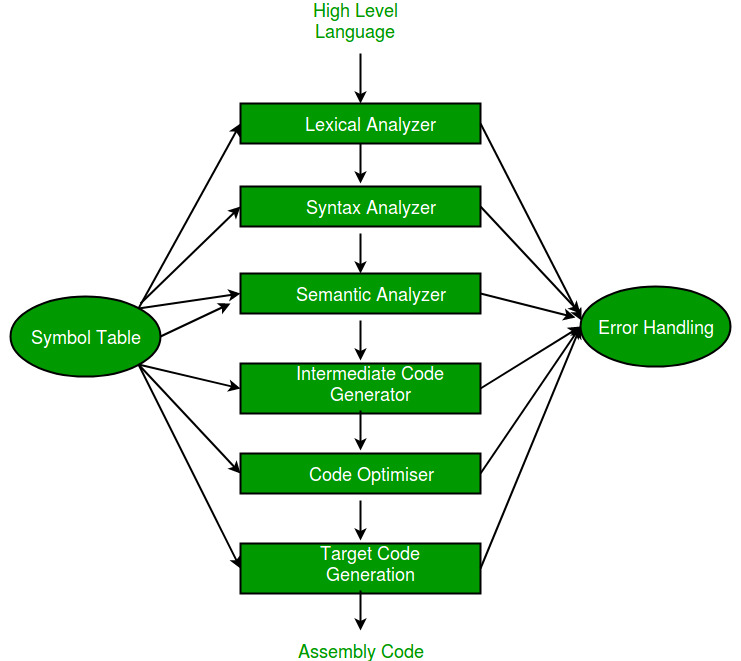
    1. Lexical analysis – text → tokens
    2. Parsing – tokens → syntax tree
    3. Optimization – improve performance
    4. Code generation – emit machine code

    Each generated instruction ultimately controls transistors.


    11. Operating Systems: Managing the Hardware

    Operating systems coordinate:

    • CPU time
    • Memory access
    • Input/output devices

    They rely on:

    • Interrupt signals
    • Privileged instructions
    • Hardware protection mechanisms

    Every OS feature still rests on electrical enforcement.


    12. Abstraction Layers: Why This Works

    Computer engineering succeeds because of layered abstraction:

    LayerDescription
    PhysicsElectrons and voltages
    DevicesTransistors
    LogicGates and circuits
    ArchitectureCPU and memory
    Machine CodeBinary instructions
    LanguagesHuman-readable logic
    ApplicationsReal-world software

    Each layer hides complexity while preserving correctness.


    13. Why Understanding This Matters

    Understanding how hardware encodes programs:

    • Improves performance-aware programming
    • Explains limitations like latency and power
    • Enables better system design
    • Bridges theory and practice

    Software is not magic—it is controlled physics.


    Conclusion

    Computer engineering reveals how simple physical principles—electricity, switching, and timing—can scale into machines capable of executing complex programs, simulating worlds, and powering modern society. From voltage levels and transistors to boolean logic, CPUs, and high-level languages, every abstraction rests on a carefully engineered physical foundation. Understanding this connection not only deepens technical knowledge but also highlights the elegance of turning raw energy into computation, logic, and meaning.

  • Technology for Small Businesses: Essential Software Systems That Enable Sustainable Growth

    Technology for Small Businesses: Essential Software Systems That Enable Sustainable Growth

    Written by Alexander Christian Greco

    With the Help of ChatGPT

    https://s47295.pcdn.co/wp-content/uploads/2022/08/flexible-workspace-technology.jpg

    Introduction

    Technology has become a defining factor in whether a small business merely survives or develops the capacity to scale. Unlike large enterprises, small businesses operate under strict constraints: limited capital, small teams, and minimal tolerance for inefficiency. As a result, business technology must serve a clear functional purpose—reducing workload, increasing accuracy, improving customer relationships, or enabling informed decision-making.

    Over the last two decades, cloud computing, software-as-a-service (SaaS), and mobile platforms have dramatically lowered the barrier to entry for professional-grade business systems (Laudon & Laudon, 2023). Today, even a sole proprietor can access accounting, marketing, analytics, and cybersecurity tools once reserved for corporations.

    This article examines core categories of technology used by small businesses, explains their practical applications, and references established platforms widely adopted across industries. The goal is not to promote tools indiscriminately, but to clarify how technology functions as business infrastructure rather than optional convenience.


    1. Accounting and Financial Management Software

    https://images.klipfolio.com/website/public/efa0da16-51e2-4d8e-a3a8-01a8ae3ce8be/accounting-dashboard.png

    Financial management software forms the operational backbone of most small businesses. These platforms automate bookkeeping tasks that were traditionally handled manually or outsourced to accountants, reducing error rates while increasing financial transparency (Horngren et al., 2021).

    Modern accounting systems typically support:

    • Double-entry bookkeeping
    • Automated expense categorization
    • Invoicing and receivables tracking
    • Payroll and contractor payments
    • Tax reporting and compliance documentation

    Platforms such as QuickBooks and Xero integrate directly with banks and payment processors, allowing real-time cash flow monitoring. For micro-businesses, tools like Wave offer simplified, low-cost solutions.

    Accounting technology enables small business owners to move from reactive bookkeeping to proactive financial planning, improving long-term sustainability (OECD, 2021).


    2. Payment Processing and Point-of-Sale (POS) Technology

    Payment processing technology determines how efficiently revenue enters the business. Digital payment systems allow small businesses to accept credit cards, mobile wallets, online payments, and subscriptions with minimal setup.

    Widely adopted platforms such as Square, Stripe, and PayPal provide:

    • Secure transaction handling
    • Fraud detection and dispute resolution
    • POS hardware for physical locations
    • Integrated invoicing and recurring billing

    For retailers and food service businesses, POS systems also track inventory and sales patterns, providing operational data that informs pricing and purchasing decisions (Kokemuller, 2022).


    3. Customer Relationship Management (CRM) Systems

    https://cdn.dribbble.com/userupload/18067702/file/original-fcc83a6ceb00a30995b5e1baf7614257.png

    CRM software centralizes customer data, enabling small businesses to manage relationships systematically rather than informally. This is particularly important as customer bases grow and communication complexity increases.

    CRM platforms are commonly used to:

    • Track customer interactions and history
    • Manage sales pipelines and leads
    • Automate follow-ups and reminders
    • Segment customers for targeted marketing

    Solutions such as HubSpot, Zoho, and Freshworks are designed to scale with business growth while remaining accessible to small teams.

    From a strategic perspective, CRM systems convert customer relationships into organizational knowledge, reducing dependence on individual memory and enabling delegation (Buttle & Maklan, 2019).


    4. Marketing and Digital Communication Tools

    https://media.whatagraph.com/strapi_blog_files/Monitor_All_of_your_Crucial_Email_Marketing_Metrics_2beeac34cd.png?width=992

    Marketing technology enables small businesses to compete for attention in saturated markets. Automation tools reduce the time and expertise required to run consistent marketing campaigns.

    Key categories include:

    • Email marketing platforms
    • Social media scheduling tools
    • Website builders and landing page creators
    • Performance analytics and A/B testing

    Platforms such as Mailchimp, Canva, and Hootsuite allow non-specialists to produce professional-quality content.

    https://agencyanalytics.com/_next/image?q=75&url=https%3A%2F%2Fimages.ctfassets.net%2Fdfcvkz6j859j%2F3V7axLNnk7iDQzyVFmIudf%2F28a3f89c6681ea89329a9da754c8b1b6%2FDigital-Marketing-Reporting-Software.png&w=3840

    Marketing technology shifts outreach from ad-hoc effort to repeatable systems, improving customer retention and brand consistency (Kotler et al., 2022).


    5. E-Commerce and Online Sales Infrastructure

    https://www.gooddata.com/img/blog/_2000xauto/salesperf2.png.webp

    E-commerce platforms provide small businesses with direct access to national and global markets. These systems integrate storefront design, payments, inventory, and logistics into unified environments.

    Popular platforms include Shopify, WooCommerce, and BigCommerce.

    These tools support:

    • Product catalog management
    • Tax and shipping calculations
    • Order fulfillment tracking
    • Customer accounts and analytics

    For service-based businesses, similar systems handle digital products, subscriptions, and bookings, reducing manual coordination while increasing scalability (Chaffey & Ellis-Chadwick, 2019).


    6. Productivity, Project Management, and Collaboration Software

    https://d1x9j2lb4srxrw.cloudfront.net/media/uploads/2023/09/27/group-625323.png

    As businesses grow beyond solo operations, coordination becomes a limiting factor. Productivity software formalizes workflows and improves accountability.

    Commonly used platforms include Trello, Asana, Notion, and Slack.

    These tools:

    • Track tasks and deadlines
    • Document standard operating procedures
    • Reduce email dependency
    • Support remote and hybrid teams

    Productivity software enables operational clarity, which is critical for consistent execution and employee onboarding (Drucker, 2007).


    7. Cloud Storage, Data Management, and Backup Systems

    https://www.backup-eagle.de/wp-content/uploads/2025/02/backup-eagle_backup-dashboard.png

    Cloud storage systems ensure business data remains accessible, secure, and recoverable. Physical storage solutions lack redundancy and scalability compared to cloud-based alternatives.

    Services such as Google Drive, Dropbox, and Microsoft OneDrive support collaboration while protecting against data loss.

    Data management technology contributes directly to business continuity planning and regulatory compliance (NIST, 2020).


    8. Cybersecurity and IT Protection for Small Businesses

    https://support.catonetworks.com/hc/article_attachments/24275726506909

    Small businesses are increasingly targeted by cybercrime due to limited defenses. Cybersecurity tools mitigate these risks through layered protection strategies.

    Core tools include:

    • Password managers
    • Endpoint security software
    • Network firewalls
    • Multi-factor authentication

    Solutions from providers such as LastPass, Norton, and Bitdefender are designed for non-technical users.

    Cybersecurity technology functions as risk insurance, protecting reputation, revenue, and customer trust (Verizon, 2024).


    9. Analytics and Business Intelligence Tools

    https://blog.bismart.com/hs-fs/hubfs/Imported_Blog_Media/captura%20dashboard%20cuadro%20de%20mando%20bismart%20customer%20journey-Sep-26-2023-09-14-06-4900-AM.jpg?name=captura+dashboard+cuadro+de+mando+bismart+customer+journey-Sep-26-2023-09-14-06-4900-AM.jpg&width=1928

    Analytics platforms transform operational data into actionable insights. Small businesses use these tools to evaluate performance, marketing effectiveness, and customer behavior.

    Widely used systems include Google Analytics and built-in dashboards within accounting, CRM, and e-commerce platforms.

    Analytics technology enables evidence-based decision making, reducing reliance on intuition and anecdotal feedback (Davenport & Harris, 2017).

    https://bscdesigner.com/wp-content/uploads/2020/07/data-driven-decision-7-steps.png

    Conclusion

    Technology is not a substitute for sound business fundamentals, but it is a force multiplier. For small businesses, carefully selected software systems reduce administrative burden, improve visibility, and enable growth without proportional increases in labor.

    Successful small businesses typically adopt technology incrementally—starting with finance and payments, expanding into customer and marketing systems, and later investing in analytics and security. When aligned with strategy, technology becomes a stable foundation rather than an operational distraction.


    References

    Buttle, F., & Maklan, S. (2019). Customer Relationship Management: Concepts and Technologies. Routledge.
    Chaffey, D., & Ellis-Chadwick, F. (2019). Digital Marketing. Pearson.
    Davenport, T. H., & Harris, J. G. (2017). Competing on Analytics. Harvard Business Review Press.
    Drucker, P. F. (2007). Management Challenges for the 21st Century. HarperBusiness.
    Horngren, C. T., Datar, S. M., & Rajan, M. V. (2021). Cost Accounting. Pearson.
    Kotler, P., Kartajaya, H., & Setiawan, I. (2022). Marketing 5.0. Wiley.
    Laudon, K. C., & Laudon, J. P. (2023). Management Information Systems. Pearson.
    NIST. (2020). Small Business Information Security Fundamentals.
    OECD. (2021). Digital Security Risk Management for Small Businesses.
    Verizon. (2024). Data Breach Investigations Report.


    Further Reading

    • Harvard Business Review – Technology & Small Business Strategy
    • U.S. Small Business Administration (SBA) – Digital Tools for Entrepreneurs
    • MIT Sloan Management Review – Data-Driven Organizations
    • McKinsey & Company – Small Business Digital Transformation
    • World Economic Forum – Technology and SME Growth
  • How to Profit and Monetize From a Small Business

    How to Profit and Monetize From a Small Business

    Written by Alexander Christian Greco

    With ChatGPT

    A practical, economics-driven guide to sustainable revenue generation

    https://www.nyc.gov/assets/sbs/images/content/neighborhoods/grandst-storefront.png

    Introduction

    Starting a small business is often motivated by independence, creativity, or the desire to solve a real-world problem. However, many businesses that generate strong interest, traffic, or even sales fail because they do not monetize effectively. Profitability is not guaranteed by effort, visibility, or passion—it is achieved through deliberate economic design.

    Monetization refers to the structured process by which a business converts value creation into consistent, surplus income. This includes pricing strategy, cost control, revenue models, customer retention, and scalability. Research consistently shows that poor pricing, weak financial controls, and lack of revenue diversification are among the top causes of small business failure¹.

    This article explains how small businesses generate profit, how monetization models work, and how entrepreneurs can design systems that produce reliable, long-term income rather than short-term sales spikes.


    1. Revenue vs. Profit: The Core Financial Distinction

    https://docs.infor.com/ln/10.3/en-us/lnolh/help/tp/images/revenue_vs_cost_by_period.png

    Revenue is the total income generated from sales, while profit is the amount remaining after all expenses are paid, including operating costs, taxes, debt service, and reinvestment². A business can appear successful on the surface while remaining financially fragile if margins are thin or cash flow is inconsistent.

    Key financial concepts include:

    • Gross profit: Revenue minus cost of goods or services
    • Net profit: Earnings after all expenses
    • Cash flow: Timing of money entering and leaving the business
    • Margin: Profit expressed as a percentage of revenue
    https://www.smartsheet.com/sites/default/files/IC-Business-Expense-Template.png

    The U.S. Small Business Administration emphasizes that sustainable businesses focus on cash flow management as much as top-line growth³.


    https://cdn.prod.website-files.com/61f266e377abdf882aef404f/66b4d1d35493dc8bab6afcf9_667d3bc0d14f3d2832a2d37b_Frame%25201000008726.webp

    2. Value Creation and the Customer’s Willingness to Pay

    https://www.groupmap.com/wp-content/uploads/2020/11/Value-Proposition-Canvas-GroupMap.png

    Customers do not pay for effort—they pay for outcomes. A business’s ability to monetize depends on how clearly it communicates and delivers value. According to economic theory, price is determined by perceived utility, not production cost⁴.

    Strong value propositions typically provide one or more of the following:

    • Time savings
    • Cost reduction or income generation
    • Risk reduction
    • Increased convenience or reliability
    • Status, expertise, or access

    Businesses that articulate measurable outcomes—rather than vague features—command higher prices and retain customers longer⁵.


    3. Core Monetization Models for Small Businesses

    https://www.altexsoft.com/static/blog-post/2024/3/86679648-f5cf-46fc-9e05-7f85ab11c67a.png

    Monetization models define how customers pay. Selecting the wrong model can constrain growth even when demand is strong.

    Common Monetization Structures

    1. Transactional Sales
      One-time payments for goods or services. Simple but volatile.
    2. Subscription or Retainer Models
      Recurring payments that stabilize revenue and increase customer lifetime value⁶.
    3. Tiered Pricing
      Multiple service levels that capture different customer segments.
    4. Usage-Based Pricing
      Fees tied to consumption, common in utilities and digital services.
    5. Licensing and Intellectual Property
      Monetization of designs, software, content, or proprietary processes.

    High-performing businesses often combine multiple models to reduce revenue volatility⁷.


    4. Pricing Strategy and Long-Term Profitability

    Pricing is one of the most powerful profit levers available to a small business. Research from McKinsey & Company suggests that a 1% improvement in pricing can generate an 8–11% increase in operating profit⁸.

    Common Pricing Approaches

    • Cost-plus pricing: Covers expenses but may undervalue outcomes
    • Value-based pricing: Anchored to customer results
    • Competitive pricing: Market-aligned but margin-sensitive
    • Psychological pricing: Uses framing to influence perception

    Underpricing often results from fear of losing customers, but studies show that customers associate higher prices with higher quality when value is clearly communicated⁹.


    5. Cost Control and Margin Expansion

    Profit growth does not always require more sales. Reducing costs while maintaining value directly increases margins.

    Effective cost strategies include:

    • Process automation
    • Outsourcing non-core tasks
    • Standardizing operations
    • Eliminating low-margin offerings
    • Renegotiating supplier contracts

    Because every dollar saved flows directly to profit, cost control is often more efficient than aggressive revenue expansion¹⁰.


    6. Customer Lifetime Value and Retention

    https://coolerinsights.com/wp-content/uploads/2016/09/Digital-Marketing-Funnel-March-2019-2.jpg

    Acquiring new customers can cost five to seven times more than retaining existing ones¹¹. Monetization improves dramatically when businesses focus on long-term relationships rather than single transactions.

    https://images.ctfassets.net/lzny33ho1g45/jUTu7dLnuZYo7VhYfoL8z/ddd9cb7f1df5de7614514868b5bf7c15/upselling-vs-cross-selling.png

    Retention strategies include:

    • Subscription plans
    • Maintenance or service agreements
    • Upselling and cross-selling
    • Loyalty programs
    • Personalized communication

    Increasing customer lifetime value (LTV) allows businesses to spend more on marketing without reducing profitability.

    https://www.comarch.com/files-com/miniatures/file_715/customer-retention-strategies-2022-infographic.736x1838.bc6b1367.jpg

    7. Marketing for Monetization, Not Visibility

    https://fitsmallbusiness.com/wp-content/uploads/2022/08/Infographic_Sales_funnel_versus_sales_pipeline.svg

    Marketing should be evaluated by conversion and return on investment, not attention alone. Content marketing, email marketing, and referral programs consistently outperform paid advertising for small businesses in terms of cost efficiency¹².

    https://media.licdn.com/dms/image/v2/D5612AQE3bUfNAo0Vig/article-cover_image-shrink_720_1280/article-cover_image-shrink_720_1280/0/1679406937323?e=2147483647&t=3OVn6BENIs35i8PLZx3bKs2AMfrl0GknNuBZ5NxNAgo&v=beta

    High-performing marketing systems:

    • Educate before selling
    • Build trust through proof and transparency
    • Guide customers toward clear decisions

    Monetization improves when marketing aligns directly with sales systems.

    https://www.leadsquared.com/wp-content/uploads/2021/11/lead-funnel.png

    8. Revenue Diversification and Risk Management

    https://qonto.com/blog/images/bdf0c080b79d6a2173b17683280c9163.png

    Dependence on a single income source exposes businesses to market shocks. Diversified revenue streams stabilize cash flow and increase resilience¹³.

    Examples include:

    • Services plus digital products
    • Physical products plus subscriptions
    • Consulting plus education or licensing

    Diversification also increases business valuation and exit potential.


    9. Scaling Without Destroying Profit

    https://www.onepagecrm.com/wp-content/uploads/blog-scale-business-steps-1024x576.png

    Growth increases complexity. Without systems, scaling often reduces profitability rather than increasing it.

    Successful scaling requires:

    • Documented processes
    • Automation and delegation
    • Financial forecasting
    • Capacity planning
    https://www.slideteam.net/media/catalog/product/cache/1280x720/w/o/workflow_automation_flowchart_for_business_process_improvement_slide01.jpg

    Economies of scale occur when per-unit costs decrease as volume increases—this should be the goal of growth¹⁴.


    10. Legal, Tax, and Financial Infrastructure

    https://fundsnetservices.com/wp-content/uploads/Practical-journal-entries-1.png

    Profitability depends on what a business retains, not just what it earns. Tax inefficiencies, legal penalties, or poor accounting can erase years of progress.

    Foundational requirements include:

    • Accurate bookkeeping
    • Tax planning
    • Proper business structure
    • Insurance and compliance
    https://m.media-amazon.com/images/I/81LDuXtHd2L._UF1000%2C1000_QL80_.jpg

    Well-structured businesses consistently outperform informal operations¹⁵.


    11. Measuring Performance and Adjusting Strategy

    https://ajelix.com/wp-content/uploads/2024/02/18-kpis-for-small-business-owners.webp
    https://cdn.vertex42.com/ExcelTemplates/Images/income-and-expense-worksheet.png

    Data-driven businesses make better monetization decisions. Key metrics include:

    • Profit margin
    • Cash flow
    • Conversion rates
    • Customer acquisition cost
    • Retention rates

    Continuous measurement allows businesses to refine pricing, marketing, and operations over time.


    12. The Long-Term Monetization Mindset

    https://www.timechamp.io/blogs/wp-content/uploads/2024/05/Why-Long-term-planning-is-Important-3.jpg

    Sustainable profit comes from long-term thinking. This includes investing in brand equity, customer trust, systems, and adaptability.

    Businesses designed for durability—not quick wins—are better positioned to survive economic cycles, technological shifts, and competitive pressure.


    Conclusion

    Monetizing a small business is a structured process rooted in economics, strategy, and execution. Profit emerges when value creation, pricing, cost control, customer retention, and systems work together cohesively.

    Businesses that master monetization gain more than income—they gain stability, autonomy, and long-term opportunity.


    References

    1. Small Business Administration. (2023). Small business failure rates and causes.
    2. Horngren, C. T., et al. (2021). Introduction to Financial Accounting. Pearson.
    3. U.S. Small Business Administration. (2022). Cash flow management.
    4. Varian, H. R. (2019). Intermediate Microeconomics. W. W. Norton & Company.
    5. Osterwalder, A., et al. (2014). Value Proposition Design. Wiley.
    6. Zuora. (2022). Subscription economy index.
    7. Blank, S., & Dorf, B. (2020). The Startup Owner’s Manual. Wiley.
    8. McKinsey & Company. (2018). The power of pricing.
    9. Nagle, T., & Müller, G. (2017). The Strategy and Tactics of Pricing. Routledge.
    10. Porter, M. E. (2008). Competitive Strategy. Free Press.
    11. Reichheld, F. F. (2003). The one number you need to grow. Harvard Business Review.
    12. Content Marketing Institute. (2023). B2C and B2B benchmarks.
    13. Taleb, N. N. (2012). Antifragile. Random House.
    14. Chandler, A. D. (1990). Scale and Scope. Harvard University Press.
    15. IRS. (2022). Small business tax guide.

    Further Reading

    • The Lean Startup – Eric Ries
    • Profit First – Mike Michalowicz
    • Good to Great – Jim Collins
    • The Personal MBA – Josh Kaufman
    • Harvard Business Review – Small Business & Entrepreneurship Series
  • Computer Engineering: The Internal Structure and Creation of Modern Computers

    Computer Engineering: The Internal Structure and Creation of Modern Computers

    Written by Alexander Christian Greco

    With the Help of ChatGPT

    https://i.pinimg.com/736x/70/6d/3c/706d3c30eefc0d4ef39749678b23ee3c.jpg
    https://static.righto.com/images/8086-overview/die-labeled-w600.jpg
    https://io.bikegremlin.com/wp-content/uploads/2024/07/modern-pc-computer-motherboard.jpg

    Abstract

    Computer engineering is the discipline that enables abstract computation to manifest as physical machines. By combining principles from electrical engineering, computer science, materials science, and manufacturing, computer engineers design systems capable of executing billions of operations per second with extraordinary reliability. This article explores the internal structure of modern computers, examining how each major component—processors, memory, storage, motherboards, and input/output systems—is architected and manufactured. Emphasis is placed on structural organization, hierarchical design, and the interaction between hardware and software layers.


    1. Introduction

    Modern society depends on computers whose internal complexity is largely invisible to end users. Beneath familiar interfaces lies a meticulously structured hierarchy of components, each engineered to operate within strict physical, electrical, and logical constraints. Computer engineering addresses this complexity by designing systems that transform logic into hardware and hardware into computation at scale [1].

    Rather than focusing on usage or consumer-level descriptions, this article examines how computers are structured internally, revealing how billions of microscopic devices cooperate to perform meaningful work.


    2. Computer Engineering as a Systems Discipline

    Computer engineering is inherently interdisciplinary. It draws simultaneously from:

    • Electrical engineering (circuits, signals, power distribution)
    • Computer science (algorithms, operating systems, abstraction)
    • Materials science (semiconductors, insulators, conductors)
    • Manufacturing engineering (yield, reliability, scalability)

    A computer is best understood not as a single machine, but as a layered system of subsystems, each built atop the previous layer [2].


    3. Structural Layers of a Computer System

    At a conceptual level, computers are organized into multiple layers:

    1. Transistor layer – physical semiconductor switches
    2. Logic layer – gates, latches, and arithmetic blocks
    3. Microarchitecture layer – pipelines, caches, execution units
    4. Component layer – CPU, memory, storage, I/O devices
    5. System interconnect layer – buses, chipsets, controllers
    6. Software interface layer – firmware and operating systems

    This layered approach allows engineers to manage complexity while improving performance and reliability [3].


    4. Central Processing Unit (CPU): Internal Structure

    https://www.researchgate.net/profile/Ranjan_Hebbar/publication/360345940/figure/fig2/AS%3A1151749746360320%401651609946011/Skylake-Microarchitecture-CPU-Core-Block-Diagram-67.png
    https://media.geeksforgeeks.org/wp-content/uploads/20200506200800/Untitled-Diagram-618.png

    4.1 Architectural Overview

    The CPU is the primary execution engine of the computer. Internally, it is composed of billions of transistors arranged into structured regions on a silicon die. These regions form functional blocks responsible for instruction processing, data movement, and control flow [4].


    4.2 Instruction Fetch and Decode

    Instructions are fetched from memory and decoded into internal control signals. Modern CPUs employ sophisticated decoding logic capable of translating complex instructions into simpler internal operations known as micro-operations [5].


    4.3 Execution Units

    Execution units perform computation. These include:

    • Arithmetic Logic Units (ALUs) for integer operations
    • Floating-Point Units (FPUs) for real-number arithmetic
    • Vector units for parallel data processing
    • Branch units for control flow decisions
    https://www.oreilly.com/api/v2/epubs/urn%3Aorm%3Abook%3A059600513X/files/httpatomoreillycomsourceoreillyimages88042.png

    Multiple execution units allow CPUs to exploit instruction-level parallelism [6].


    4.4 Registers and Control Logic

    Registers provide ultra-fast storage directly adjacent to execution units. The control logic orchestrates instruction scheduling, hazard detection, and data forwarding to ensure correctness while maximizing throughput [7].


    4.5 Cache Hierarchy

    Because main memory access is slow relative to processor speed, CPUs include on-chip caches:

    • L1 cache – smallest and fastest
    • L2 cache – larger, moderate latency
    • L3 cache – shared among cores

    Caches are critical to modern performance and dominate CPU die area [8].


    5. Graphics Processing Unit (GPU): Structural Parallelism

    https://global.discourse-cdn.com/nvidia/original/3X/0/6/066e36668ba4610d899fa15838a9507e598b2c6b.png

    5.1 Design Philosophy

    GPUs prioritize throughput rather than low latency. Instead of a few complex cores, GPUs contain thousands of simpler processing elements optimized for data-parallel workloads [9].


    5.2 Streaming Multiprocessors

    The GPU is divided into repeating blocks—often called streaming multiprocessors (SMs) or compute units—each containing:

    • Many arithmetic units
    • Shared local memory
    • Instruction schedulers

    This structure enables simultaneous execution of thousands of threads [10].


    https://www.cs.emory.edu/~cheung/Courses/355/Syllabus/94-CUDA/FIGS/0/CUDA01.gif

    5.3 GPU Memory Structure

    GPUs feature a hierarchical memory system including registers, shared memory, cache, and high-bandwidth external memory. This hierarchy is designed to sustain massive data movement for graphics and AI workloads [11].


    6. Main Memory (RAM): Internal Organization

    https://www.allaboutcircuits.com/uploads/articles/intro_to_DRAM1.png
    https://www.systemverilog.io/images/min/ddr4-basics-banks.png

    6.1 Memory Cells

    Dynamic Random-Access Memory (DRAM) stores data using cells composed of one transistor and one capacitor. The capacitor’s charge represents binary information [12].

    https://www.primrosebank.net/computers/mtx/components/memory/dram/M3764_Read_Timing_760.jpg

    6.2 Hierarchical Organization

    Memory cells are organized into rows, columns, and banks. This structure allows parallel access and efficient addressing while minimizing latency [13].


    6.3 Refresh and Timing

    Because capacitors leak charge, DRAM must be periodically refreshed. Memory controllers coordinate refresh cycles, access timing, and synchronization with the CPU [14].


    7. Storage Devices: Structural Comparison

    7.1 Solid-State Drives (SSD)

    SSDs use NAND flash memory, organized into pages and blocks. Data is stored by trapping electrons in floating-gate transistors, enabling non-volatile storage [15].

    Internal controllers manage:

    • Wear leveling
    • Error correction
    • Logical address translation

    https://www.informit.com/content/images/Tip9_9780789756107/elementLinks/th08fig16.jpg

    7.2 Hard Disk Drives (HDD)

    HDDs store data magnetically on rotating platters. Precision mechanical systems position read/write heads to access data at nanometer-scale tolerances [16].


    8. Motherboard: Structural Interconnection

    https://ascentoptics.com/blog/wp-content/uploads/2023/07/%E6%97%A0%E6%A0%87%E9%A2%98-10.png

    8.1 Multilayer PCB Design

    Motherboards are multilayer printed circuit boards containing:

    • Signal routing layers
    • Power planes
    • Ground reference layers

    High-performance systems may use more than twelve layers to ensure signal integrity [17].


    8.2 Chipsets and Buses

    Chipsets coordinate communication between the CPU, memory, storage, and peripherals. High-speed buses such as PCI Express require precise trace geometry to maintain timing accuracy [18].


    9. Input and Output (I/O) Systems

    https://www.tutorialsweb.com/computers/Images/pc-mot3.jpg
    https://www.orientdisplay.com/wp-content/uploads/2021/01/1-8.png

    9.1 I/O Controllers

    I/O controllers translate external signals into internal data formats. They buffer, schedule, and prioritize data transfer between devices and system memory [19].


    9.2 Displays and Human Interfaces

    Displays consist of pixel matrices controlled by thin-film transistors. Human interface devices such as keyboards and mice integrate sensors, microcontrollers, and firmware to interpret physical input [20].


    10. Software–Hardware Interface

    Hardware alone cannot function meaningfully without software. Firmware initializes hardware, operating systems allocate resources, and device drivers translate software instructions into hardware-specific actions [21]. Computer engineering therefore requires deep awareness of both domains.


    11. Conclusion

    Computers are among the most complex machines ever built. Their functionality arises from hierarchical structure, precise engineering, and the coordination of billions of microscopic components. By understanding how CPUs, memory, storage, and interconnects are internally organized, we gain insight into why computers behave as they do—and why advances in computer engineering continue to reshape nearly every aspect of modern life.


    References

    1. Patterson, D. A., & Hennessy, J. L. Computer Organization and Design. Morgan Kaufmann.
    2. Tanenbaum, A. S. Structured Computer Organization. Pearson.
    3. IEEE Computer Society. Computer Engineering Body of Knowledge.
    4. Intel Corporation. Intel® 64 and IA-32 Architectures Software Developer Manuals.
    5. Hennessy, J., & Patterson, D. Computer Architecture: A Quantitative Approach.
    6. Wikipedia contributors. “Central Processing Unit.”
    7. ARM Ltd. ARM Architecture Reference Manual.
    8. Hill, M. D. “Cache Memory.” Computer.
    9. NVIDIA Corporation. CUDA Programming Guide.
    10. Wikipedia contributors. “Graphics Processing Unit.”
    11. Kirk, D. B., & Hwu, W. W. Programming Massively Parallel Processors.
    12. Wikipedia contributors. “Dynamic Random-Access Memory.”
    13. Micron Technology. DRAM Technical Notes.
    14. JEDEC Solid State Technology Association. DDR Memory Standards.
    15. Wikipedia contributors. “Solid-State Drive.”
    16. Seagate Technology. Hard Disk Drive Fundamentals.
    17. Altium. High-Speed PCB Design Guidelines.
    18. PCI-SIG. PCI Express Base Specification.
    19. Wikipedia contributors. “Input/Output.”
    20. Sharp Corporation. LCD Technology Overview.
    21. Linux Foundation. Device Driver Documentation.

    Further Reading & Learning Pathways

    Foundational Texts

    • Computer Organization and Design – Patterson & Hennessy
    • Digital Design and Computer Architecture – Harris & Harris

    Semiconductor & Hardware

    • CMOS VLSI Design – Weste & Harris
    • IEEE Micro Magazine

    Parallel & GPU Computing

    • Programming Massively Parallel Processors – Kirk & Hwu

    Online Resources

    • MIT OpenCourseWare: Computer Architecture
    • ARM Developer Documentation
    • IEEE Xplore Digital Library