Author: Alexander Christian Greco

  • Dallas Half Acre Farm

    Dallas Half Acre Farm

    Written by Alexander Christian Greco

    Michael Bell is a small farm owner from the Dallas area who’s managed to sell a variety of crops, with a focus on salad greens. With only 1/3 of an acre, Bell has been making a profit for several years. While their focus is on CSA profit, their farm serves as a model for anyone attempting to either start a farm-to-market or direct to consumer venture, or anyone looking to start a homestead and feed their family from their land. I had the opportunity to talk with Michael Bell about his farm—which he’s successfully been making a healthy profit with for several years—and greatly appreciate sharing this knowledge of his about growing greens.

    Without further ado, here is my interview with Michael Bell:


    Bell:

    I am a full time intermediate PE teacher and have been since 2002. I also run a 1/3 of an acre market garden where I grow seasonal organic vegetables to families using a CSA business model.

    I graduated from College with a Bachelor of Science in Kinesiology which I use for my PE job. As for farming, I have 40 years of experience growing vegetables. I learned the business model of market gardening from YouTube following great farmers like Curtis Stone and J.M. Forteir.


    Around the country, there’s around 1.9 million farms, 42%, or 800,000, of which are small farms, under 50 acres.

    Many farms are utilized for either farm to market sales or for self-sustainability. Around 50-70% of direct-to-consumer farms are around 25 acres or less, and the average homestead being around 3-5 acres.

    With only 1/4 acres of land, growing potatoes, squash or legumes, some of the most common crops, one person has the capacity to grow food to supplement their entire family around 8,000 calories/day for the entire year.

    A market farm of a few acres might make up to $40,000-$80,000+/year.

    Michael Bell has one of these market farms, utilizing a CSA model, or a Community Supported Agriculture model.

    Shareholders pay the farmer upfront for a recurring reportion of the farmers’ harvest. This helps the farmer pay for costs, and share the risk for things like droughts, floods, and blights. If the harvest is good, then the shareholders receive more produce.

    With this, Bell has been able to make a stable profit from their farm for several years.


    What should people know about your farm?

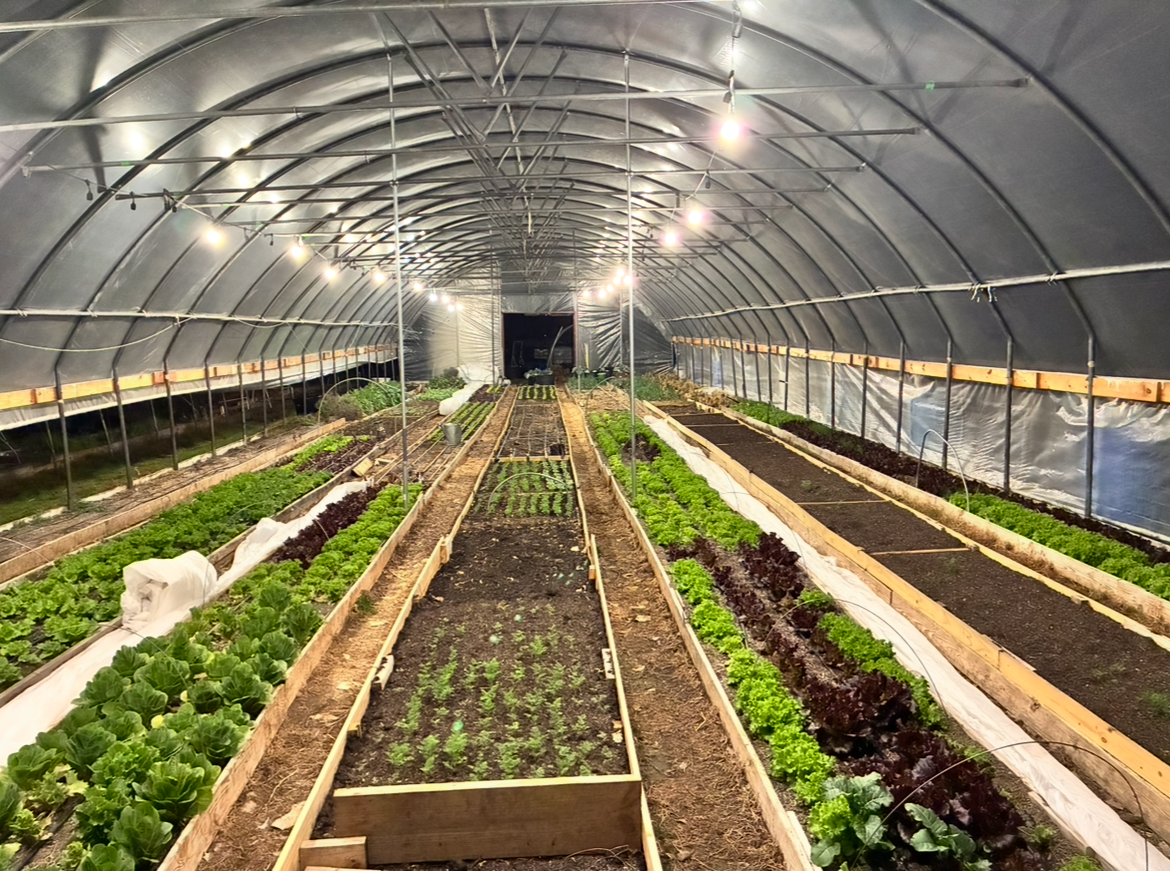
    The first thing is it’s tiny but very productive. I grow in basically 10 36-inch-wide beds that are 140 feet long. In each bed which I can grow 4 rows of lettuce, 7 rows of carrots, or 8 rows of radishes. I can also grow tomatoes that I trellis upwards and grow a nice row or two of green beans or beets underneath the tomatoes.

    Needless to say, growing is very intense and space is not left empty for long.

    People should also know everything I do on the farm is done by hand. I do not have a tiller or any other mechanized items on the farm. I plant everything by hand, pull weeds by hand and harvest by hand,


    If you’re looking to start your own farm, there are a number of considerations.

    What to grow depends on the type of garden or farm you’re trying to start/what the goal of the farm is.

    Plan before you spend any money on your farm though, you need to plan the entire farm.

    What are the exact dimensions of the greenhouse/fence. How many seeds are you going to need. What sort of watering system are you going to need.

    From here, you can begin determining costs, and then a plan to start the farm. You might get everything you need all at once. You might pay for materials as you go, over time.


    When did you get started?

    I have always grown stuff. I always tell people I was probably the only college kid that would water his tomatoes with a really bad hangover. It’s been a passion for as long as I can remember. I started my farm in 2016 though and have been growing the farm and the business every year since.

    What sort of crops do you grow?

    I grow the same things a person would grow in their back yard just on a larger scale. Salad mix is my bread butter as far as sales go. During the winter its a ton of salad and a lot of root crops like, radishes, beets, carrots, and turnips. Then in Spring I grow salad ’til mid June when it gets too hot but its also the same time the tomatoes, squash zucchini and peppers also take off. I sale 52 weeks a year with August being my slowest month due to the heat and dryness.


    What to grow depends on the type of garden or farm you’re trying to start/what the goal of the farm is.

    Farmer’s markets succeed with crops that are valuable and difficult to grow—aren’t easy to find or readily available, and/or are locally grown, which supports local farmers communities, and compliment peripheral purchases. Farmers markets near the ocean do well complementing things like fishing, while areas with deer/bird hunting, bird and cattle farms do well complementing these diets.

    Family farms aimed at self-sufficiency are successful with high calorie/nutrient crops, with a high calorie:cost/square foot ratio. How much food can you feed your family the most efficiently and make sure they’re getting all the vitamins and minerals.

    Either route requires commitment, determination, and a ton of time and effort.


    What are your day-to-day activities on the farm like?

    I wake up at 4 am and I get to the farm by 4:20 AM. I usually take a quick walk around the beds looking for insects that might have moved in the last 24 hours. After that I either plant something, water something or harvest something and most days I do all three things. I leave the farm about 6:15 to get home and change so I can get to school by 7:00 am. I am at school til 4ish. After dinner and family time I go back to the farm around 8:30-10. I don’t go every night, just during the busy seasons.

    What should people know about starting a farm in general?

    I do a ton of consulting with new farmers and the biggest thing I have learned is to start small! Focus on 3-4 crops a year and a very small area. Most beginners want to start with way too much space and way too many crops, which usually causes massive failures. Become a great grower of 3-4 crops then each season add in 1 or 2 new crops. Within a couple of years you are rolling!

    Another thing farmers do is over commit when trying to make a sale. For example, a guy might try a bag of lettuce and love it then immediately call the farmer. This guys might say “Hey my sister owns a catering business and she wants 50 pounds a week of this salad can you get it to her?” First of all 50 pounds of salad is a huge order! The farmer is so excited they instantly said yes before any thought goes into it 6 weeks later the farmer only has 12 pounds for the caterer and shes very upset! That farmer had good intentions they just didn’t know how much that was and lost a future customer! Always scale up slowly!

    What should people know before starting a farm?

    People need to know what will sell in their area. Ask as many people as you can what they would be interested in. Weather is the next important thing. They need to know their first and last average frost date. They need to average temps for each month and the extreme temps, rainfall amounts. etc. You can’t control the weather but if you can predict it will help tremendously. You should finally know what your financial goals are. I like to count backwards which means If i want to make $1000 a dollar a month, that equals out to $250 a week. In order to sell $250 a week I need to sell 50 bags of salad at $5 a bag. It could also mean I need to sell 31 bags of salad AND radishes which i get $8 total for. Using this method has really simplified things for me in trying to budget and plan ahead financially.


    An average acre of land costs around $5,000, though some areas, particularly metropolitan areas, can reach up to $10,000 – $20,000 an acre. The infrastructure for a market farm can cost around $3,000 to $4,000+ to $20,000 to $25,000+. Equipment costs around $5,000 – $10,000 an acre. These prices scale per acre, though some costs can be mitigated.

    Average profit on an acre of land will return around $10k/year, which then returns the value of the land, equipment, etc. after around 3-5 years. Most farmers ought to expect little to no returns the first year—potentially a few hundred to thousand, though don’t expect to bring home $10,000+ your first year or two. Most farmers will begin making $8,000-$12,000+/year from one acre of land after around 2-4 years. Generally speaking, full-time, committed farmers can potentially expect $15,000 to $30,000 on a 1-2 acre lot after 5-7+ years, though this requires much dedication, effort and resource commitment.

    As a part-time commitment, or even as a full-time commitment, there is much potential to market farms, even at a small scale. A farm like Michael Bell’s likely costs less than $20,000 for initial costs. Across the same trajectory scale as a 1-2 acre plot, a .5 acre plot of land can likely return $7,000-$12,000/year, with enough effort and commitment.


    What should people know before making a business out of it? People need to know simple things about their bills. Things like water bill, property tax bill, electric bill, and then supply costs, like packaging, seed cost and other farm expenses. Without having some sort of idea of what these numbers look like it makes planning for income very difficult.

    What can people expect when they first start out?

    They need to plan to fail their first year!

    This is why I am such a huge fan of starting out part time and keeping your full time job for the first year at least. You will learn things about your farm that you never even considered. My first year I made less than $1000 total but what I gained in knowledge was worth so much more. Things like how much moisture will your soil hold which in turn determines how often you water, or in the Fall that huge Pecan tree puts too much shade on a certain area of the farm and that 20 feet of bed space just doesn’t grow due to lack of sunshine. Little things like this can’t be taught in a book, they have to be learned through experience.

    They will also learn if they truly love farming or if they just want to go back to a small backyard garden! I know several people that thought they wanted to grow commercially but after 6 months they hated it for various reasons. While others fall in love with it and would go to the ends of Earth to make it successful.

  • Caroline Phillips Interview

    Caroline Phillips Interview

    Written by Alexander Christian Greco

    I’ve had the distinct honor of talking to Caroline Phillips—artist and CEO of Lingual Muse, a remote language learning company. As an artist, her work concentrates on the portrayal of transient energy structures of life, primarily as a method of recovery. As a business owner, and as one of the coaches of her company, Caroline has a company dedicated to developing language skills through cultural immersion, and personally teaches German, French and English. We’ve spoken together quite a lot the last few months, there’s an endless amount to learn from Caroline, her art and her business, and, while this article has only partially transcribed our discussions, hopefully this article serves as a good first foothold for future conversations.

    When we first began our conversation, the primary concentration was on Caroline’s artwork. She describes her artwork as “intuitive abstract paintings”, which she creates as “conversations”. To me, knowing Caroline’s background with language, and knowing her art serves as a conversation, I immediately began to see her artwork as a form of linguistic projection of geometric shapes as a form of language. I think it’s genius.

    The shapes and structures of the geometric forms act as linguistic projections of ideas—the shape acts as a way to communicate something. The patterns might be patterns of emotions, patterns of networks of ideas, patterns of interlocking ideas forming a chart, diagram or map of ideas, concepts, emotions, projections.

    Her self-description of her art is as “Intuitive Abstract Paintings”, and she consistently describes these as conversations. What is the conversation being had, and what is the language? What is the language Caroline is speaking with, and how can we understand the structure of that language? Now, with this being intuitive, I’m sure a large part of the artwork is meant to confer something without strict definition and structure, and to communicate ideas that maybe adapt to each viewer—Caroline intuits the shape of the idea and the structure of the connections of shapes and thoughts, and the viewer intuits their own adapted meaning.

    However, with this too, Caroline’s art is primarily designed—or, at least, was initially designed—to act as a recovery tool. Caroline suffered a major injury at an early age, and art—particularly intuitive abstract art—served as a way to communicate ideas with her self, and to recover from the traumatic injury.

    Me: Who are you?

    Phillips: I am Caroline Phillips—an abstract artist, photographer, and the co-founder of LingualMuse. I was raised in a bilingual German and French family and have spent my life navigating the intersection of language, culture, and visual expression.

    Me: What sort of art do you create, and what is the inspiration and purpose for it?

    Phillips: I create intuitive abstract paintings and photography. My work is a “conversation” with the canvas, focusing on themes of impermanence, resilience, and healing. The purpose is to capture the transient energy of life—a process that became my lifeline after a serious accident at 19 turned art into my primary tool for recovery.

    Caroline Phillips activities aren’t limited to just her artwork though—Caroline is a linguistic expert who has formerly worked for the Foreign Service Institute in Washington DC, and has brought her knowledge of language to her own small business—Lingual Muse. Lingual Muse functions as a language coaching team that is dedicated to the hands-on, immersive language acquisition of her students. Rather than a broad, downloadable app, the business develops one-on-one linguistic coaching, and focuses on remote learning centered on the individual or personalized coaching model for each student and their specific goals.

    Me: What is your business?

    Phillips: My business is LingualMuse, a boutique online language school. We provide personalized, one-on-one coaching in over 18 languages, moving far beyond the limitations of standard apps to offer true cultural immersion.

    Generally, cultural and language immersion is created through face-to-face conversations . This is generally done in person, and this in-person immersion is then turned into real-life experiences designed to simulate what an actual conversation or event where you’d need to apply the language would be like. However, through Lingual Muse, this is all done remotely, with a team of coaches whose specific goal is to tailor individual, immersive learning environments for each individual student’s goals.

    Me: What is some of the background of your business?

    Phillips: It is rooted in high-level pedagogy. Before starting the company, I worked at the Foreign Service Institute (FSI) in D.C., training U.S. delegates for diplomatic missions. That experience in rapid, high-stakes language acquisition forms the backbone of our teaching methodology.

    While working with the Foreign Service Institute, the goals of teaching languages to individuals were much more fast-paced, in environments that required few errors, and language acquisition at the highest level of professionalism. These language acquisition timelines were much stricter, and the necessity for high-level language acquisition was paramount—there could be no room for miscommincation, understanding the nuances of how to speak politely, professionally and formally were paramount to everything being taught.

    It wasn’t just a matter of language acquisition at the highest level, it was learning etiquette, learning professionalism and learning how to navigate an entirely different culture. These peripheral skills all formed the backbone of how Caroline Phillips founded her company and how Caroline Phillip’s language acquisition coaching methods were formed.

    Me: How did you get started?

    Phillips: In 2016, my partner Joe Galea and I decided to take my years of independent teaching and FSI experience and scale it into a formal digital platform. We combined my linguistic expertise with his administrative background to build a school that could reach students anywhere.

    Me: What made you want to start?

    Phillips: I saw a gap in the market. Many people were frustrated with “cookie-cutter” language apps that didn’t help them actually speak or understand the culture. I wanted to create a space for tailored teaching that adapts to a student’s specific goals, whether they are moving abroad or reconnecting with their heritage.

    Me: What was the initial start of the business like?

    Phillips: It was a period of intense transition. I was  moving from the D.C. area to New Hampshire while simultaneously building the digital infrastructure. It was about proving that the intimate, 1:1 classroom experience could be effectively replicated—and even improved—in an online environment.

    Language acquisition businesses are highly successful, and operate across the economic industries and digital economy platforms. They primarily operate across remote networking, AI integrated systems which aim at developing skills for job places and globalized industrial sectors. The vast majority of companies rely on some form of international language skillset, and the major company sectors who do this are connected to healthcare, international business, and logistics.

    Me: What were some barriers and challenges to overcome?

    Phillips: The biggest challenge was shifting the mindset that “online” meant “lower quality.” We had to find and train a global team of coaches who could maintain our high standards of engagement through a screen. Additionally, balancing the growth of a startup with my own need for artistic practice required strict discipline.

    Most language acquisition companies rely on the utilization of freemium subscriptions, where there are free software and paid software, with upgrades to the paid software. The primary businesses at the forefront of language acquisition are companies like duolingo and babbel. However, there are hundreds if not thousands of language acquisition companies. At the forefront, there are a few with similar business models as Lingual Muse—the primary business with this structure being Preply.

    Me: What is your business model, and what are some things you’d like people to learn from your approach?

    Phillips: We operate on a personalized coaching model rather than a subscription-to-software model. I want people to learn that human connection is the most efficient way to learn. Technology should be a bridge, not a replacement for a mentor who understands your unique pace and interests.

    Can you tell me about your use of technology, both with your company, and in networking with people for your art?

    For LingualMuse, technology is our “classroom”—we use advanced digital tools to make lessons interactive and accessible globally. In my art, technology allows me to bridge the physical distance of the New Hampshire woods. I use it for digital photography and to network with curators, leading to opportunities like my 2024 show at the Arts Club of Washington. It’s about using digital tools to foster real-world presence.

    The best way to learn how to accomplish something requires that you just do it. Experience and forge an understanding of what we do rooted in reality. At the heart of what Caroline Phillips does, everything is rooted in reality, and everything is rooted in actual experience—hands-on language use, and direct application to some of the highest stakes foreign language environments. Hopefully, this conversation leads the way for more conversation in the future.

  • 360 Drone Mapping

    360 Drone Mapping

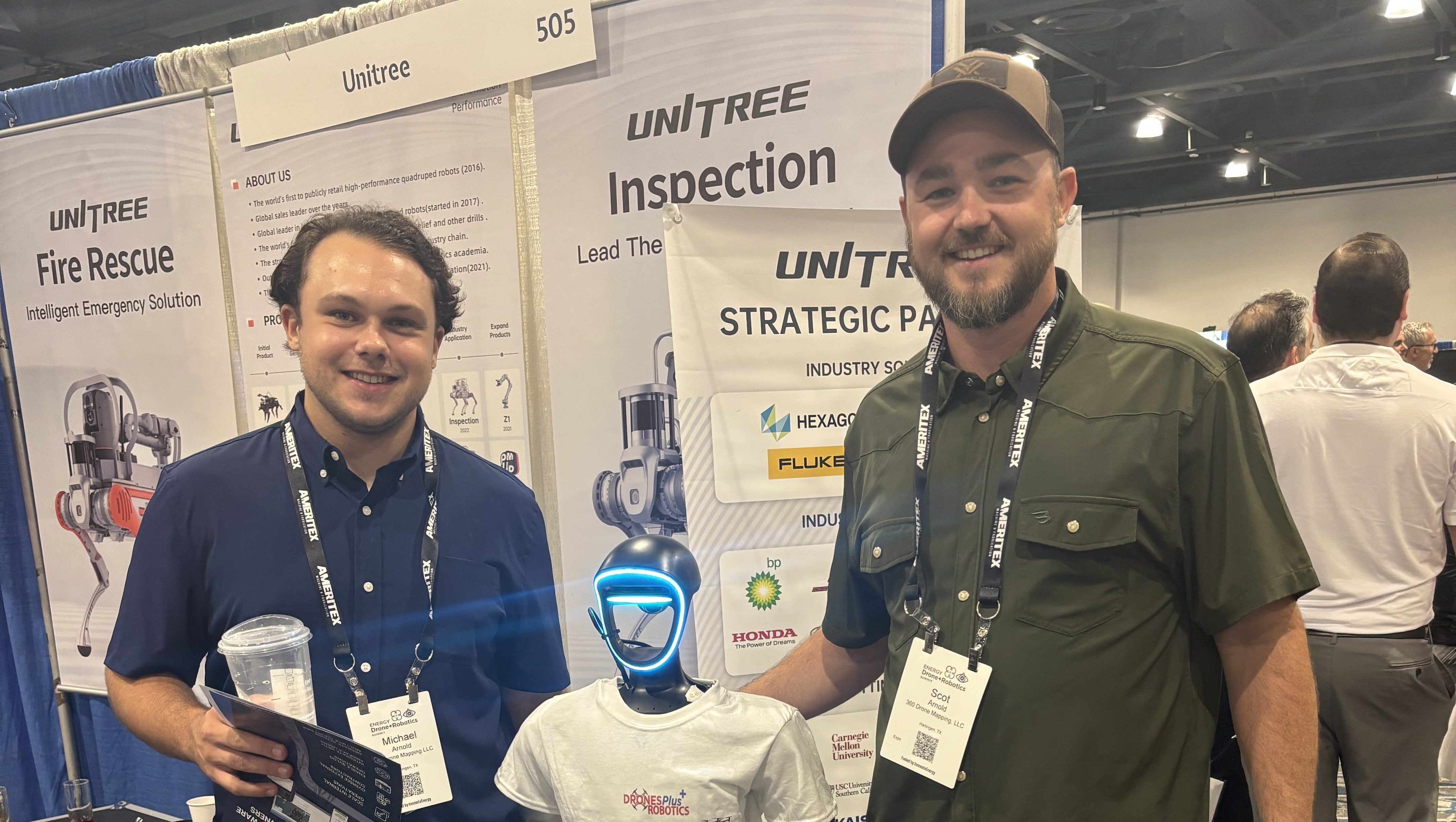
    Interview by Alexander Greco with Scot Arnold


    One of the most important emerging technologies right now are drones. Though, right now, drones are making headlines due to their use abroad, they’re used across a number of industries for a wide variety of functions. Drones are currently utilized across construction, land and infrastructure surveying, and agriculture, to name a few. 360 Drone Mapping is one such company who have been a part of the industrial movement changing the way we approach engineering, farming, construction and understanding the world around us.

    360 Drone Mapping is an aerial surveying team based out of Texas, who use drone technology to provide information to clients. This includes everything from topography and land surveys to time lapsed data regarding project site progressions. In this interview, I got the chance to talk with Scot Arnold to hear about their use of drones and aerial mapping, and learn about how this technology is changing the world.


    Me: What should people know about you and your company?

    Scot: We are 360 Drone Mapping, LLC, a South Texas based company focused on helping people understand land and construction projects through accurate aerial data. Our work centers on turning real world environments into measurable information that developers, engineers, and contractors can actually use to make decisions.

    Most people first think of drones as cameras in the sky, but what we provide goes much deeper than visuals. We create detailed maps, elevation models, and site documentation that help projects move forward with clarity and confidence. The goal is simple. Give clients a clear understanding of what exists today so they can plan what comes next.

    Me: How did you get started?

    Scot: We came from a family business background and were already familiar with project driven work and client expectations. We originally began on the visual media side doing aerial photography and video, but we quickly noticed clients were asking bigger questions. They wanted measurements, progress tracking, and reliable site information rather than just imagery.

    As drone technology matured, we transitioned into mapping and modeling. We saw an opportunity to bridge the gap between traditional surveying needs and modern aerial technology. That shift shaped the company into what it is today, a data focused operation rather than a media company.


    There are a number of advances occurring in industries outside the common perception—innovations not only in technology, also how we think about technology and how we apply these new technologies. 360 Drone Mapping is one of many companies at the forefront of integrating and applying new technology.

    These technologies additionally include:

    • 3D and 4D printing
    • Generative AI
    • Autonomous Robotics
    • Block Chain

    4D printing is currently designing smart materials and structures which react to environmental changes. This includes materials that change shape or structure from environmental factors (temperature, moisture, sunlight), materials that respond to structural damage and self-repair, reactive concrete polymers adapting the resiliency of building structures, as well as self-constructing materials and mechanical components.

    Generative AI has been used to create medicines, stress test various strains of crops to find resilient crop varieties, predict market trends, generate and compare different construction designs and streamline problem detection.

    Blockchain is well known for providing cryptocurrency, though is more widely used for securing transactions, digital information and identity management and securing property rights.

    Many of these technologies are advancing initial assumptions, with drones being no exception.

    Though we hear horror stories about a number of new technologies, our capacity to innovate has outpaced our worst fears.


    Me: What is it that you do?

    Scot: We specialize in drone based mapping and site analysis. Our services include photogrammetry mapping, LiDAR topographic surveys, volume calculations, and long term construction progression documentation. These deliverables help clients understand grading, drainage behavior, material quantities, and project changes over time.

    At its core, our job is to transform large physical areas into clear digital models that people can analyze and act on.

    Me: What are your day to day operations?

    Scot: A typical project begins with understanding what decision the client needs to make. From there we plan the flight, evaluate airspace and safety considerations, and prepare the capture workflow. Field collection is followed by processing and quality control, which is where much of the real work happens.

    After processing, we review accuracy, prepare deliverables, and walk clients through how to use the data. Many people are surprised to learn that flying the drone is actually the shortest part of the process. Most of the effort goes into preparation, processing, and ensuring reliability.

    Me: What is crucial to success in your industry?

    Scot: Accuracy and consistency are everything. Data has to be repeatable and trustworthy. Success also depends on understanding the client’s real objective. A map itself is not the goal. The goal is helping someone make a better decision about land, construction, or infrastructure.

    Operational discipline is equally important. Clear workflows, strong communication, and dependable delivery build long term relationships more than anything else.


    Me: Can you tell us about the drone technology you use?

    Scot: We operate professional grade drone platforms equipped with RTK positioning and LiDAR sensors. RTK technology allows captured data to be precisely located, while LiDAR helps us accurately model terrain even in areas with heavy vegetation. This is especially important in regions like South Texas where ground visibility can be limited.

    The technology allows us to capture terrain details that would otherwise require significant time and manpower using traditional methods.

    Me: What is your background with drone technology?

    Scot: Our experience developed alongside client needs. We moved from aerial visuals into technical mapping by learning positioning systems, coordinate frameworks, and data processing workflows. Over time the focus became less about flying and more about producing reliable deliverables that stand up to engineering and planning requirements.

    We approach drone work as a professional discipline rather than a hobby. Good results come from process and experience, not just equipment.

    Me: Is there additional technology involved beyond drones?

    Scot: Absolutely. Drones are only one piece of the workflow. We also use GNSS positioning equipment, specialized processing software, and cloud based delivery systems that allow clients to access and review data efficiently. The combination of capture technology and processing tools is what turns raw flights into usable information.


    Drones rely on software to find their position in relation to everything around them.

    They primarily use GPS coordiantes and tracking systems, oftentimes using Global Navigation Satellite Systems or GNSS. However, the accuracy of standard GNSS measurements can be off by several meters, reducing efficacy with certain technologies.

    360 Drone Mapping utilizes Real Time Kinematic GNSS, or RTK GNSS. RTK is a corrective technique utilizing a primary base, acting as a stationary node, and a rover, a moving node, communicating with each other to correct the position of standard GNSS systems, which then improves accuracy of tracking systems. While the accuracy of standard GNSS can be off by up to several meters, RTK GNSS is accurate with a margin of only 1-2 centimeters.

    They then use this in conjunction with LiDAR (Light Detection and Ranging), which will scan an area with pulses of light, reflecting back the topography of the surveyed area. The LiDAR scans are then processed using photogrammetric software to create 2D and 3D renderings of the surveyed area.


    Me: How has social media helped your company?

    Scot: Social media has primarily helped us build trust and educate clients. Many people are unfamiliar with how mapping technology works, so showing real project examples helps them understand the value quickly. It allows potential clients to see consistent results and understand how the technology applies to real world problems.

    Me: What have you learned about using social media effectively?

    Scot: Clarity matters more than complexity. Showing outcomes works better than explaining technical details. Consistency also matters. Regularly sharing real projects demonstrates reliability and experience over time.

    The most effective content focuses on results people can immediately understand, such as project progress or before and after comparisons.

    Me: Are there other tools or software you rely on?

    Scot: Yes. Processing and analysis software play a major role in our work. We produce orthomosaic maps, elevation models, point clouds, and comparison reports that integrate into engineering and construction workflows. The emphasis is always on delivering formats that clients can immediately use within their own systems.


    To recap this process, 360 Drone Mapping utilizes RTK GNSS tracking to send their drones over an area, and utilize LiDAR to scan the area. These initial scans then utilize photogrammetry software to create the orthomosaic image, which is a corrected rendering of the topographical scans.

    This can be adapted for a number of industries, namely construction, agriculture, conservation and land management, land development and for infrastructural surveys with industrial infrastructure and utilities sources.

    While the process is similar, different industries might require different technology and software. For example, if surveying utilities, such as plumbing and underground power lines, thermal imaging and GPR (Ground Penetrating Radar) might be used. When surveying land for agriculture, multi-spectral, hyper-spectral and EC (electrical conductivity) scanners might be used for assessing material composition and water use and composition.


    Me: Is there anything people should understand about your industry or starting a business?

    Scot: One important lesson is that tools alone do not create success. Anyone can purchase equipment, but consistent results come from discipline, learning, and reliability.

    Building a business also requires staying focused on real problems. Technology should simplify decisions, reduce uncertainty, and save time. When you stay aligned with solving those needs, growth follows naturally.

    Another key takeaway is that consistency matters more than hype. Delivering quality work repeatedly builds trust, and trust ultimately drives long term success.

    Thank you,

    Scot Arnold

    360 Drone Mapping, LLC

    121 W Tyler Avenue

    (956)873-3524

  • Ellie/Mop Garden

    Ellie/Mop Garden

    Written by Alexander Greco

    Across the last two decades, content creation as we generally think of it has been growing. Content creation, technically is the creation of any sort of content—written, audio, visual/graphic, app or system creation—however, when we think of content creators, the most well known are YouTubers, streamers and podcasters, particularly for their ability to incorporate several mediums of content or communication at once. Ellie—who goes by Mop Garden online—is one such streamer who has found success with streaming, and I was fortunate enough to talk with her about what she does and what she’s done to become a successful streamer.

    Here is my interview with Ellie, also known as Mop Garden:


    So, first, can I get to know a bit about yourself?

    MG:

    I am a Canadian who has been living in Australia for the last 6 years. I started streaming back in 2014 and have been passionate about it since the day I began. I am grateful that my streaming career allowed me to make the big move between countries! I enjoy the ocean – scuba diving, snorkelling and swimming. I also love fitness and running – I completed my first half marathon back in November.

    [My name is] Ellie, but I go by Mop or MopGarden online.

    I have been a gamer since as young as I can remember. My older brother and cousins all played video games so I played a lot with them and it just became a part of my normal life and things that I love. 

    This isn’t super important to know about me but it’s a not very known fact – I went to University for anthropology/archaeology and have my honours degree in it. I also have a diploma and certificate in early childhood education! I’ve always loved helping people and my “when I grow up” thing was always just that I wanted to help people. I think streaming has been really great in that regard for me – I can be a friend to those who may need one, and to provide some entertainment to folks who are bored. 

    Me:

    Can you tell me a bit about what’s important to you, what matters the most in your life? Ideas or beliefs you live by. Actions, ideas, habits and so on that are important to you.

    MG:

    I think practicing fitness and mental health exercises are crucial in life. I was someone who never really understood the gym / working out but it’s made me realize how good it is for your mental and physical health. I also think having a good work/life balance is so important. It’s hard with streaming to turn off anything from stream and to make time for yourself. There are so many streamers who burn out within a year of doing it and I think it’s because they don’t take that separation. I try to keep my balance between a full-time week, hours as similar to a “regular job” schedule as I can, and to take weekends off. 

    I also think that friendliness and kindness is not an option in life. I think we all need to treat one another with the utmost respect because we never know what people are going through and how you can make or break people’s days. 

    Me:

    What inspired you to start [streaming]?

    MG:

    I was playing a lot of video games, primarily CS, when I graduated university. I heard that people were having fun on Twitch and that I could possibly make some money by playing games. I also really loved the idea of a community of my own! 

    I didn’t really understand what it was at the time but I am grateful to those British fellows because I probably would’ve never even heard about Twitch. 

    Me:

    Next, can you tell me a bit about what you do?

    MG:

    I am a full-time variety streamer on Twitch. I stream 9:30-4 Monday to Friday and also produce shorts/reels on platforms like Instagram and Tiktok. 

    I play a wide variety of games but I love indies and shooters. I think my favourite genre is Soulslikes but I enjoy everything but MMO and MOBA games… mostly because I am terrible at them and do not have the patience for them haha.

    I love to talk about games – new releases, the content that is happening in the game, and watching new game trailers. I also enjoy reviewing what games we played and discussing plots, ideas about game theories, and so on.


    Across the World there are an estimated 300+ million content creators, with around 45 million being considered professionals, with as many as 30-50 million content creators in the united states, with around 10+ million treating it as a full time job. While streaming can be done across a variety of platforms, the premier and most widely utilized platform is Twitch. Globally, out of these content creators, there is an estimated 8 million active monthly streamers on Twitch, and approximately 50-60,000 of these streamers are considered professional streamers with Twitch partnerships.

    Ellie is one of those 50-60,000.

    Streamers operate similarly to podcasters, and a lot of streamers will convert turn their streams to podcasts. However, streaming alone functions as a way to directly interact with live viewers across live streams, often times hosting live events, directly talking to their chat and inviting people on their stream to talk. This differs tremendously from most similar content creators, who focus on carefully planned, curated content—staged, filmed, edited and reviewed.

    While streaming is professionally produced and curated, it is done live, with less focus on editing, and more focus on in-the-moment interactions. This format lends itself well to gaming and reaction videos, however, it is also used for IRL, live production (music, coding, creative works) and for live discussions, including as a platform for debates, and for live events—charities, fundraising and so forth.


    Me:

    How did you get started [professionally] once you set your mind to it?

    MG:

    I just booted up stream one day and people came around, to my surprise. I have an issue with letting people down and really struggle with it. Once I had people in the community that were looking forward to the stream I made sure I showed up every day – I didn’t want to let them down.

    I am very grateful that my brother let me borrow his laptop when I wanted to stream back in the day. I did a lot of research on streaming because it was a lot harder to do back then. I streamed from a Macbook for a while and the software just didn’t exist for it. Once I got it all booted up it was good and then I saved up to buy a proper PC, with the help of my community!

    Me:

    How has what you’ve done grown and changed across time?

    MG:

    My community has mostly stayed the same over time, which I’m very grateful for. They’ve always been very positive and respectful and it keeps me wanting to stream day in and day out. I’ve changed from playing just a few games (like CS and Binding of Isaac) to having played hundreds of games on stream. I’m very happy that so many game devs have supported my stream and sent over game codes for me to check out.

    Me:

    What are some major milestones or events since starting?

    MG:

    I was very happy at first about reaching 10,000 followers. I still think that’s such a huge amount of people, even though I’m up at 70,000 now! I was also really happy when I reached Twitch partner about 9 years ago.

    Me:

    What experience do you have that helped?

    MG:

    I got bullied a lot in elementary school so I think that’s helped make my thin thick, which is important in streaming. People can be nasty online and it’s sometimes hard to remember that you aren’t always what people think you are and to speak positively to yourself.

    Me:

    What has been your favorite aspect of your content?

    MG:

    I think getting to explore so many various games – from tabletop to video games. I’ve discovered so many amazing games through streaming that I probably would have never thought twice about prior to streaming. I’ve also been super grateful to meet people from around the world and to meet some of my best friends through Twitch.


    Streaming, primarily, is done with a computer or console, a camera, a microphone, lighting equipment and an audio interface. Software includes a digital audio workspace, or DAW, and streaming software.

    The stream generally has the streamer sitting at a computer, playing video games, watching clips or having conversations, while recording the player and the game, and streaming these two video feeds.

    When doing IRL streams or event streams, streamers will utilize their phones or GoPros and similar cameras, and equipment for maintaining equipment power and data and stream connectivity.


    Me:

    What is the mindset people should have? How should you develop that mindset?

    MG:

    What should you do to carry out that mindset and perform at a high level, the same way that people do in a standard workplace or industry?

    Look at your analytics and what works and what doesn’t. Keep positive if something doesn’t succeed and learn from it and proceed better in the future with your content. Analytics are your friend and tell you a lot of information, just like sales reports do.

    Focus on your successes. If a video reached more than your regular viewership, focus on that one and be happy and look at what you did well. Don’t look at the ones that didn’t do well as a fail – look at maybe why they didn’t do well and learn from that and do better in your next one.

    Be positive and patient and good things will come!


    Streaming as a career requires developing an audience who will watch you live, and consistently return. This requires professionalism while maintaining your real personality, and keeping potential stressors from intruding on your real personality.

    Developing an audience goes the same as many platforms, with the added challenge of needing to develop a live following. Doing this successfully requires following a strict schedule, creating high quality feeds and content, and creating a strong relationship with your audience.

    Developing a network of similar streamers and supporters, reaching out to and fellow streamers and content creators, potentially cross-platform, to develop a network and extend your reach, will similarly cultivate a strong audience.


    Me:

    How do you develop and maintain your success as a streamer?

    MG:

    Ensuring that you are utilizing various resources and other sources to bring new people to your stream (like TikTok, Reels, etc.) I think it’s also important to have a consistent schedule so that your community knows when you will be live and keep them updated for any changes. 

    Me:

    What should people know about getting an audience and making a living from this?

    MG:

    I think it’s important to make good relationships with brands so that you can work to get sponsorships and collaborations with brands. People have waves with their income and that often affects your income as well – people’s entertainment budget is usually the first to go when they are struggling. It’s important to rely on multiple resources like subscribers, the YouTube partner program, sponsorships, etc. in order to not be too reliant on one resource.

    I think it’s important to keep in mind that things won’t just happen overnight, unless you’re a very lucky specific 1%. Things work very slowly on Twitch and in content creation and you shouldn’t “quit your day job” to go forward with it until you are sure you can sustain yourself by paying rent, feeding yourself, and so on. I think it’s also important to just be yourself because if you are wanting to fulfill this as a career you don’t want to change  your persona – be who you are and be sustainable for further down the line. 

    Make sure that you’re treating your content creation and stream as a professional job. Be on time, be consistent in your schedule, and be professional and respectful to those around you. This includes game devs, other content creators, and anyone that you may work with in the industry. 

    Me:

    What do you do to stay focused or stay on task?

    MG:

    I love making lists so I always make sure that I have lists to keep me organized. Once I set down to do a task I own’t get up and do anything else until I’m done, or I find it hard to get back to the task. I try to time manage and set aside specific time each day to do tasks like video edit, upload, catch up on emails, etc. and during this time this is what I do every day. 

    You show up every day. You stay on task. You stay on point. You continually improve. You continually take pride in your work. You continually develop your career. How do you self-manage this without having a boss?

    I think I’m my worst boss and worst critic. I am really hard on myself and feel if I haven’t been improving or doing well that I need to do better. I think critiquing myself and always wanting to strive for success and perfection keeps me wanting to progress and keep myself in check.

    Me:

    What is some advice you have for people who either have or would like to make this a career?

    MG:

    I think it’s harder to get anywhere on Twitch now unfortunately. The discoverability isn’t as easy now because there are SO many people trying to become a content creator. It’s very different now too because there are so many other platforms that you can put your content on to (like TikTok, Instagram, etc.) and many people are getting “discovered” because of their content on there.

    Make sure that you have a community built up before you even think about going full-time. It is not good to hop right into these things and quit your job, not many streamers (unfortunately!) can do this full-time and make enough to live. I think also to just be patient. You aren’t going to be famous and successful overnight and these things take time – trust that if you put in the work it will come.

    Me:

    What are additional projects, organizations, work/jobs, associations and so on that you’ve been involved with related to your content?

    MG:

    I have done a lot of charity work for various organizations, such as ones for cancer research, mental heatlh, and children’s hospitals. I have an ongoing partnership with ReachOut Australia who is a great resource for teen and young adult’s mental health.

    Me:

    What are all the places people can find you on? Social media, twitch or at live events?

    MG:

    I am “MopGarden” on everything, and all of my link/socials can be found here: https://linktr.ee/MopGarden

    Me:

    What is any additional information you’d like people to know about you?

    MG:

    All of my emotes and branding are around rabbits and gardens! This is because of my random name, but I actually love the outdoors. I also had a bunny named Buster when I first started streaming so everything became bunny-branded.

  • Gradi Nitert

    Gradi Nitert

    An Interview With Gradi Nitert

    Written by Alexander Greco

    I’ve had the distinct honor of talking with Gradi Nitert from the Netherlands about her artwork, which I’m wicked grateful for. Her art consistently amazes me, and I’m always discovering something new with her art and what she does. We’ve talked before, and this will be our second go at doing an article. She provides great insight about art, finding work as an artist and the sometimes tumultuous lives of artists, as well as the creativity and imagination connected to art and everyday life.

    So, here is the conversation I’ve had with the wonderful Gradi Nitert of the Netherlands.


    Gradi:

    My name is Gradi Nitert, born in 1987 in Gorssel. For as long as I can remember, I have wanted to be an artist. So, it was very clear that from a young age, I lived with the goal of studying at an art academy. As a child and teenager, music also captivated me, both classical with the clarinet and rock with drums. But ultimately, when I could choose between the conservatory and the art academy, I chose the art academy.


    Gradi’s art utilizes painting and collage, and is similar to a variety of styles, namely impressionism, surrealism, abstract and absurdist artwork. Her artwork varies significantly, though a lot of main themes include vivid color schemes, shapes, repetition of patterns, the tessellation of these patterns, overlapping architectures, and architectures as patterns—owls and their feathers, forming patterns with architectures of buildings, forming patterns with colors of shapes, moving across the picture—these seem to be general themes that run across her art, as well as classical portraits, animals and nature, seeming to be finding their way across the frozen storms of bright hues, rivers of brush strokes and pictographic collages.

    Her work adapts a lot of surrealism, fluidly blurring the lines between reality and dream, though her art is a lot less jarring than traditional surrealism. A lot of her work still maintains cohesive structures, and orderly, regular structures and architecture, maintaining a cohesiveness between them all, while creating dream-like figures and environments.

    Good art helps everyone sees something different. Impressionist, abstract and surreal art might be the best at that, with Gradi’s art being fantastic at containing tons of potential meaning for the viewer.  I’ve looked through her art for hours—I think what she does is fascinating, she’s a phenomenal artist—it might not be possible to fully correlate every detail of what she’s made. Without imposing my own ideas, this is my understanding of Gradi’s art. We’re humans from a distant time—we’re the same humans who believed in elves living beyond the veil in Avalon, thought the Sun revolved around the Earth and went around thinking magic was a science. So, we see humans from a classical era, in the midst of modern architectures, cut and pasted together, and connected by these shapes of our imagination, piecing things together, and it makes me think of the interconnectedness of technology, buildings and computer systems, all held up by ancient life forces, with humans being these portraits merging happily with the absurd world we’re still attempting to understand, riding the waves around them, calmly navigating these architectures.

    There’s a lot more to unpack with her art—I highly suggest going through her art yourself if you have the chance. She’s a great creative mind, you’ll find yourself amazed at some of the movement, detail and structure of her creations.


    Gradi:
    Over the years, I have always created work; I feel like I’ve had 100 side jobs, but always with the vision: I am going to become an artist. And now that is the case. It might look easy from the outside, but I have had to give up a lot for it.

    Teaching turned out to be something I can do. I had to learn that too, but after 10 years, I learned it by doing it.


    Falling down and getting back up. That is my faith, I think. Making mistakes, learning from them, and becoming very strong.

    Making a picture book was also something on my bucket list, and I did this entirely by myself again.

    It was exciting too, also a process of failure and learning. But I made it. Maybe I should be a bit prouder of the things I have done.

    I have to ration my energy, and unfortunately, I often have to choose tasks that allow me to pay my bills. And then there is no energy left for making art. It is getting better, but I do not view these kinds of personal setbacks as inspiration at all. I draw much more from the positive things in life, however difficult they may sometimes be to see.


    Nature, crazy characters or situations, old books, paper, new materials, stories.

    Despite the creative capacity of Gradi’s work, it’s still difficult being an Artist. While many artists will find success selling prints of their work, most who study art and pursue it as a career will find a lot of their success from one of a few routes:

    • Teaching
    • Commissions
    • Licensing
    • Workshops
    • Festivals
    • Freelancing
    • Online Support through Social Media and Fundraising

    Despite how much art influences our world, a lot of artists have difficulty supporting themselves with their artwork alone, and lot of people question how art actually helps the world out. However, Art remains necessary to our culture, and support for creative minds remains paramount.


    Gradi:

    The most beautiful thing about making art is being in the moment, surrendering completely to the materials, the smell of paper and paint, the coincidences that arise, making something out of nothing. Creating. Wondering yourself, letting others wonder.


    Put that fucking phone aside.


    At the schools where I teach, the kids sit hunched over their phones during recess; it is sometimes an absurd sight. At the bus stop, at shops…

    My studio displays all the fishing rods I have cast over the past 15 years.

    In cupboards, I find an incredible number of projects that I have tried.

    Webshops, printing, jewelry, workshops, graphic design, festival decor, murals, selling at markets… I’ve tried so much, cast so many lines, and on a few lines, I got a bite.


    Gradi personally has found success a number of ways. She’s developed a few styles, artforms and creative ventures that develop economic viability as an artist. Beyond online success, she’s worked as a teacher, become a tattoo artist and has done commission work for the Hague (a very important institution, for those not familiar…) on top of regular commissions, festivals and workshops.


    Gradi:

    Some really fun jobs included: an illustration commission for the Peace Palace in The Hague, a very special place I would otherwise never come into contact with, but which is very magical to be there. Festival work, applying temporary tattoos, and decoration & entrance gates. Crazy projects like illustrating an entire city covered in Post-it notes, the Moustacherie I created where I generated moustaches with my machine. And something I also had a lot of fun with: creating CD covers for producers. I also always love the combination of music/sound and visual work.

    And so I knew what worked and what didn’t, both financially and mentally. Because some things turned out not to suit me; there was too much friction for it to work well.

    I think the quality of being flexible is also necessary as an artist. Allowing yourself the time to cast those lines, to make mistakes, to truly feel what you are good at—what makes your heart beat faster. It is tempting to fall into conformity; I, too, am sometimes drawn towards that. Instead of thinking about what *I* want to make, making what you think society, people, would want.

    But in a world where everything has already been made, uniqueness is your superpower.

    So staying true to yourself is the key, if you ask me. That is where you excel, and that is how people who also feel your work eventually come to you—with that dose of perseverance.

    Reaching people like that is also a skill that not every artist has mastered.

    It is something that is incredibly useful, but often does not align with most artists’ personalities. Here too, perseverance and discipline are necessary.

    At the beginning of my career, I made posters for a local pub for years for a few tens of cash. It was great fun, but it didn’t pay the bills. I often had to scrape by, but I also knew that I mainly needed to show my work everywhere.

    And connecting with many people. Vitamin “R,” an artist used to tell me (Relationship Vitamins). And she was more than right.


    If your own creative endeavors go beyond acting only as a creative outlet, there are a number of ways to show your art, and potentially make a living from your creativity.

    Art is often shown and sold through:

    • Galleries
    • Digital Galleries
    • Workshops
    • Creative Festivals

    Additionally, many small businesses support local artists, either showing or commissioning art at or for their storefront. Commissions are everywhere, for those who look, make friends and network. Maintaining a professional demeanor, consistency and positive attitude are crucial. Take the time to master your own domain, your own creative voice, while being able to adapt to the needs of those around you.

    A growing trend has been streaming live art creation, and social media has been used across a variety of methods to introduce art. There are currently a growing number of social media platforms specific to art:

    • Cara
    • ArtStation
    • Behance
    • DeviantArt
    • Bluesky/Mastodon

    In addition, traditional social media outlets that help artists include:

    • Pinterest
    • TikTok
    • Discord
    • Instagram
    • Facebook

    Gradi:

    Something I really don’t enjoy doing, which would probably help me a lot – going to entrepreneur gatherings much more often. A rotary event or something similar. But I find it difficult to exhibit my work this way. I did do it following my picture book, though; it brought me a tremendous amount of promotion and sales outlets. Other entrepreneurs were really supportive, which was super sweet. Now that I write it down like this, maybe I should do it a bit more often in the future after all…

    As a tattoo artist, I am still just a beginner, but the learning curve is steep.

    The contact with people is very nice there too, but in this field—because I want and need to become sooooo much better, it is still too new—it is also still very uncertain and nerve-wracking.

    Anyway, no effort, no gain. Sometimes there is only one way, and that is just doing it. That is very often the case for me, so this one can be added to the list.

    I do not have a teaching degree, so like many things, I had to learn this autodidactically. In the beginning, I really had to make progress to get a better grasp of it. I am still learning about teaching.

    Because explaining something to someone is truly a skill in itself.

    In this way, I have truly found a unique “language” for every pupil, student, and course participant to guide their process. It is very rewarding work; it gives me a really good feeling to be able to help someone else and, in doing so, give them a good feeling too. And it is often just like therapy, through conversations or obstacles that parallel obstacles in other areas of someone’s life.

    Kunst Educatie Nederland is a wonderful employer; they offer cultural lessons in all shapes and sizes (visual arts (I often teach tattoo art), but also dance, music, food, etc., etc.)).

    The great thing about this company is that, in my opinion, they have found a really cool way to introduce young people and young adults to culture.

    They organize festival-style cultural days for schools. It really does feel like a festival, with music, theater, visual arts workshops, dance workshops, cooking classes, etc. The young people receive a card on which they have to collect stamps, often with two visual arts workshops and one theater or dance performance. When the card is full, they get fries at the end of the afternoon.

    Brilliant. Young people aren’t keen on culture lessons, and this way they get a good introduction to it.

    ZINKWIT is where I teach illustration and painting classes, a place where I have been working for quite a few years. I have known these groups for a long time, and I can help many people beautifully.

    This is a private art school for young and old, great fun for motivated children and adults.

    This is very different from the young people who often don’t feel like going to a lesson.

    But both are fun. To see motivated students flourish.

    But imagine having touched just one young person on such a festival day with your art or a cultural subject. That is fantastic, isn’t it?


    Gradi’s art is highly unique, her adaptivity allows her to work with a variety of mediums, as well as creating tattoos for festivals and shops, while also working as a teacher, and making commissions for institutions such as the Hague—the headquarters for the UN Judicial Branch. We are going to talk with each other more in the future, this time, hoping to speak more about creativity.

    Give her artwork a look, give her a follow on Instagram, and definitely consider her for any commissions you might need.


    Gradi:

    What helps me look ahead: less time on social media, making more connections with people. More peace brings more time to really zoom in, literally—including on nature, for example. Allow yourself time to marvel. But I also realize that I simply have a rich imagination—and can easily set it in motion. It is probably partly in my character, but it has also always been heavily encouraged by my parents. They saw it, and I was given all the space to develop it—just like my craft skills and materials, and music.

    That is a privilege, and I am incredibly grateful for it.

    Photographer: Robert Flierman

    @Beelduit

    Home

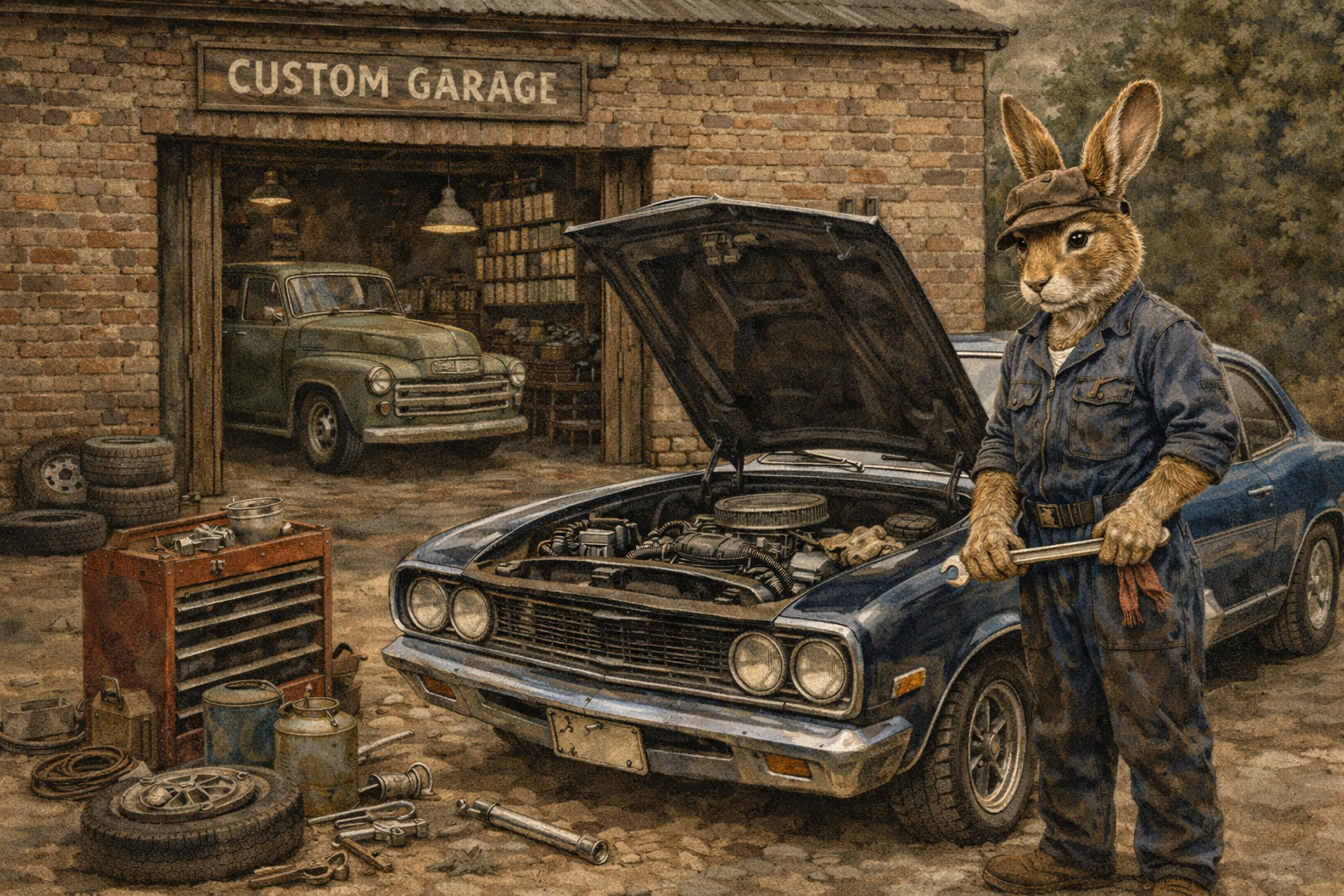
  • Fabbit Customs

    Fabbit Customs

    An Interview With Michael Faucher

    A Look at Starting a Business

    Written By: Alexander C Greco


    “I’d rather succeed in doing what we can than fail to do what we can’t.”

    Hazel from Watership Down, by Richard Adams


    Over the last few months, I’ve had the opportunity to meet and talk with Michael Faucher of Fabbit Customs. Michael Faucher is a retired USMC vet, with training in everything from automotives, automation, ordinance maintenance and industrial marketing and sales. While there’s a tremendous list of things we could’ve talked about with even further, with our limited time, we managed to have a great conversation, from which I was able to develop a lot of insight for additional writing, and hopefully develop the groundwork for further conversations in the future.


    Me [Greco]: Can you tell me about your business and how you guys got started? How long have you been working on cars, and what made you start your own company?

    Michael Faucher: This business was started by my father-in-law, Ben Corbett, in 1989, utilizing a small 30 x 40 shop behind his house. The original intent of the company was to help the surrounding rural community with general mechanical repairs and tires. At that time the name of the company was Corbett’s Auto Clinic. I came along in 1993 after a medical discharge from the Marine Corps. I helped shape the focus to repairs on computer-controlled cars, which were new on the scene and there were few shops troubleshooting the various new sensors on these cars. We also did collision repair and paint.

    Michael: By 1995, we had switched entirely to the restoration of classic cars and offered full turnkey jobs and the name changed to Corbett’s Auto Restoration. This continued slowly until the internet allowed us to create a website and we exploded overnight. This made us look for a larger space and in 2004(ish) we purchased a 30 x 60 shop in Cherryville, NC. Ben retired a few years later and we began to do business as Fabbit Customs.

    Michael: In 2016 we finally found the location of our dreams and moved into a 150 year old cotton mill on the river. The shop now occupies over 15,000 sqft of space and serves customers worldwide.

    Michael: The drive to start all of this stems back to building my first car, a 1967 VW Beetle, in the garage of our home while I was in high school. Everything about that build was terrible… But, doing something wrong, and knowing it, is the best learning tool I know.


    Starting a small business is tough. Michael had a strong support system, and was backed by a ton of previous knowledge and skill. This is still a tough endeavor though, even with a support system and his skill set.

    Starting a small business can cost anywhere from a few thousand dollars to hundreds of thousands of dollars as far as upfront costs, and ongoing overhead costs can range from 10% to 50% of total revenue a month. Depending on your small business type, parts, tools and additional investments for a small business can similarly range from a few thousand dollars to $10k-$100k+. The cost varies from company to company, and varies based on opportunities you may or may not be aware of, as well as having frugal strategies to achieve your goals.

    Some businesses can be run almost completely free. For example, digital marketing, network admin and online tutoring only require a laptop, software and peripheral computer hardware and any business fees. Most businesses require a lot of commitment, economically and with your time.

    So, here are a few examples of common startup costs for businesses:

    • Average rent for an average storefront (3500 sq ft) is about $6,700/month, $80,400/year
    • Digital businesses cost from a few hundred dollars to $10,000
    • Physical businesses can cost tens to hundreds of thousands of dollars
    • Equipment, insurance and inventory for a small business can cost $5,000-$25,000
    • The cost of specialized equipment can raise this cost to $50,000-$100,000+
    • Staff wages vary by industry and state, though many annual salaries for full time workers range from $35,000 to $80,000
    • Legal costs are generally around a few hundred dollars to $2k-$5k

    Common startup costs for specific businesses:

    • House Repair and Handyman Services
      • Equipment can cost several thousand dollars, unless you are using your own equipment
      • Insurance can cost from a few hundred dollars to a few thousand dollars
    • Retail and E-Commerce
      • Retail can cost from the $3,000-$10,000 for a business without a storefront, to tens of thousands of dollars, up to potentially hundreds of thousands, for physical storefronts
      • Retail costs include website, legal registration, licensing, and inventory, which can cost a couple thousand dollars, up to tens of thousand dollars, with most of that cost coming from inventory costs and marketing
    • Food
      • While running a food truck, delivery or cart can cost as low as a few thousand dollars to a few dozen thousand dollars, average startup costs for the food industry start at the $100,000 range, up to millions of dollars
    • Freelancing/Digital Media
      • Most freelancing costs start at $400-$2000 dollars for legal fees, website domain and equipment—typically just a laptop—while higher-end costs are around $10,000 to $60,000 dollars.
    • Small Scale Manufacturing
      • Equipment costs can vary, though can cost up to $100k-$500k+
      • Initial facility costs can reach $100k+
      • Inventory, legal costs and marketing can each cost up to $10k-$20k+
    • Specialized Contracting
      • While startup costs can be as low as $5,000, most startup contracting businesses cost anywhere from $10k-$100k+

    There are many ways a business can reduce these costs, though, in most cases, starting a business is a hefty commitment.

    Most large costs are from storefronts, equipment, inventory, overhead and employees.

    Here are a few ways to mitigate these costs:

    • Storefront:
      • Look for spaces outside prime retail, and locations that might not be listed
      • Look for storefronts through websites, online listings, and social media networks
      • Contact a local Commercial Real Estate Agent who would know more about the market, have networking advantages and more experience finding properties
    • Equipment
      • Buy used or refurbished, or lease, rent, and consolidate purchases from vendors
      • Minimize equipment, optimize usage, and handle repairs and training in-house
      • Become familiar with tax codes, deductions and optimizing deductions
    • Inventory
      • Maintain essential inventory for current demand
      • Forecast demand, and optimize stock levels through inventory analysis
      • Inventory and warehouse management software
    • Overhead
      • Optimize utilities and efficient behaviors (turning off unused equipment, water-efficient systems, going paperless)
      • Audit utilities, proper building code and management
      • Embrace remote work, hybrid spaces or shared workspaces where possible
      • Invest in energy efficient technology and automated tasks
    • Staff
      • Benchmark wages Bureau of Labor Statistics and tools like MIT Living Wage Calculator to match industry salaries and wages
      • Compensate through performance-based wages
      • Proper use of payroll technology—automating payroll, digital timekeeping, payroll management software
      • Ensure you’re optimizing roles and clearly defined labor and duties

    Me: What sort of fabrications and custom work do you guys do? Do you guys work with steel fabrications only? Do you guys make custom electrical components? Are you building or customizing cars from the ground up?

    Michael: We fabricate parts in an old-school hot-rodder mindset, out of necessity. The goal is to build a car to better suit the driver’s needs, which falls into two categories… so that it can be driven daily or used as a play toy. To do this requires installing modern parts, many never originally designed to be used on the car we are installing them on. This requires being creative with custom brackets or mounts.

    Michael: We work in all kinds of medium: steel, aluminum, plastic, fiberglass, carbon fiber, etc… the project, or customer, will dictate what is needed. Many of the designs start off in the computer as a 3D model. From there, it might get printed in 3D to check fit in the real world. And finally, it will go into production for the final part.

    Michael: Not all cars are a ground-up build, but yes, we do build from the ground up.

    Me: What are some important traits for people working on automotives? I know patience is one, patience, determination, being careful with all the details of what you guys do is another.

    Michael: One of the things that I think works well in this industry is a diverse background. Guys that have been in multiple industries have a much larger pool of experience, knowledge and skills from which to pull and this makes it easier to make the seemingly impossible possible. Personally, I have formal education in many areas: a degree in Autobody repair and painting, a degree in Electronic Engineering, Training in construction as well as explosives and demolition.”

    Michael: My work history includes things like Pizza Delivery (before GPS), 3 years in the USMC, Nationwide sales of industrial equipment, Reverse engineering and design of industrial machinery, designing complex automation systems with PLCs, touchscreens and industrial electrical panels, and finally 30+ years of building cars with wild concepts from customers.


    Across traditional companies and newer company-types, having a variety of skill sets is a must:

    • Software and Practical Computer Skills
    • Electrical, Digital and Technical Knowledge
    • Mechanical Know-How
    • Knowledge of Standard Work-Force Skills and Practical Experience

    In addition, we can find a variety of new technologies shaping a variety of industries:

    • 3-D and 4-D Printing
    • Digital Networks and Internet of Things
    • Advanced Data, Computing, Security and Crypto/Blockchain Systems
    • Robotics & Automation
    • Agentive and Generative AI
    • Advanced Manufacturing Systems

    Many of these technologies may seem a bit out of reach, though these are all readily attainable technologies. As far as developing these skill sets and knowledge base, there are a variety of approaches.

    In the future, I will publish articles on these topics even further, however, for right now, here is a basic run-down of achieving this sort of training, or equivalent, as well as costs, training time and everyday use of these technologies.

    • Training
      • Most training is either done through a company—through an employer or contracted training group working with or for hiring companies—or is done independently, contacting educators and training facilities on your own time.
      • Employers may pay for training fees, though many trade skills and trade school degrees or certificates will be out of pocket.
      • Certification: A few hundred to a few thousand dollars
      • Trade School: A few thousand dollars up to $20k-$25k+
      • Virtual Training can reduce trade school certs to a few hundred dollars
    • Education
      • Some companies have their own education programs, and offer either tuition assistance or tuition reimbursement: Walmart, Amazon, Starbucks and Boeing.
      • The traditional costs of an Associates Degree is $3k-$12k, with a Bachelors Degree costing $30k-$40k, though potentially up to $100k+.
    • Practical Experience

    The best form of practical experience is on-the-job training, though there are a variety of ways to achieve and develop practical knowledge

    • High School Trade Programs
      • Internships
      • Part-Time Jobs
      • Niche Clubs or Groups
      • Part Time Jobs
      • Volunteer and Community Service

    Another great avenue is military service, which provides access to training, work experience and education opportunities—often for free.

    Here are the primary uses for these technologies and average pricing:

    • 3-D Printing
      • Prototyping
      • Manufacturing alternatives
      • Production of medical, dental, consumer and construction components and goods
      • Cost: High-End and Industrial Printers range from $15k-$500k, with annual operational costs ranging from $2,500 to $10k-$15k.
      • Less expensive Professional-Grade Printers can cost around $5k-$50k
    • Advanced Computer Technology
      • Software, networking and computing systems for faster data processing and smart applications
      • Costs can vary with upfront server costs ranging from $5k to $250k
    • Automation
      • Can be applied to manufacturing, including welding, painting and assembling.
      • Used for quality control, logistics, supply change and process control—distribution, warehouse systems, refineries, oil and gas systems, material handling
      • Energy systems and management
      • $5k-$20k, up to $100k-$1M+ upfront costs, overhead of approx. $10k-$100k annually.
    • AI Technology
      • AI Technology, currently, can be applied to nearly any line of work, and can be applied to payroll, marketing, business and admin of any company
      • Costs: A few hundred dollars for basic uses, up to thousands of dollars to hundreds of thousands of dollars for major applications.
    • Advanced Manufacturing Systems
      • These systems include advanced software utilization, networking systems, and specialized manufacturing systems, and can be applied to nearly every company or sector with manufacturing capacities or needs.
      • Costs: Generally range from hundreds of thousands to $1M+ for small and medium companies.

    Me: What should people know about starting an automotive company?

    Michael: Don’t start any company unless it is your passion. Next, find a niche that isn’t filled and fill it. Finally, have fun… don’t focus on success, focus on enjoying your life. Success naturally follows joy.


    Starting a small business can be approached from a variety of vantage points. The key to being successful requires understanding your goals, understanding what is required to achieve these goals, having a strategy, and having a passion for what you do that will carry you through. Enjoying what you do will make obstacles easier to confront and the effort to successfully confront these goals much lighter—you will find what you need to be successful from the passion you have for achieving your goals.

    Starting a small business like Michael’s can require a lot of upfront cost and commitment. If you have access to your own tools and equipment already, the costs to start a business similar to Mr. Faucher’s can range anywhere from a few thousand to $10k-$30k+ for tools, licenses and permits, and either converting building space or developing new building space—though costs for similar businesses can cost upwards of $100k+. However, having a strong support system, being smart and frugal with your decisions, and having a passion for what you do that carries you through can be all it takes at the core of being successful.

    While there was much more to discuss with Michael Faucher, hopefully we can continue this conversation in the future, and hopefully our discussion offered valuable insight and inspiration for whatever your goals may be.


    Me: What are some things people might not know about starting or running this sort of business, and what are some things that people should know about this industry in general?


    Michael: Not sure there is a way to quantify or create a simple list of things people do not know about this industry. Most gain their knowledge from watching the shows on cable TV, which does a terrible job of describing a typical day. I guess the main thing they should know before diving in is that they love working on cars and find it hard to see themselves doing anything else. If they know this… they will find a way.

  • The Traits of Successful People: Lifelong Development, Evidence, and How to Build Them at Any Age

    The Traits of Successful People: Lifelong Development, Evidence, and How to Build Them at Any Age

    Written by Alexander Christian Greco

    With the Help of ChatGPT

    https://kajabi-storefronts-production.kajabi-cdn.com/kajabi-storefronts-production/themes/2150071826/settings_images/EIpsxw5WSpCin2peJVle_file.jpg

    The Traits of Successful People: Lifelong Development, Evidence, and How to Build Them at Any Age

    Success is often portrayed as a result of talent, intelligence, or fortunate circumstances. Decades of psychological, educational, and sociological research, however, suggest a more nuanced and hopeful reality: success emerges from developed traits that evolve over time and remain adaptable across the lifespan. These traits are shaped by early experiences, reinforced or weakened during adolescence, and refined through adulthood via deliberate practice, reflection, and environment design.

    This article recreates and expands the earlier discussion by integrating inline scholarly references, a formal reference list, and further reading, while preserving the original structure and ideas. Success is defined broadly to include personal effectiveness, resilience, fulfillment, competence, and sustained achievement—not merely wealth or status.


    1. A Growth-Oriented Mindset

    A growth-oriented mindset refers to the belief that abilities and intelligence can be developed through effort, learning, and persistence. Individuals with this mindset interpret challenges as opportunities and failure as information rather than proof of limitation.

    Research by Carol Dweck demonstrates that people who hold incremental beliefs about intelligence are more likely to embrace challenges and persist after setbacks (Dweck, 2006). Longitudinal studies show that mindset predicts academic achievement, career adaptability, and resilience over time.

    Development Across the Lifespan

    In early childhood, mindset is shaped by feedback. Praise focused on effort (“you worked hard”) rather than fixed traits (“you’re smart”) fosters resilience and curiosity (Haimovitz & Dweck, 2017). During adolescence—when social comparison intensifies—mindset can either crystallize into rigidity or expand through supportive mentorship and autonomy.

    In adulthood, a growth mindset supports reskilling, career transitions, and psychological flexibility in rapidly changing environments (Yeager et al., 2019).

    Cultivating It at Any Age

    • Reframe failure as diagnostic feedback rather than personal deficiency
    • Use process-oriented self-talk (“What strategy can I improve?”)
    • Track learning curves rather than outcomes alone
    • Engage in tasks slightly beyond current competence

    2. Self-Discipline and Consistency

    Self-discipline is the capacity to align behavior with long-term goals despite short-term discomfort. Consistency transforms discipline into results through compounding effects.

    Research on self-regulation and delayed gratification—most famously associated with Walter Mischel—demonstrates that early self-control predicts later academic, health, and social outcomes (Moffitt et al., 2011).

    Development Across the Lifespan

    Children learn discipline through structure and routines. Predictable environments and clear expectations build executive function. Adolescents, gaining autonomy, begin internalizing regulation through time management and goal-setting.

    In adulthood, discipline shifts from external enforcement to system design. Successful individuals rely less on willpower and more on habits, routines, and environmental cues (Clear, 2018).

    Cultivating It at Any Age

    • Start with small, repeatable habits
    • Tie habits to identity (“I am someone who practices daily”)
    • Reduce friction for positive behaviors
    • Measure streaks and consistency, not perfection

    3. Emotional Regulation and Self-Awareness

    Emotional regulation is the ability to monitor, evaluate, and modify emotional reactions. Self-awareness—the capacity to recognize internal states and patterns—supports regulation and decision-making.

    Studies in emotional intelligence by Daniel Goleman show strong links between emotional skills, leadership effectiveness, and interpersonal success (Goleman, 1995).

    Development Across the Lifespan

    Children learn emotional regulation through modeling and language. Caregivers who label emotions and demonstrate calm responses foster emotional literacy. Adolescence challenges regulation due to neurodevelopmental changes, but also offers rapid growth through social feedback.

    In adulthood, emotional regulation predicts stress tolerance, conflict resolution, and long-term mental health (Gross, 2015).

    Cultivating It at Any Age

    • Practice mindfulness or reflective journaling
    • Name emotions precisely rather than broadly
    • Insert a pause between emotion and action
    • Solicit feedback to uncover emotional blind spots

    4. Resilience and Adaptability

    Resilience refers to recovery from adversity, while adaptability reflects the ability to adjust strategies when conditions change. Together, they enable sustained progress over time.

    Research by Ann Masten frames resilience not as extraordinary toughness, but as “ordinary magic” arising from basic adaptive systems (Masten, 2014).

    Development Across the Lifespan

    Moderate, manageable stress in childhood—when paired with support—builds coping skills. Adolescents experience identity, academic, and social challenges that can either erode or strengthen resilience depending on context.

    Adults face structural changes such as career shifts, economic instability, and health challenges. Adaptability becomes critical in navigating uncertainty (Fletcher & Sarkar, 2013).

    Cultivating It at Any Age

    • Normalize setbacks as part of development
    • Focus on controllable variables during crises
    • Develop multiple competencies to reduce fragility
    • Establish recovery routines after stress

    5. Purpose and Long-Term Orientation

    Purpose provides coherence and motivation across time. Individuals with a sense of meaning demonstrate greater persistence, psychological health, and life satisfaction.

    Research in positive psychology by Viktor Frankl and later empirical work shows that meaning buffers stress and supports long-term goal pursuit (Alimujiang et al., 2019).

    Development Across the Lifespan

    Children initially borrow purpose from caregivers and social structures. Adolescents explore values and identities. In adulthood, purpose often consolidates through work, relationships, service, or creative pursuits.

    Purpose is not static; it evolves with life stages and circumstances.

    Cultivating It at Any Age

    • Reflect on moments of deep engagement
    • Identify values that guide decision-making
    • Set long-term goals aligned with those values
    • Revisit purpose periodically and revise as needed

    6. Learning Orientation and Skill Accumulation

    Successful people view learning as a lifelong process. They prioritize skills that compound—critical thinking, communication, adaptability, and technical literacy.

    Educational research emphasizes “learning how to learn” as a key predictor of long-term success (Bjork et al., 2013).

    Development Across the Lifespan

    Early exposure to exploratory learning fosters curiosity. Adolescence allows specialization and skill discovery. Adulthood demands strategic learning aligned with changing contexts.

    Cultivating It at Any Age

    • Schedule dedicated learning time
    • Focus on transferable skills
    • Apply knowledge immediately
    • Teach others to deepen understanding

    7. Social Intelligence and Relationship Building

    Social intelligence encompasses empathy, communication, cooperation, and conflict navigation. Success in nearly all domains depends on relational competence.

    Longitudinal research indicates that social skills predict career advancement and life satisfaction independent of IQ (Deming, 2017).

    Development Across the Lifespan

    Children develop social skills through play. Adolescents refine them through peer interaction. Adults rely on trust-based relationships in professional and personal contexts.

    Cultivating It at Any Age

    • Practice active listening
    • Seek understanding before persuasion
    • Communicate clearly and respectfully
    • Invest in long-term relationships

    8. Responsibility and Internal Locus of Control

    An internal locus of control reflects the belief that outcomes are influenced by one’s actions. This trait correlates strongly with motivation, resilience, and leadership.

    Foundational work by Julian Rotter demonstrates that individuals with internal control beliefs engage more proactively with challenges (Rotter, 1966).

    Development Across the Lifespan

    Children develop agency through responsibility. Adolescents learn accountability through consequences. Adults leverage internal control to adapt and self-correct.

    Cultivating It at Any Age

    • Ask “What can I influence here?”
    • Avoid excessive blame or victim narratives
    • Track cause-and-effect in personal actions
    • Take ownership of mistakes and corrections

    Integrating Traits Across Time

    These traits are interdependent. Growth mindset supports learning; discipline enables consistency; emotional regulation strengthens resilience; purpose guides effort. Importantly, none are age-limited. Adults can develop new traits just as children do—often more efficiently due to accumulated self-awareness.

    Success, therefore, is not a fixed identity but a trajectory shaped by repeated choices.


    Conclusion

    Successful people are not defined by innate talent or luck alone. They cultivate mindsets, habits, emotional skills, and values across time. These traits begin forming early but remain plastic throughout life. With intentional practice, structured environments, and reflective learning, anyone can strengthen these characteristics at any stage.

    Success is less about who you are today and more about the systems you build to become who you aim to be tomorrow.


    References

    Alimujiang, A., et al. (2019). Association between life purpose and mortality among US adults. JAMA Network Open, 2(5), e194270.
    Bjork, R. A., Dunlosky, J., & Kornell, N. (2013). Self-regulated learning. Annual Review of Psychology, 64, 417–444.
    Clear, J. (2018). Atomic Habits. Avery.
    Deming, D. J. (2017). The growing importance of social skills. Quarterly Journal of Economics, 132(4), 1593–1640.
    Dweck, C. S. (2006). Mindset: The New Psychology of Success. Random House.
    Fletcher, D., & Sarkar, M. (2013). Psychological resilience. European Psychologist, 18(1), 12–23.
    Goleman, D. (1995). Emotional Intelligence. Bantam Books.
    Gross, J. J. (2015). Emotion regulation. Annual Review of Psychology, 66, 17–39.
    Haimovitz, K., & Dweck, C. S. (2017). The origins of children’s growth mindsets. Psychological Science, 28(9), 1236–1245.
    Masten, A. S. (2014). Ordinary Magic: Resilience in Development. Guilford Press.
    Moffitt, T. E., et al. (2011). A gradient of childhood self-control. PNAS, 108(7), 2693–2698.
    Rotter, J. B. (1966). Generalized expectancies for internal versus external control. Psychological Monographs, 80(1).
    Yeager, D. S., et al. (2019). A national experiment reveals growth mindset improves achievement. Nature, 573, 364–369.


    Further Reading

    • Duckworth, A. (2016). Grit: The Power of Passion and Perseverance
    • Ericsson, K. A., & Pool, R. (2016). Peak
    • Peterson, C., & Seligman, M. (2004). Character Strengths and Virtues
    • Pink, D. H. (2009). Drive
    • Sapolsky, R. (2017). Behave
  • The Foundations of Business Management

    The Foundations of Business Management

    A Practical and Evidence-Based Guide to Organizing, Leading, and Sustaining Organizations

    Introduction: What Business Management Really Is

    Business management is the disciplined practice of coordinating people, resources, processes, and decisions in order to achieve organizational objectives efficiently, ethically, and sustainably. While economics focuses on markets and incentives, and entrepreneurship emphasizes opportunity creation, management is the mechanism through which organizations function day to day.

    https://www.yeoandyeo.com/wp-content/uploads/09_13_23_420082828_BB_560x292.jpg

    Classic management theorists such as Peter Drucker argued that management is not simply a function of authority but a practice rooted in responsibility, effectiveness, and results (Drucker, 1954). Modern organizations—whether startups, nonprofits, corporations, or public institutions—depend on management systems to transform intention into consistent outcomes.

    At its foundation, business management answers four persistent questions:

    1. What are we trying to accomplish?
    2. How should work be organized?
    3. How do we ensure people perform effectively?
    4. How do we adapt when conditions change?

    Understanding these questions provides a portable framework applicable across industries, roles, and career stages.


    1. The Purpose of Business Management

    The fundamental purpose of management is to reduce organizational entropy—the natural tendency toward disorder—by creating structure, predictability, and coordination (Mintzberg, 1979).

    Without management, organizations rely on informal norms, individual effort, or luck. With management, they rely on defined roles, systems, accountability, and feedback loops.

    Core Purposes of Management

    • Alignment: Ensuring efforts support shared goals
    • Efficiency: Optimizing limited resources
    • Coordination: Synchronizing interdependent tasks
    • Stability: Maintaining reliable operations
    • Adaptability: Responding intelligently to change

    Management does not eliminate uncertainty; rather, it absorbs uncertainty so organizations can function despite volatility (Drucker, 1967).


    2. The Classical Functions of Management

    Modern management education still relies on the foundational framework first formalized by Henri Fayol, who identified five essential managerial functions (Fayol, 1916/1949).

    https://saylordotorg.github.io/text_principles-of-management-v1.1/section_05/8c2b73a21019156d47887a1a60247d4d.jpg

    2.1 Planning

    Planning involves anticipating the future and preparing for it. This includes defining objectives, evaluating constraints, allocating resources, and identifying risks (Fayol, 1916/1949).

    Effective planning incorporates:

    • Strategic goals
    • Tactical initiatives
    • Risk assessment
    • Timelines and benchmarks

    Research consistently shows that organizations that plan systematically outperform those that rely on reactive decision-making (Porter, 1985).


    2.2 Organizing

    Organizing is the process of designing structures and workflows that enable plans to be executed.

    This includes:

    • Task specialization
    • Authority distribution
    • Reporting relationships
    • Process design

    Clear organization reduces ambiguity and internal friction, improving both productivity and morale (Mintzberg, 1979).


    2.3 Leading

    Leadership translates plans into action through motivation, communication, and influence. Unlike authority, leadership depends on trust, credibility, and emotional intelligence.

    Effective leadership behaviors include:

    • Clear communication
    • Consistent example
    • Feedback and recognition
    • Ethical conduct

    Leadership quality has been repeatedly linked to employee engagement, retention, and organizational performance (Yukl, 2013).


    2.4 Coordinating

    Coordination ensures that specialized units work together rather than at cross-purposes. As organizations grow more complex, coordination becomes a primary managerial challenge (Mintzberg, 1979).

    Mechanisms include:

    • Cross-functional meetings
    • Shared goals
    • Integrated schedules
    • Conflict-resolution systems

    2.5 Controlling

    Controlling involves measuring performance and correcting deviations. It is not micromanagement, but feedback-based learning.

    Control systems include:

    • Financial reports
    • Key performance indicators (KPIs)
    • Quality standards
    • Audits and reviews

    According to W. Edwards Deming, effective control systems are essential for continuous improvement rather than punishment (Deming, 1986).


    3. Management as a System Rather Than a Personality

    One of the most persistent myths in business is that success depends primarily on charismatic individuals. In reality, sustainable performance depends on systems.

    https://klariti.com/wp-content/uploads/2011/06/standard-operating-procedure-template-1.gif

    Systems-based management emphasizes:

    • Standard operating procedures
    • Decision frameworks
    • Training systems
    • Documentation
    • Feedback loops

    Organizations built around systems can scale, adapt, and survive leadership transitions more effectively than personality-driven organizations (Drucker, 1999).


    4. Decision-Making as the Core Managerial Skill

    https://www.cflowapps.com/wp-content/uploads/2021/03/Purchasing_process.png

    Management is fundamentally a decision-making discipline. Managers continuously allocate attention, capital, labor, and time under conditions of uncertainty.

    Treviño, L. K., Weaver, G. R., & Reynolds, S. J. (2006). Behavioral ethics in organizations. Journal of Management, 32(6), 951–990.

    Decisions occur at three levels:

    • Strategic: Direction-setting, long-term choices
    • Tactical: Resource allocation and implementation
    • Operational: Day-to-day execution

    High-quality decisions balance data, judgment, ethical considerations, and long-term consequences (Kahneman, 2011).


    5. Human Capital and Workforce Management

    People are not interchangeable inputs. They bring skills, motivation, values, and limitations.

    Effective workforce management includes:

    • Recruitment and selection
    • Training and development
    • Performance evaluation
    • Incentive alignment
    • Culture management

    Organizations that neglect human capital often experience high turnover, disengagement, and declining performance (Pfeffer, 1998).


    6. Organizational Culture and Ethics

    Culture represents the informal norms and values that guide behavior when rules are absent.

    Ethical management ensures:

    • Fair treatment of stakeholders
    • Transparency in decision-making
    • Psychological safety
    • Long-term trust

    Research shows that ethical cultures are associated with higher performance and lower risk exposure (Treviño et al., 2006).


    7. Financial Literacy as a Management Requirement

    Managers do not need to be accountants, but they must understand:

    • Revenue vs. profit
    • Cost structures
    • Cash flow
    • Budgeting
    • Investment trade-offs

    Financial ignorance is a leading contributor to organizational failure, especially in small and growing enterprises (Drucker, 1999).


    8. Operations and Process Management

    Operations management focuses on how value is created and delivered.

    Key concerns include:

    • Process efficiency
    • Quality assurance
    • Capacity planning
    • Supply chain coordination

    Lean and continuous-improvement approaches emphasize reducing waste while improving reliability (Deming, 1986).


    9. Innovation, Adaptation, and Change Management

    https://cdn.prod.website-files.com/60ffbc3a211dee2c1a74db99/67538f2d01e9ceffa8385f38_64b5d60f146d77fd25126bdb_change.webp

    Modern managers must guide organizations through constant change driven by technology, globalization, and shifting expectations.

    Effective change management requires:

    • Clear communication
    • Employee involvement
    • Training and reskilling
    • Gradual implementation
    • Continuous feedback

    Organizations that fail to adapt risk decline regardless of past success (Christensen, 1997).


    10. Levels of Management

    Management operates across hierarchical levels:

    • Top management: Strategy, vision, culture
    • Middle management: Coordination and implementation
    • Frontline management: Daily supervision and execution

    Alignment across levels is essential for organizational coherence.


    11. Measuring Managerial Success

    Managerial effectiveness is assessed through:

    • Financial outcomes
    • Employee retention
    • Productivity
    • Customer satisfaction
    • Innovation capacity
    • Organizational resilience

    Long-term sustainability is often a more meaningful measure than short-term profit.


    Conclusion: Management as a Discipline of Responsibility

    Business management is not merely administrative oversight. It is a discipline of responsibility, requiring judgment, ethical reasoning, and systems thinking.

    Strong management:

    • Transforms vision into action
    • Enables people to perform effectively
    • Sustains organizations over time
    • Balances efficiency with humanity

    In an increasingly complex world, effective management is a foundational societal skill, not merely a business function.


    References

    Christensen, C. M. (1997). The innovator’s dilemma. Harvard Business School Press.

    Deming, W. E. (1986). Out of the crisis. MIT Press.

    Drucker, P. F. (1954). The practice of management. Harper & Row.

    Drucker, P. F. (1967). The effective executive. Harper & Row.

    Drucker, P. F. (1999). Management challenges for the 21st century. HarperCollins.

    Fayol, H. (1949). General and industrial management (C. Storrs, Trans.). Pitman. (Original work published 1916)

    Kahneman, D. (2011). Thinking, fast and slow. Farrar, Straus and Giroux.

    Mintzberg, H. (1979). The structuring of organizations. Prentice Hall.

    Pfeffer, J. (1998). The human equation. Harvard Business School Press.

    Porter, M. E. (1985). Competitive advantage. Free Press.


    Further Reading

    • Mintzberg, H. – Managers Not MBAs
    • Drucker, P. – Managing for Results
    • Kotter, J. – Leading Change
    • Schein, E. – Organizational Culture and Leadership
    • Porter, M. – What Is Strategy? (Harvard Business Review)
  • Fundamentals of Agricultural Science

    Fundamentals of Agricultural Science

    Written by Alexander Christian Greco

    With the Help of ChatGPT

    The Scientific Foundations of Food, Land, and Sustainable Human Systems

    https://offer.osu.edu/sites/offer/files/imce/Images/weed_measure_cropped.jpg


    Abstract

    Agricultural science is the interdisciplinary study of how humans cultivate plants, raise animals, manage land and water, and design food systems capable of sustaining societies across generations. Drawing from biology, chemistry, ecology, engineering, economics, and social sciences, agricultural science seeks to understand both the biological mechanisms and systemic consequences of food production. This article presents a comprehensive overview of the fundamental domains of agricultural science, including soil systems, plant and animal biology, water management, climate interactions, technology, sustainability, and human dimensions. Together, these foundations explain how agriculture functions as a complex socio-ecological system and why scientific understanding is essential for food security, environmental stewardship, and long-term resilience (Lal, 2020; Food and Agriculture Organization of the United Nations, 2023).


    1. What Is Agricultural Science?

    Agricultural science is the systematic study of managed biological systems designed to convert natural resources—sunlight, water, soil nutrients, and genetic diversity—into food, fiber, fuel, and ecosystem services. Unlike purely traditional or experiential farming knowledge, agricultural science relies on experimentation, measurement, modeling, and long-term observation to improve outcomes across diverse environments (NRC, 2010).

    At its core, agricultural science addresses four interrelated questions:

    1. How do plants and animals grow, reproduce, and function biologically?
    2. How do soil, water, climate, and ecosystems support or constrain production?
    3. How can agricultural systems be managed efficiently, ethically, and sustainably?
    4. How does agriculture interact with economies, societies, and environmental systems?

    Because agriculture directly links natural processes to human survival, agricultural science is inherently applied, systems-oriented, and interdisciplinary (Altieri, 2018).


    2. Soil Science: The Foundation of Agriculture

    https://passel2.unl.edu/image.php?display=ORIGINAL&extension=png&uuid=56301d02e403&v=1619102234

    Soil science underpins all terrestrial agriculture. Productive soils provide physical support for roots, regulate water movement, store and cycle nutrients, and host diverse microbial communities essential for plant health (Brady & Weil, 2017).

    2.1 Soil Composition and Structure

    Agricultural soils are composed of:

    • Mineral particles (sand, silt, clay)
    • Organic matter
    • Water
    • Air
    • Living organisms

    The relative proportions of sand, silt, and clay define soil texture, which strongly influences infiltration, drainage, nutrient retention, and root penetration (USDA Natural Resources Conservation Service, 2022). Soil structure—the arrangement of these particles into aggregates—further determines resistance to erosion and compaction.

    2.2 Soil Fertility and Nutrient Cycling

    Plants require macronutrients such as nitrogen (N), phosphorus (P), and potassium (K), along with micronutrients including iron, zinc, copper, and boron. Nutrient availability depends not only on total nutrient levels but also on soil pH, redox conditions, microbial activity, and chemical form (Havlin et al., 2014).

    Agricultural science examines nutrient cycles to balance productivity with environmental protection, minimizing losses through leaching, volatilization, and runoff.

    2.3 Soil Health and Conservation

    Modern agricultural science emphasizes soil health rather than short-term fertility alone. Healthy soils exhibit stable aggregation, high organic carbon, biological diversity, and resilience to disturbance (Lal, 2020). Conservation tillage, cover cropping, diversified rotations, and organic amendments are evidence-based strategies for sustaining long-term productivity.


    3. Plant Science and Crop Biology

    https://planetforward.org/wp-content/uploads/2023/11/astry-1.jpg

    Plant science investigates how crops convert light, water, and nutrients into biomass and yield under varying environmental conditions.

    3.1 Plant Physiology

    Photosynthesis, respiration, transpiration, and nutrient uptake govern plant growth and development. Environmental variables—temperature, light intensity, water availability, and nutrient supply—strongly influence these processes (Taiz et al., 2018).

    Understanding plant physiology allows for scientifically informed decisions regarding planting density, irrigation scheduling, fertilization, and harvest timing.

    3.2 Genetics and Crop Improvement

    Crop improvement relies on genetic diversity and selection to enhance yield, stress tolerance, disease resistance, and nutritional quality. Traditional breeding techniques are now complemented by molecular tools such as marker-assisted selection and genomic analysis (Acquaah, 2012).

    These approaches are essential for adapting crops to climate variability and emerging pests.

    3.3 Crop Protection and Integrated Pest Management

    Weeds, insects, and pathogens reduce global crop yields substantially. Integrated Pest Management (IPM) combines biological control, resistant varieties, cultural practices, and targeted chemical use to manage pests while minimizing ecological harm (United States Environmental Protection Agency, 2023).


    4. Animal Science and Livestock Systems

    https://www.bentoli.com/wp-content/uploads/2017/04/Livestock-Nutrition.jpg

    Animal science focuses on domesticated animals used for food, fiber, labor, and ecosystem management.

    4.1 Animal Nutrition and Physiology

    Livestock diets must balance energy, protein, vitamins, and minerals to support growth, reproduction, and health. Feed efficiency directly influences economic viability and environmental impact (NASEM, 2016).

    4.2 Genetics and Breeding

    Selective breeding improves traits such as growth rate, milk production, fertility, and disease resistance. Agricultural science also emphasizes preserving genetic diversity to enhance system resilience.

    4.3 Animal Welfare

    Animal welfare science integrates ethics, physiology, and behavior. Reduced stress, humane housing, and proactive health management improve both productivity and ethical outcomes (Fraser, 2008).


    5. Water Science and Irrigation Management

    https://watercalculator.org/wp-content/uploads/2017/04/iStock_000010933844_1950.jpg

    Water availability is often the primary limiting factor in agricultural production.

    5.1 Crop Water Requirements

    Water needs vary by species, growth stage, soil type, and climate. Agricultural science quantifies evapotranspiration to guide efficient irrigation scheduling (Allen et al., 1998).

    5.2 Irrigation Technologies

    Surface, sprinkler, and drip irrigation systems are evaluated for efficiency, energy use, and effects on soil salinity and structure.

    5.3 Water Quality and Conservation

    Nutrient runoff and sediment loss from agriculture can impair aquatic ecosystems and drinking water supplies. Best management practices reduce these impacts while maintaining productivity (FAO, 2023).


    6. Climate, Weather, and Agroecology

    https://eu-images.contentstack.com/v3/assets/bltdd43779342bd9107/blt6b5b1f2876a08f4e/6409095ce5335a38e1139427/0313W2-3443-1800x1012.jpg

    Agriculture is highly sensitive to climate variability and long-term climate change. Temperature, precipitation patterns, and extreme events affect crop suitability, pest pressures, and water availability (Intergovernmental Panel on Climate Change, 2022).

    Agroecology applies ecological principles—biodiversity, nutrient cycling, redundancy—to agricultural systems, increasing resilience and reducing reliance on external inputs (Altieri, 2018).


    7. Agricultural Engineering and Technology

    https://media.beehiiv.com/cdn-cgi/image/fit%3Dscale-down%2Cformat%3Dauto%2Conerror%3Dredirect%2Cquality%3D80/uploads/asset/file/8749b5d7-23c0-4416-965c-faaf4922f165/63d20418-0cc9-48d8-b5cf-95a40a8dd57f_1792x1024.jpg?t=1716722268

    Mechanization, automation, and digital technologies have transformed agriculture. Precision agriculture uses sensors, GPS, and data analytics to apply inputs only where needed, improving efficiency and reducing waste. Controlled-environment systems such as greenhouses and vertical farms allow year-round production with minimal land use (Kalantari et al., 2018).


    8. Sustainability and Environmental Stewardship

    Sustainability is a central objective of modern agricultural science. Research focuses on reducing greenhouse gas emissions, conserving biodiversity, improving nutrient efficiency, and restoring degraded landscapes (Tilman et al., 2011).

    Sustainable agriculture seeks not only to maintain yields but to preserve the ecological systems that support agriculture itself.


    9. Human, Economic, and Social Dimensions

    https://images.ctfassets.net/go54bjdzbrgi/c7KXOIgLocAmAQteqcM9J/a5a2088421e348b8a442af3561297e2a/Comparing-images-thermal_images_to_create_VRA_maps.jpg

    Agriculture operates within complex economic, cultural, and political systems. Agricultural science intersects with farm management, labor systems, food security, land tenure, and public policy (FAO, 2023). Scientific advances must align with social and economic realities to be effective.


    10. Why Agricultural Science Matters

    Agricultural science underpins food security, economic stability, environmental sustainability, and climate resilience. As global populations grow and environmental pressures intensify, scientifically informed agriculture becomes essential for human survival and planetary health.


    Conclusion

    Agricultural science reveals agriculture as a complex, adaptive system linking biology, environment, technology, and society. By integrating soil science, plant and animal biology, water management, climate science, engineering, and human systems, agricultural science provides the tools needed to design productive, resilient, and ethical food systems. Mastery of these fundamentals enables informed decisions that will shape the future of food, land use, and environmental stewardship.


    References

    Acquaah, G. (2012). Principles of plant genetics and breeding. Wiley.
    Allen, R. G., Pereira, L. S., Raes, D., & Smith, M. (1998). Crop evapotranspiration. FAO.
    Altieri, M. A. (2018). Agroecology: The science of sustainable agriculture. CRC Press.
    Brady, N. C., & Weil, R. R. (2017). The nature and properties of soils. Pearson.
    FAO. (2023). The state of food and agriculture. Food and Agriculture Organization of the United Nations.
    Fraser, D. (2008). Understanding animal welfare. Wiley-Blackwell.
    Havlin, J. L., et al. (2014). Soil fertility and fertilizers. Pearson.
    IPCC. (2022). Climate change 2022: Impacts, adaptation, and vulnerability.
    Kalantari, F., et al. (2018). Vertical farming: Concepts and challenges. Renewable and Sustainable Energy Reviews.
    Lal, R. (2020). Managing soils for food security and climate change. Soil & Tillage Research.
    NASEM. (2016). Nutrient requirements of beef cattle. National Academies Press.
    NRC. (2010). Toward sustainable agricultural systems. National Academies Press.
    Taiz, L., et al. (2018). Plant physiology and development. Sinauer.
    Tilman, D., et al. (2011). Global food demand and sustainable intensification. PNAS.
    USDA NRCS. (2022). Soil health technical resources.


    Further Reading

    • Gliessman, S. R. – Agroecology: Ecological Processes in Sustainable Agriculture
    • Montgomery, D. R. – Dirt: The Erosion of Civilizations
    • Foley, J. A. et al. – Solutions for a Cultivated Planet
    • Pretty, J. – Sustainable Intensification of Agriculture
    • FAO Knowledge Gateway on Sustainable Agriculture
  • Business-Related Technology in the Secondary Economic Industries

    Business-Related Technology in the Secondary Economic Industries

    Written by Alexander Christian Greco

    With the Help of ChatGPT

    Manufacturing, Construction, and Industrial Processing in the 21st Century

    https://iticollege.edu/wp-content/uploads/2023/07/Automation.jpg

    1. Introduction: Why Secondary Industries Matter

    Secondary economic industries are responsible for transforming raw materials into usable products, components, and infrastructure. This includes manufacturing, construction, industrial processing, and fabrication. These industries form the core value-adding layer of the economy, sitting between extraction and services [1].

    Historically, secondary industries were dominated by:

    • Manual labor
    • Linear assembly lines
    • Fragmented supply chains
    • Reactive maintenance models

    Today, advances in automation, data systems, materials science, and digital infrastructure have fundamentally changed how value is created in these sectors [2]. Secondary industries now operate as cyber-physical systems, where digital intelligence is embedded directly into physical production.


    2. Automation and Robotics in Manufacturing

    https://www.azorobotics.com/images/Article_Images/ImageForArticle_702_17215975053294536.jpg

    Industrial automation has been one of the most transformative forces in manufacturing over the past five decades. Modern factories deploy robots for tasks that require speed, precision, consistency, or hazardous exposure [3].

    Key Developments

    • Multi-axis robotic arms for welding, painting, and assembly
    • Vision-guided robots capable of adapting to variability
    • Collaborative robots (“cobots”) designed to operate safely near humans

    Business Impacts

    Automation increases:

    • Output consistency
    • Production scalability
    • Workplace safety
    • Long-term cost predictability

    Rather than eliminating human labor entirely, automation reshapes labor demand, shifting workers toward higher-skill roles in programming, maintenance, quality assurance, and systems oversight [4].


    3. Smart Factories and Industrial Data Systems

    https://www.qualitymag.com/ext/resources/Issues/2025/09-September/Features/QM0925-FEAT-Manage-IoT-p1FT-GettyImages-2217641657-JPH-downloaded.webp?t=1754562273

    Smart factories integrate sensors, connectivity, and analytics directly into production systems. This model—often associated with “Industry 4.0”—treats factories as continuously monitored, self-optimizing environments [5].

    Core Components

    • Sensors measuring vibration, temperature, pressure, and load
    • Real-time dashboards for operations and management
    • Predictive maintenance algorithms
    • Machine-to-machine communication

    Strategic Value

    Unplanned downtime is among the largest hidden costs in manufacturing. Data-driven monitoring reduces downtime, extends equipment lifespan, and enables proactive decision-making [6].


    4. Advanced Manufacturing Techniques

    https://cdn.thefabricator.com/a/what-metal-additive-manufacturing-means-for-the-metal-fabricator-1543260445.JPG

    Advanced manufacturing refers to production methods that combine precision hardware, software control, and flexible design.

    https://www.goodwin.edu/enews/wp-content/uploads/2024/07/homa-appliances-_XDK4naBbgw-unsplash-scaled.jpg

    Additive Manufacturing

    3D printing enables:

    • Rapid prototyping
    • Small-batch and customized production
    • Complex internal geometries
    • On-demand spare parts fabrication [7]

    Hybrid Systems

    https://xometry.pro/wp-content/uploads/2023/12/A-3D-printing-machine-printing-a-complex-part.jpeg

    Many facilities now combine:

    • CNC machining
    • Laser and waterjet cutting
    • Additive-subtractive hybrid machines

    These approaches shorten product development cycles and reduce material waste, giving firms a competitive advantage in fast-moving markets [8].


    5. Construction Technology and the Digital Jobsite

    https://www.therealtytoday.com/media/django-summernote/2024-05-03/66f21a2a-d3d5-4de7-b3eb-1f54f9094a99.jpg

    Construction has historically lagged behind manufacturing in productivity growth. Recent technological adoption is closing this gap [9].

    Core Technologies

    • Digital building models used across the project lifecycle
    • Drones for surveying and inspection
    • Site-level sensors for safety and logistics
    • Cloud-based collaboration tools

    Business Outcomes

    Digitized construction reduces:

    • Cost overruns
    • Rework
    • Schedule delays
    • Safety incidents

    Projects increasingly operate as data-coordinated systems, rather than isolated trades working sequentially [10].


    6. Modular, Prefabricated, and Off-Site Construction

    https://www.pbctoday.co.uk/news/wp-content/uploads/2023/08/Volumetric-Building-Companies-3626.jpg

    Modular construction applies manufacturing principles to building creation. Components are fabricated in controlled environments and assembled on-site [11].

    Advantages

    • Faster project timelines
    • Consistent quality control
    • Reduced labor variability
    • Lower environmental impact

    This approach is expanding rapidly in housing, healthcare facilities, data centers, and infrastructure development [12].


    7. Materials Science and Industrial Innovation

    https://wordpress.textileworld.com/wp-content/uploads/2017/03/CompositesA.jpg

    Technological progress in secondary industries is driven as much by materials innovation as by machinery [13].

    https://www.viatechnik.com/wp-content/uploads/2023/07/Lightweight-Construction-Materials-The-Uses-and-Challenges-_1.jpg

    Examples

    • Lightweight composites for transportation and construction
    • High-strength alloys requiring less raw material
    • Recyclable and circular-economy materials
    • Smart materials that respond to environmental changes

    Materials innovation improves durability, energy efficiency, and lifecycle performance across products and infrastructure [14].

    https://images.adsttc.com/media/images/63f4/5b83/2b86/6c01/7024/fd82/newsletter/what-does-it-cost-to-recycling-building-materials_1.jpg?1676958597=

    8. Energy Efficiency and Sustainability Technologies

    https://facilitiesmanagementadvisor.com/app/uploads/sites/8/2022/03/shutterstock_605472758.jpg

    Energy costs represent a major operational expense for secondary industries. Technology now enables precise monitoring and optimization of energy use [15].

    Key Systems

    • Energy-management software
    • Electrified industrial processes
    • Waste-heat recovery systems
    • On-site renewable integration
    https://images.ctfassets.net/v7wr16nrr0mz/7gQQniBFO9qgCSstNZnNrx/eec3b3cf3aa5cf9590005ec4bd8b44c2/green-building-technology-understanding-1920x1080.jpg?f=center&fit=fill&fm=webp&h=1080&w=1920

    Sustainability increasingly aligns with cost reduction and risk management, rather than being solely a regulatory requirement [16].


    9. Supply Chain Integration and Digital Manufacturing Networks

    https://www.viastore.com/systems/sites/systems/files/styles/2_1_lg/public/2020-05/2020-manufacturing-industry-milkrun-for-production-supply-assembly-line-viastore-knorr-bremse.jpg?h=a000ff99&itok=75Y45UsF

    Secondary industries are now embedded within digitally synchronized global supply chains.

    Capabilities

    • Real-time inventory visibility
    • Automated procurement
    • Integrated logistics planning
    • Production linked directly to demand forecasts

    This integration increases resilience and reduces vulnerability to disruptions [17].

    https://www.viennaadvantage.com/blog/wp-content/uploads/Finance-Management-ERP-Dashboards-VIENNA-Advantage.jpg

    10. Workforce Transformation in Secondary Industries

    Technological adoption reshapes labor demand rather than eliminating it outright.

    High-Demand Skills

    • Automation and controls
    • Robotics maintenance
    • Data interpretation
    • Digital construction management

    Workers increasingly occupy hybrid roles, combining mechanical understanding with digital fluency [18].


    11. Business Strategy Implications

    Technology adoption in secondary industries enables:

    • Capital efficiency
    • Faster innovation cycles
    • Localized production
    • Reduced operational risk

    Firms that fail to modernize face competitive disadvantages tied to rigidity, cost inflation, and supply-chain fragility [19].


    12. The Next Decade of Secondary Industry Technology

    Looking ahead, major trends include:

    • Semi-autonomous and autonomous production systems
    • AI-driven design and production planning
    • Construction shifting toward industrialized models
    • Deeper integration between sustainability and profitability

    Secondary industries are transitioning from mechanical production systems into intelligent, adaptive ecosystems [20].


    References

    1. Smith, A. (1776). The Wealth of Nations.
    2. OECD. (2023). Industrial Transformation and Digitalization.
    3. International Federation of Robotics. (2024). World Robotics Report.
    4. Autor, D. (2015). Why Are There Still So Many Jobs? Journal of Economic Perspectives.
    5. Kagermann, H. et al. (2013). Industry 4.0.
    6. McKinsey Global Institute. (2022). The Value of Predictive Maintenance.
    7. Gibson, I., Rosen, D., & Stucker, B. (2021). Additive Manufacturing Technologies.
    8. MIT Manufacturing Initiative. (2020). Advanced Production Systems.
    9. McKinsey. (2017). Reinventing Construction.
    10. World Economic Forum. (2022). Shaping the Future of Construction.
    11. Kieran, S., & Timberlake, J. (2018). Refabricating Architecture.
    12. Dodge Data & Analytics. (2023). Modular Construction Outlook.
    13. Ashby, M. (2017). Materials Selection in Mechanical Design.
    14. Ellen MacArthur Foundation. (2021). Circular Economy in Industry.
    15. International Energy Agency. (2023). Industry Energy Efficiency.
    16. Porter, M. & Kramer, M. (2011). Creating Shared Value.
    17. Harvard Business Review. (2021). The New Supply Chain.
    18. World Economic Forum. (2023). Future of Jobs Report.
    19. Boston Consulting Group. (2022). Competing in the Age of Industry 4.0.
    20. National Academies of Sciences. (2020). Smart Manufacturing Systems.

    Further Reading & Learning Pathways

    • Industry 4.0 and Smart Manufacturing (WEF, OECD)
    • Construction Digitalization and BIM Standards
    • Advanced Materials and Circular Manufacturing
    • Industrial Energy Systems and Electrification
    • Workforce Reskilling for Industrial Automation