Written by Alexander Christian Greco

I’ve had the distinct honor of talking to Caroline Phillips—artist and CEO of Lingual Muse, a remote language learning company. As an artist, her work concentrates on the portrayal of transient energy structures of life, primarily as a method of recovery. As a business owner, and as one of the coaches of her company, Caroline has a company dedicated to developing language skills through cultural immersion, and personally teaches German, French and English. We’ve spoken together quite a lot the last few months, there’s an endless amount to learn from Caroline, her art and her business, and, while this article has only partially transcribed our discussions, hopefully this article serves as a good first foothold for future conversations.
–

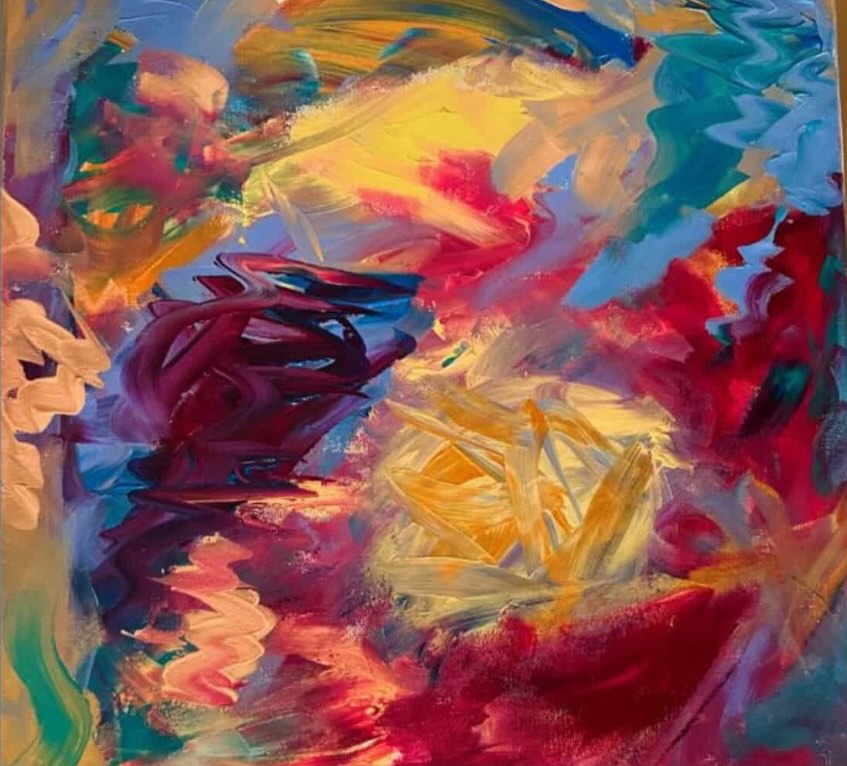
When we first began our conversation, the primary concentration was on Caroline’s artwork. She describes her artwork as “intuitive abstract paintings”, which she creates as “conversations”. To me, knowing Caroline’s background with language, and knowing her art serves as a conversation, I immediately began to see her artwork as a form of linguistic projection of geometric shapes as a form of language. I think it’s genius.
The shapes and structures of the geometric forms act as linguistic projections of ideas—the shape acts as a way to communicate something. The patterns might be patterns of emotions, patterns of networks of ideas, patterns of interlocking ideas forming a chart, diagram or map of ideas, concepts, emotions, projections.
Her self-description of her art is as “Intuitive Abstract Paintings”, and she consistently describes these as conversations. What is the conversation being had, and what is the language? What is the language Caroline is speaking with, and how can we understand the structure of that language? Now, with this being intuitive, I’m sure a large part of the artwork is meant to confer something without strict definition and structure, and to communicate ideas that maybe adapt to each viewer—Caroline intuits the shape of the idea and the structure of the connections of shapes and thoughts, and the viewer intuits their own adapted meaning.
However, with this too, Caroline’s art is primarily designed—or, at least, was initially designed—to act as a recovery tool. Caroline suffered a major injury at an early age, and art—particularly intuitive abstract art—served as a way to communicate ideas with her self, and to recover from the traumatic injury.
–
Me: Who are you?
Phillips: I am Caroline Phillips—an abstract artist, photographer, and the co-founder of LingualMuse. I was raised in a bilingual German and French family and have spent my life navigating the intersection of language, culture, and visual expression.
Me: What sort of art do you create, and what is the inspiration and purpose for it?

Phillips: I create intuitive abstract paintings and photography. My work is a “conversation” with the canvas, focusing on themes of impermanence, resilience, and healing. The purpose is to capture the transient energy of life—a process that became my lifeline after a serious accident at 19 turned art into my primary tool for recovery.
–
Caroline Phillips activities aren’t limited to just her artwork though—Caroline is a linguistic expert who has formerly worked for the Foreign Service Institute in Washington DC, and has brought her knowledge of language to her own small business—Lingual Muse. Lingual Muse functions as a language coaching team that is dedicated to the hands-on, immersive language acquisition of her students. Rather than a broad, downloadable app, the business develops one-on-one linguistic coaching, and focuses on remote learning centered on the individual or personalized coaching model for each student and their specific goals.
–
Me: What is your business?
Phillips: My business is LingualMuse, a boutique online language school. We provide personalized, one-on-one coaching in over 18 languages, moving far beyond the limitations of standard apps to offer true cultural immersion.
–

Generally, cultural and language immersion is created through face-to-face conversations . This is generally done in person, and this in-person immersion is then turned into real-life experiences designed to simulate what an actual conversation or event where you’d need to apply the language would be like. However, through Lingual Muse, this is all done remotely, with a team of coaches whose specific goal is to tailor individual, immersive learning environments for each individual student’s goals.
–
Me: What is some of the background of your business?
Phillips: It is rooted in high-level pedagogy. Before starting the company, I worked at the Foreign Service Institute (FSI) in D.C., training U.S. delegates for diplomatic missions. That experience in rapid, high-stakes language acquisition forms the backbone of our teaching methodology.
–
While working with the Foreign Service Institute, the goals of teaching languages to individuals were much more fast-paced, in environments that required few errors, and language acquisition at the highest level of professionalism. These language acquisition timelines were much stricter, and the necessity for high-level language acquisition was paramount—there could be no room for miscommincation, understanding the nuances of how to speak politely, professionally and formally were paramount to everything being taught.
It wasn’t just a matter of language acquisition at the highest level, it was learning etiquette, learning professionalism and learning how to navigate an entirely different culture. These peripheral skills all formed the backbone of how Caroline Phillips founded her company and how Caroline Phillip’s language acquisition coaching methods were formed.
–
Me: How did you get started?
Phillips: In 2016, my partner Joe Galea and I decided to take my years of independent teaching and FSI experience and scale it into a formal digital platform. We combined my linguistic expertise with his administrative background to build a school that could reach students anywhere.
Me: What made you want to start?
Phillips: I saw a gap in the market. Many people were frustrated with “cookie-cutter” language apps that didn’t help them actually speak or understand the culture. I wanted to create a space for tailored teaching that adapts to a student’s specific goals, whether they are moving abroad or reconnecting with their heritage.

Me: What was the initial start of the business like?
Phillips: It was a period of intense transition. I was moving from the D.C. area to New Hampshire while simultaneously building the digital infrastructure. It was about proving that the intimate, 1:1 classroom experience could be effectively replicated—and even improved—in an online environment.
–
Language acquisition businesses are highly successful, and operate across the economic industries and digital economy platforms. They primarily operate across remote networking, AI integrated systems which aim at developing skills for job places and globalized industrial sectors. The vast majority of companies rely on some form of international language skillset, and the major company sectors who do this are connected to healthcare, international business, and logistics.
–
Me: What were some barriers and challenges to overcome?
Phillips: The biggest challenge was shifting the mindset that “online” meant “lower quality.” We had to find and train a global team of coaches who could maintain our high standards of engagement through a screen. Additionally, balancing the growth of a startup with my own need for artistic practice required strict discipline.
–
Most language acquisition companies rely on the utilization of freemium subscriptions, where there are free software and paid software, with upgrades to the paid software. The primary businesses at the forefront of language acquisition are companies like duolingo and babbel. However, there are hundreds if not thousands of language acquisition companies. At the forefront, there are a few with similar business models as Lingual Muse—the primary business with this structure being Preply.
–
Me: What is your business model, and what are some things you’d like people to learn from your approach?
Phillips: We operate on a personalized coaching model rather than a subscription-to-software model. I want people to learn that human connection is the most efficient way to learn. Technology should be a bridge, not a replacement for a mentor who understands your unique pace and interests.
–
Can you tell me about your use of technology, both with your company, and in networking with people for your art?
For LingualMuse, technology is our “classroom”—we use advanced digital tools to make lessons interactive and accessible globally. In my art, technology allows me to bridge the physical distance of the New Hampshire woods. I use it for digital photography and to network with curators, leading to opportunities like my 2024 show at the Arts Club of Washington. It’s about using digital tools to foster real-world presence.
–
The best way to learn how to accomplish something requires that you just do it. Experience and forge an understanding of what we do rooted in reality. At the heart of what Caroline Phillips does, everything is rooted in reality, and everything is rooted in actual experience—hands-on language use, and direct application to some of the highest stakes foreign language environments. Hopefully, this conversation leads the way for more conversation in the future.
Leave a Reply