
Written by Alexander Christian Greco
With ChatGPT
A practical, economics-driven guide to sustainable revenue generation

Introduction
Starting a small business is often motivated by independence, creativity, or the desire to solve a real-world problem. However, many businesses that generate strong interest, traffic, or even sales fail because they do not monetize effectively. Profitability is not guaranteed by effort, visibility, or passion—it is achieved through deliberate economic design.
Monetization refers to the structured process by which a business converts value creation into consistent, surplus income. This includes pricing strategy, cost control, revenue models, customer retention, and scalability. Research consistently shows that poor pricing, weak financial controls, and lack of revenue diversification are among the top causes of small business failure¹.
This article explains how small businesses generate profit, how monetization models work, and how entrepreneurs can design systems that produce reliable, long-term income rather than short-term sales spikes.
1. Revenue vs. Profit: The Core Financial Distinction

Revenue is the total income generated from sales, while profit is the amount remaining after all expenses are paid, including operating costs, taxes, debt service, and reinvestment². A business can appear successful on the surface while remaining financially fragile if margins are thin or cash flow is inconsistent.
Key financial concepts include:
- Gross profit: Revenue minus cost of goods or services
- Net profit: Earnings after all expenses
- Cash flow: Timing of money entering and leaving the business
- Margin: Profit expressed as a percentage of revenue

The U.S. Small Business Administration emphasizes that sustainable businesses focus on cash flow management as much as top-line growth³.

2. Value Creation and the Customer’s Willingness to Pay

Customers do not pay for effort—they pay for outcomes. A business’s ability to monetize depends on how clearly it communicates and delivers value. According to economic theory, price is determined by perceived utility, not production cost⁴.
Strong value propositions typically provide one or more of the following:
- Time savings
- Cost reduction or income generation
- Risk reduction
- Increased convenience or reliability
- Status, expertise, or access
Businesses that articulate measurable outcomes—rather than vague features—command higher prices and retain customers longer⁵.
3. Core Monetization Models for Small Businesses

Monetization models define how customers pay. Selecting the wrong model can constrain growth even when demand is strong.
Common Monetization Structures
- Transactional Sales
One-time payments for goods or services. Simple but volatile. - Subscription or Retainer Models
Recurring payments that stabilize revenue and increase customer lifetime value⁶. - Tiered Pricing
Multiple service levels that capture different customer segments. - Usage-Based Pricing
Fees tied to consumption, common in utilities and digital services. - Licensing and Intellectual Property
Monetization of designs, software, content, or proprietary processes.
High-performing businesses often combine multiple models to reduce revenue volatility⁷.
4. Pricing Strategy and Long-Term Profitability
Pricing is one of the most powerful profit levers available to a small business. Research from McKinsey & Company suggests that a 1% improvement in pricing can generate an 8–11% increase in operating profit⁸.
Common Pricing Approaches
- Cost-plus pricing: Covers expenses but may undervalue outcomes
- Value-based pricing: Anchored to customer results
- Competitive pricing: Market-aligned but margin-sensitive
- Psychological pricing: Uses framing to influence perception
Underpricing often results from fear of losing customers, but studies show that customers associate higher prices with higher quality when value is clearly communicated⁹.
5. Cost Control and Margin Expansion
Profit growth does not always require more sales. Reducing costs while maintaining value directly increases margins.
Effective cost strategies include:
- Process automation
- Outsourcing non-core tasks
- Standardizing operations
- Eliminating low-margin offerings
- Renegotiating supplier contracts
Because every dollar saved flows directly to profit, cost control is often more efficient than aggressive revenue expansion¹⁰.
6. Customer Lifetime Value and Retention

Acquiring new customers can cost five to seven times more than retaining existing ones¹¹. Monetization improves dramatically when businesses focus on long-term relationships rather than single transactions.

Retention strategies include:
- Subscription plans
- Maintenance or service agreements
- Upselling and cross-selling
- Loyalty programs
- Personalized communication
Increasing customer lifetime value (LTV) allows businesses to spend more on marketing without reducing profitability.

7. Marketing for Monetization, Not Visibility
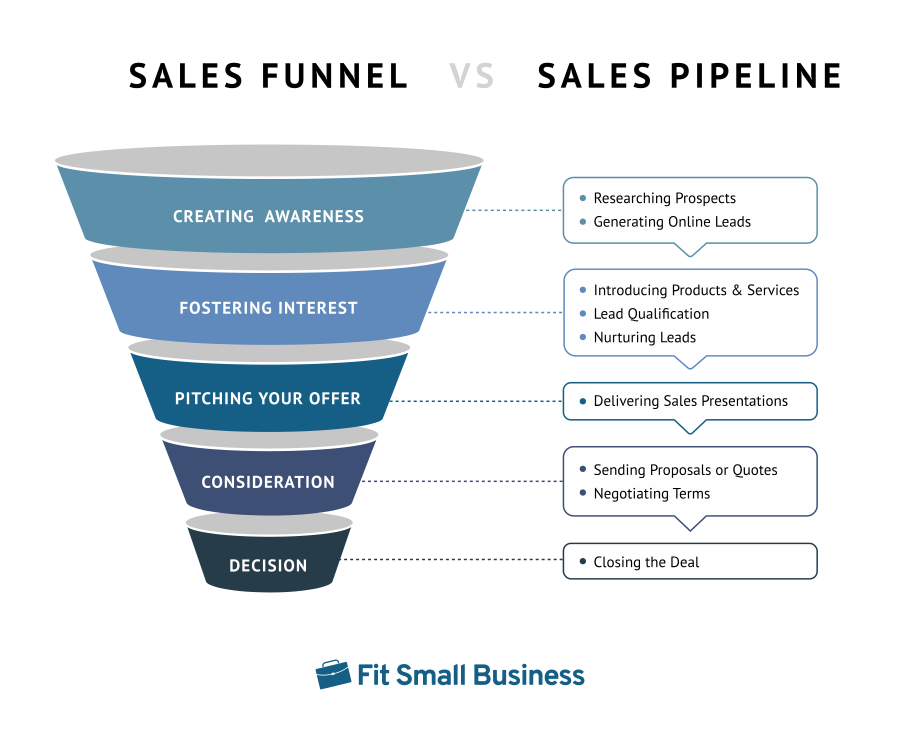
Marketing should be evaluated by conversion and return on investment, not attention alone. Content marketing, email marketing, and referral programs consistently outperform paid advertising for small businesses in terms of cost efficiency¹².

High-performing marketing systems:
- Educate before selling
- Build trust through proof and transparency
- Guide customers toward clear decisions
Monetization improves when marketing aligns directly with sales systems.

8. Revenue Diversification and Risk Management

Dependence on a single income source exposes businesses to market shocks. Diversified revenue streams stabilize cash flow and increase resilience¹³.
Examples include:
- Services plus digital products
- Physical products plus subscriptions
- Consulting plus education or licensing
Diversification also increases business valuation and exit potential.
9. Scaling Without Destroying Profit

Growth increases complexity. Without systems, scaling often reduces profitability rather than increasing it.
Successful scaling requires:
- Documented processes
- Automation and delegation
- Financial forecasting
- Capacity planning

Economies of scale occur when per-unit costs decrease as volume increases—this should be the goal of growth¹⁴.
10. Legal, Tax, and Financial Infrastructure

Profitability depends on what a business retains, not just what it earns. Tax inefficiencies, legal penalties, or poor accounting can erase years of progress.
Foundational requirements include:
- Accurate bookkeeping
- Tax planning
- Proper business structure
- Insurance and compliance

Well-structured businesses consistently outperform informal operations¹⁵.
11. Measuring Performance and Adjusting Strategy


Data-driven businesses make better monetization decisions. Key metrics include:
- Profit margin
- Cash flow
- Conversion rates
- Customer acquisition cost
- Retention rates
Continuous measurement allows businesses to refine pricing, marketing, and operations over time.
12. The Long-Term Monetization Mindset

Sustainable profit comes from long-term thinking. This includes investing in brand equity, customer trust, systems, and adaptability.
Businesses designed for durability—not quick wins—are better positioned to survive economic cycles, technological shifts, and competitive pressure.
Conclusion
Monetizing a small business is a structured process rooted in economics, strategy, and execution. Profit emerges when value creation, pricing, cost control, customer retention, and systems work together cohesively.
Businesses that master monetization gain more than income—they gain stability, autonomy, and long-term opportunity.
References
- Small Business Administration. (2023). Small business failure rates and causes.
- Horngren, C. T., et al. (2021). Introduction to Financial Accounting. Pearson.
- U.S. Small Business Administration. (2022). Cash flow management.
- Varian, H. R. (2019). Intermediate Microeconomics. W. W. Norton & Company.
- Osterwalder, A., et al. (2014). Value Proposition Design. Wiley.
- Zuora. (2022). Subscription economy index.
- Blank, S., & Dorf, B. (2020). The Startup Owner’s Manual. Wiley.
- McKinsey & Company. (2018). The power of pricing.
- Nagle, T., & Müller, G. (2017). The Strategy and Tactics of Pricing. Routledge.
- Porter, M. E. (2008). Competitive Strategy. Free Press.
- Reichheld, F. F. (2003). The one number you need to grow. Harvard Business Review.
- Content Marketing Institute. (2023). B2C and B2B benchmarks.
- Taleb, N. N. (2012). Antifragile. Random House.
- Chandler, A. D. (1990). Scale and Scope. Harvard University Press.
- IRS. (2022). Small business tax guide.
Further Reading
- The Lean Startup – Eric Ries
- Profit First – Mike Michalowicz
- Good to Great – Jim Collins
- The Personal MBA – Josh Kaufman
- Harvard Business Review – Small Business & Entrepreneurship Series
Leave a Reply