
Written by Alexander Christian Greco
With Help from ChatGPT
Warehousing, Wholesale, and Logistics

Abstract
The distribution industry—encompassing wholesale distribution, warehousing, and logistics—has entered a structural transformation driven by digitalization, automation, and artificial intelligence. Distribution centers are no longer static storage facilities; they are dynamic cyber-physical systems that sense conditions, make decisions, and execute actions in near real time. Advances in warehouse automation, robotics, computer vision, Internet of Things (IoT) sensors, digital twins, and AI-driven decision intelligence are redefining how goods flow from producers to customers. This article examines the most important new technologies specific to the distribution industry, explains how they fit together as a modern operational stack, and explores how these technologies improve accuracy, speed, resilience, and cost efficiency across physical supply chains.
Disclosure

This article was drafted with the assistance of ChatGPT (OpenAI) as a writing and organization tool. The content is provided for educational and informational purposes and should be evaluated against real-world operational, safety, regulatory, and vendor-specific requirements before implementation.
Table of Contents
- What “Distribution” Means in a Technology Context
- The Modern Distribution Technology Stack
- Warehouse Automation 2.0: AMRs, AS/RS, and Goods-to-Person
- Computer Vision and AI at the Dock Door
- RFID, IoT, and Real-Time Location Systems
- Digital Twins for Distribution Center Design and Control
- Agentic AI and Decision Intelligence in Distribution
- Supply Chain Visibility Standards and Event-Based Data
- Transportation Technologies and Last-Mile Integration
- Cybersecurity and Operational Resilience
- Implementation Strategy: Sequencing, Metrics, and Risks
- Conclusion
- Further Reading
- References
1. What “Distribution” Means in a Technology Context
Distribution sits between manufacturing and consumption, acting as the physical execution layer of commerce. While manufacturers focus on production efficiency and retailers focus on demand capture, distributors must manage:
- High-volume physical handling of goods
- Time-sensitive fulfillment commitments
- Inventory accuracy across constantly moving assets
Historically, distribution relied on manual labor, forklifts, paper pick lists, and batch-updated inventory systems. Even early Warehouse Management Systems (WMS) were primarily record-keeping tools rather than real-time control systems. Today, distribution technology is shifting toward continuous sensing, decision-making, and execution, enabled by real-time data streams and automation [1].
The result is a fundamental redefinition of the distribution center: from a warehouse that stores goods to a system that orchestrates flow.
2. The Modern Distribution Technology Stack
Modern distribution operations are built as layered systems rather than isolated tools. These layers increasingly interoperate through APIs, event streams, and shared data models [2].
Core layers include:
According to DHL, this convergence of digital intelligence and physical logistics represents a long-term structural trend rather than a short-term efficiency play [3].
3. Warehouse Automation 2.0: AMRs, AS/RS, and Goods-to-Person
- Systems of Record – ERP, WMS, TMS, OMS
- Execution & Orchestration – Warehouse Execution Systems (WES), Labor Management Systems (LMS), Yard Management Systems (YMS)
- Automation & Robotics – AS/RS, AMRs, AGVs, conveyors, sortation, robotic picking
- Sensing & Data Capture – barcode scanners, RFID, cameras, dimensioners, IoT sensors
- Intelligence Layer – forecasting, optimization, computer vision, AI decision engines
- Interoperability & Standards – EPCIS, APIs, modernized EDI
Autonomous Mobile Robots (AMRs)
AMRs represent a major shift from traditional fixed automation. Unlike conveyor-heavy systems, AMRs navigate dynamically and can be added or removed as demand changes. Their primary value is not speed alone, but reduced walking, labor flexibility, and scalability [4].
Automated Storage and Retrieval Systems (AS/RS)
Modern AS/RS solutions—such as shuttle systems and cube-based storage—enable goods-to-person workflows that dramatically reduce pick travel time while increasing accuracy. Integration with WES software allows automated systems and human labor to work from the same execution plan.
Advanced Robotics and Emerging Systems
Robotic depalletizing, induction, and piece picking are transitioning from experimental pilots to production deployments, especially in high-volume distribution environments. Large operators, including those reported on by the Financial Times, have expanded robotics programs to address labor shortages and throughput volatility [5].
4. Computer Vision and AI at the Dock Door
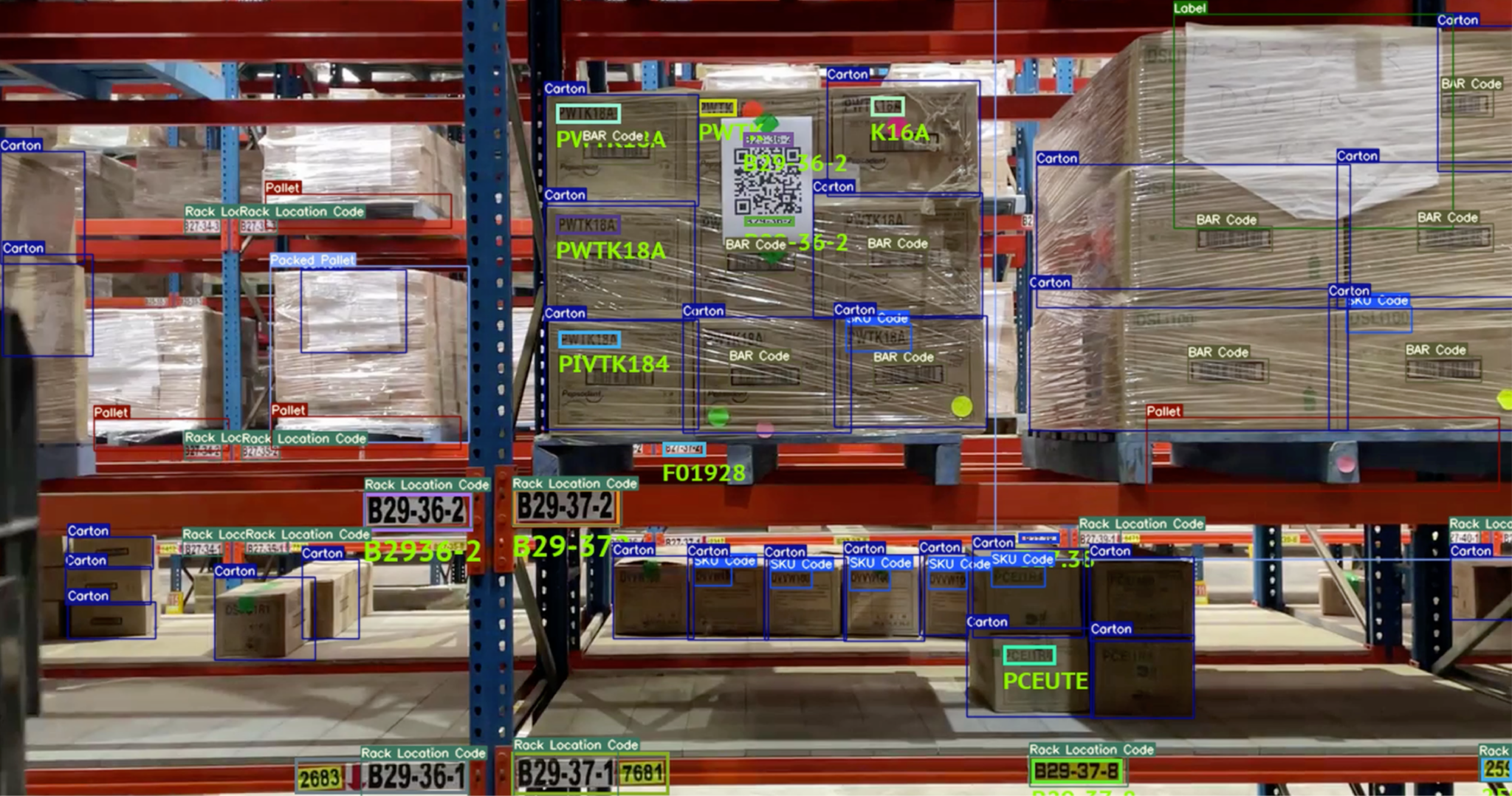
Computer vision addresses one of distribution’s oldest problems: the mismatch between digital records and physical reality.
Common use cases include:
- Automated verification of inbound shipments
- Damage detection during receiving and sortation
- Dimensioning and cubing for accurate billing
- Safety monitoring and incident prevention
By processing images at the edge, modern vision systems provide near-instant feedback without requiring full cloud connectivity [6].

5. RFID, IoT, and Real-Time Location Systems
RFID and IoT technologies enable frictionless visibility across the distribution lifecycle.
- RFID reduces scan labor and improves cycle count accuracy
- IoT sensors monitor environmental conditions such as temperature and shock
- RTLS tracks pallets, equipment, and high-value assets in real time
Together, these technologies enable event-based inventory visibility, a prerequisite for advanced analytics and AI-driven optimization [7].
6. Digital Twins for Distribution Center Design and Control
A digital twin is a continuously updated virtual representation of a physical distribution environment. According to DHL, digital twins allow organizations to simulate operations, predict bottlenecks, and test changes before deploying them physically [8].
Applications include:
- Facility layout and automation design
- Throughput and congestion analysis
- Peak planning and stress testing
- Real-time operational monitoring
7. Agentic AI and Decision Intelligence in Distribution
AI in distribution is evolving beyond forecasting toward decision intelligence—systems that recommend or initiate actions in real time.
Gartner identifies agentic AI as a key supply-chain trend, describing systems that continuously sense conditions, evaluate options, and coordinate execution across people and machines [9].
Examples include:
- Dynamic slotting and replenishment
- Automated exception handling
- Labor and robot workload balancing
- Inventory prioritization during shortages
The defining shift is that AI is embedded directly into operational systems rather than operating as a separate analytics function.
8. Supply Chain Visibility Standards and Event-Based Data
Distribution networks span multiple organizations, making shared visibility difficult. GS1’s EPCIS standard provides a common event-based language for answering:
- What happened?
- Where did it happen?
- When did it happen?
- Why did it happen?
According to GS1, EPCIS enables interoperable, real-time traceability across supply-chain partners [10].
9. Transportation Technologies and Last-Mile Integration
Distribution technology increasingly extends beyond the warehouse.
Key advancements include:
- AI-driven route optimization
- Telematics for fleet health and ETA accuracy
- Electrification and energy-aware routing
These tools directly impact service reliability, cost-to-serve, and sustainability reporting [11].
10. Cybersecurity and Operational Resilience
As distribution becomes cyber-physical, cybersecurity risks increase. Attack surfaces now include robots, IoT sensors, handheld devices, and vendor remote access.
Resilient distribution systems are designed for graceful degradation—maintaining reduced operations even when digital systems fail [12].
11. Implementation Strategy: Sequencing, Metrics, and Risks
Recommended Technology Sequence
- Data hygiene and inventory accuracy
- Event-based visibility
- Execution orchestration (WES/LMS)
- Targeted automation
- Digital twins and AI optimization
- Partner interoperability
Key Metrics
- Order cycle time
- Pick accuracy and travel distance
- Inventory record accuracy
- Cost per order
- Dock-to-stock time
Common Pitfalls
- Automating unstable processes
- Underestimating change management
- Vendor lock-in through proprietary data models
12. Conclusion
New technologies in distribution are not isolated tools—they form a coordinated shift toward event-driven, intelligent execution. Organizations that succeed will focus on data quality, orchestration, and scalability rather than chasing individual automation trends. Distribution’s future belongs to systems that can continuously sense reality, decide intelligently, and act efficiently across complex physical networks.
13. Further Reading
Reports & Industry Research
- DHL – Logistics Trend Radar
- Gartner – Supply Chain Technology Trends
- McKinsey & Company – Warehouse Automation Insights
Standards & Technical Resources
- GS1 – EPCIS and CBV Standards
Journalism & Case Studies
- Financial Times – Robotics and logistics reporting
14. References (APA Style)
- Chopra, S., & Meindl, P. (2022). Supply chain management: Strategy, planning, and operation. Pearson.
- Christopher, M. (2016). Logistics & supply chain management. Pearson.
- DHL. (2024). Logistics Trend Radar 7.0.
- McKinsey & Company. (2023). Getting warehouse automation right.
- Financial Times. (2025). Robotics expansion in warehouse operations.
- Zhang, Z., et al. (2021). Computer vision applications in logistics. IEEE Access.
- Karkkainen, M. (2003). Increasing efficiency in supply chains using RFID. International Journal of Retail & Distribution Management.
- DHL. (2023). Digital twins in logistics.
- Gartner. (2025). Top supply chain technology trends.
- GS1. (2024). EPCIS and Core Business Vocabulary.
- OECD. (2022). Digital transformation of transport and logistics.
- NIST. (2023). Cybersecurity framework for critical infrastructure.
Leave a Reply