

Abstract
In the previous article, we examined the functional structure of computers—how data flows through processors, memory, storage, and input/output systems. This follow-up continues from that foundation by focusing on computer engineering as a physical discipline. Rather than abstractions, this article explains how computers are physically constructed, from semiconductor materials and integrated circuits to printed circuit boards, power systems, cooling solutions, and final assembly. The goal is to provide readers with a concrete understanding of how modern computers exist as engineered objects in the real world.

1. Computer Engineering Beyond Abstraction
Computer engineering bridges theory and physical reality. While software defines instructions and logic, hardware defines electrical limits, physical constraints, and performance ceilings. Every computation depends on:
- Electron flow through conductive materials
- Voltage thresholds that represent binary states
- Timing constraints imposed by physical distance
- Heat generation from electrical resistance
At its core, a computer is a carefully synchronized electromechanical system, engineered to operate reliably at microscopic scales.
2. Silicon and Semiconductor Foundations

2.1 Why Silicon Is Used
Silicon is the dominant semiconductor material because it:
- Can be precisely doped to control conductivity
- Forms a stable insulating oxide
- Operates efficiently at room temperature
- Is abundant and cost-effective
By introducing impurities (boron or phosphorus), engineers create p-type and n-type regions, forming the basis of transistors.

2.2 Transistors as Physical Switches
A transistor is a voltage-controlled gate that allows or blocks current flow. Modern processors contain billions of transistors, each measuring only a few nanometers wide. Their physical arrangement determines:
- Switching speed
- Power efficiency
- Heat concentration
2.3 Integrated Circuit Fabrication
Semiconductor manufacturing uses photolithography to build chips layer by layer:
- Silicon wafers are polished
- Light-sensitive resist is applied
- Ultraviolet light transfers circuit patterns
- Chemical etching removes material
- Metal layers form interconnects
This process is repeated dozens of times to build complex, multi-layered circuits.

3. Central Processing Units (CPUs)

The CPU is the primary computation engine of a computer. Physically, it consists of:
- Arithmetic Logic Units (ALUs) for calculations
- Control logic to manage instruction flow
- Registers for ultra-fast temporary storage
- Cache memory embedded directly on the die

Physical Considerations
CPU performance is limited by:
- Clock distribution across the die
- Heat dissipation density
- Electrical signal delay

Modern CPUs use large metal heat spreaders and require direct contact with cooling systems to prevent thermal throttling.
4. Graphics Processing Units (GPUs)

GPUs are optimized for massive parallelism. Physically, they feature:
- Thousands of small compute cores
- Wide memory interfaces
- Large PCB footprints
Graphics cards also include:
- Dedicated voltage regulators
- Multiple power connectors
- Complex cooling assemblies
Their size and power requirements reflect the extreme electrical and thermal demands of parallel computation.
5. Motherboards and Chipsets
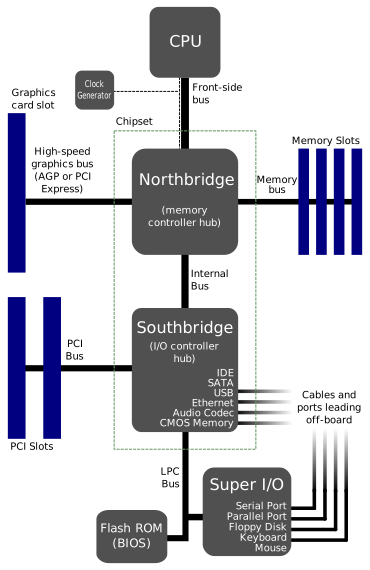
The motherboard is the structural backbone of a computer.
5.1 Printed Circuit Board Structure
Motherboards are multi-layer PCBs containing:
- Copper signal layers
- Power and ground planes
- Insulating dielectric layers
High-end boards may have 10–16 layers, allowing dense routing and stable power delivery.
5.2 Chipsets and Controllers
The chipset coordinates communication between:
- CPU
- Memory
- Storage
- Expansion devices
Its physical placement minimizes signal delay and electrical interference.
6. Memory Hardware (RAM)

Dynamic RAM (DRAM) stores data using tiny capacitors that must be refreshed continuously.
Physically, RAM modules include:
- Memory chips mounted on a PCB
- Edge connectors for the motherboard
- Timing-sensitive trace layouts
RAM performance depends on:
- Signal integrity
- Electrical noise suppression
- Precise synchronization with the CPU
7. Storage Devices

7.1 Hard Disk Drives (HDDs)
HDDs are electromechanical devices containing:
- Spinning magnetic platters
- Precision actuator arms
- Read/write heads floating nanometers above the surface
7.2 Solid State Drives (SSDs)
SSDs replace mechanical parts with:
- NAND flash memory chips
- Controllers managing wear leveling
- High-speed interfaces like NVMe
Physically, SSDs are compact PCBs optimized for signal speed and heat dissipation.
8. Power Supply Units and Voltage Regulation

Computers require multiple voltage levels. The PSU converts wall power into regulated DC outputs, while Voltage Regulation Modules (VRMs) on the motherboard fine-tune power delivery.
Poor power regulation leads to:
- Instability
- Data corruption
- Hardware failure
Power engineering is critical for system reliability.

9. Cooling and Thermal Management

Heat is the primary physical limiter of performance.
Cooling systems include:
- Heat sinks
- Fans
- Heat pipes
- Liquid cooling loops
Thermal paste improves heat transfer between chips and coolers. Proper airflow design prevents hot spots and extends component lifespan.
10. Mechanical Design and Enclosures
Enclosures provide:
- Structural integrity
- Electromagnetic shielding
- Airflow management
Form factors (desktop, laptop, server) impose different mechanical constraints that influence component layout and cooling strategy.
Conclusion: Computing as Engineered Matter
Computers are not abstract machines—they are precision-engineered physical systems. Every software instruction depends on materials science, electrical design, mechanical structure, and thermal control. Computer engineering transforms raw materials into reliable computational platforms, making modern digital life possible.
Leave a Reply